
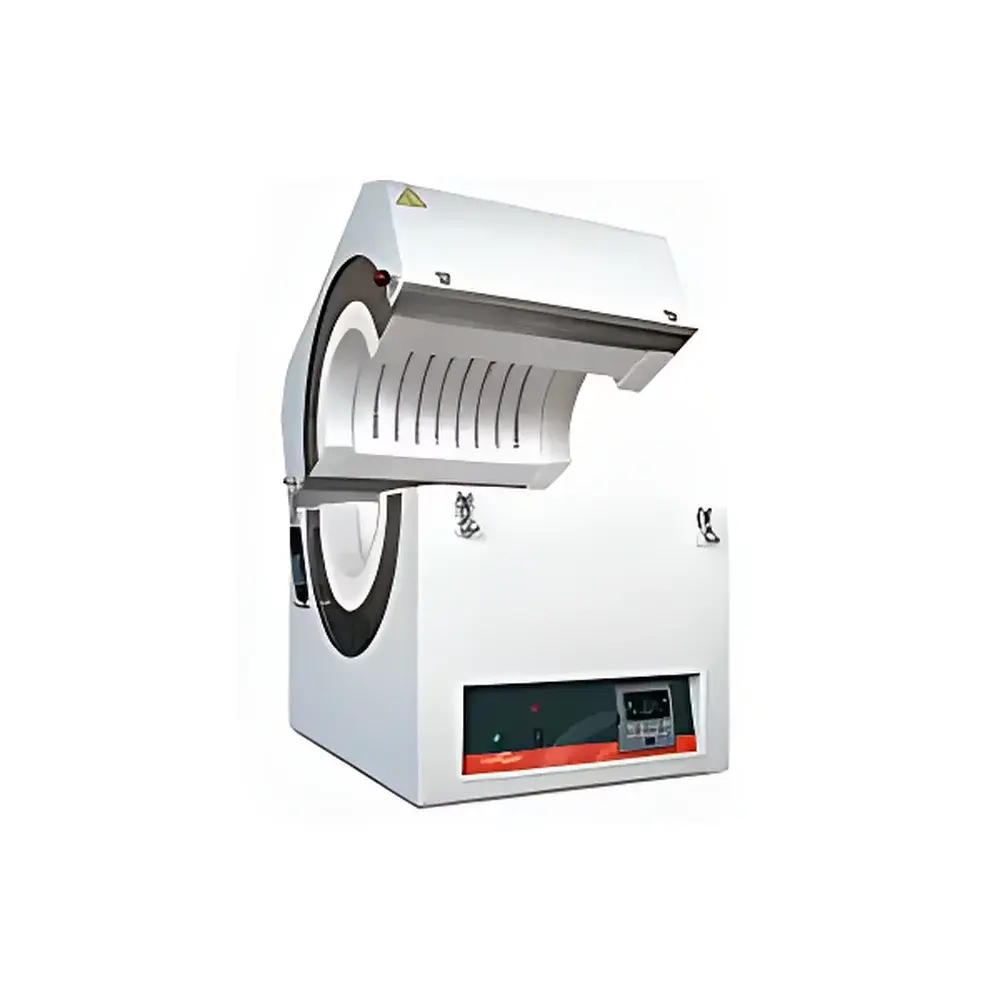
ThermConcept Flip-Open Tube Furnace – Single-Zone and Triple-Zone Temperature Control Models
| Brand | ThermConcept |
|---|---|
| Origin | Germany |
| Model | Flip-Open Tube Furnace |
| Max Operating Temperature | 1100 °C |
| Tube Diameter | Ø300 mm |
| Heating Zone Length | Up to 500 mm (extendable) |
| Control Architecture | Single-Zone or Triple-Zone PID |
| Cooling Method | Rapid air-cooling via hinged outer casing |
| Safety Compliance | EN 60519-2 overtemperature protection limiter |
| Mounting | Base-mounted vertical operation |
| Controller Location | Bottom-mounted for ergonomic access |
| Heating Element Control | Solid-state relay-driven |
| Temperature Uniformity | Optimized via axial zoning (triple-zone model) |
| Enclosure Design | Hinged front-opening shell for法兰 and tube insertion |
Overview
The ThermConcept Flip-Open Tube Furnace is a precision-engineered laboratory heating system designed for controlled thermal processing of samples in inert, reducing, or oxidizing atmospheres. Based on resistive heating principles with high-purity ceramic fiber insulation and optimized heat distribution geometry, this furnace delivers stable, repeatable temperature profiles across its axial heating zone. Its defining mechanical feature — a fully hinged front-opening shell — enables rapid, tool-free access to the working tube and simplifies integration of flanges, gas feedthroughs, and sample holders without disassembly. Available in both single-zone and triple-zone configurations, the furnace supports applications requiring either uniform thermal treatment (e.g., annealing, sintering) or precisely graded axial temperature gradients (e.g., crystal growth, CVD precursor decomposition, thermal gradient studies). Designed and manufactured in Bremen, Germany, it adheres to DIN/EN structural and electrical safety standards and is built for long-term stability under cyclic thermal loads up to 1100 °C.
Key Features
- Hinged flip-open outer casing for unobstructed access to the quartz or ceramic working tube and mounting flanges — eliminates need for full disassembly during setup or maintenance
- Triple-zone PID control option (standard on triple-zone models) enabling independent regulation of three axial heater segments to achieve ≤±2 °C axial uniformity or programmable thermal gradients
- High-density ceramic fiber insulation with low thermal mass — ensures rapid heating rates (typical 10–15 °C/min to 1000 °C) and efficient energy retention
- Bottom-mounted controller and power switch assembly — improves ergonomics and reduces cable clutter in benchtop installations
- Adjustable end flanges accommodate working tubes from Ø20 mm to Ø300 mm; standard tube length support up to 500 mm (extendable upon request)
- EN 60519-2–compliant overtemperature protection limiter with independent cut-off circuit — activates at user-set threshold to prevent thermal runaway
- Relay-controlled heating elements with zero-crossing solid-state switching — minimizes electromagnetic interference and acoustic noise during operation
Sample Compatibility & Compliance
The furnace accommodates standard cylindrical work tubes fabricated from fused silica, alumina, or silicon carbide, compatible with atmospheric, vacuum, or gas-purged environments (N₂, Ar, H₂, forming gas). Its open architecture supports custom flange interfaces (KF, CF, ISO-K) and auxiliary components including thermocouple feedthroughs, pressure ports, and gas mass flow controllers. All electrical and thermal safety systems comply with EN 60519-2 (safety requirements for industrial electroheating equipment) and meet CE marking directives. The triple-zone configuration supports GLP-compliant process documentation when paired with optional data logging modules meeting FDA 21 CFR Part 11 audit trail requirements.
Software & Data Management
While the base model features an intuitive analog/digital hybrid controller with setpoint programming and ramp/soak functionality, optional digital upgrades include RS485 Modbus RTU or Ethernet TCP/IP connectivity for integration into centralized lab automation platforms (e.g., LabVIEW, SCADA, or LIMS). ThermConcept’s proprietary FurnaceControl Suite (v3.2+) provides real-time multi-zone temperature monitoring, event-triggered data capture, CSV export, and configurable alarm thresholds. All logged data includes timestamp, zone-specific thermocouple readings, power output %, and safety interlock status — supporting traceability in regulated QC/QA environments.
Applications
- Thermal annealing of thin-film substrates and semiconductor wafers
- Controlled-atmosphere sintering of metal and ceramic powders
- Chemical vapor deposition (CVD) and physical vapor deposition (PVD) pre-treatment
- Calibration of thermocouples and reference materials per ASTM E230/E1137
- Thermal gravimetric analysis (TGA) sample conditioning and purge gas optimization
- Material phase transformation studies requiring precise axial thermal gradients
- Pre-oxidation and reduction treatments of catalysts and battery electrode materials
FAQ
What tube materials are recommended for use at 1100 °C?
Fused silica (up to 1100 °C in oxidizing atmospheres), high-purity alumina (up to 1600 °C), or recrystallized silicon carbide (for reducing conditions). Selection depends on gas compatibility and required thermal shock resistance.
Can the furnace be operated under vacuum?
Yes — when equipped with vacuum-rated flanges and seals; maximum recommended vacuum level is 10⁻² mbar using standard mechanical pumps. For high vacuum, optional water-cooled feedthroughs and metal gaskets are available.
Is third-party calibration certification included?
Factory calibration certificates (traceable to DAkkS-accredited standards) are available as an optional add-on; on-site verification services are offered globally through ThermConcept’s authorized service partners.
How is temperature uniformity validated across the heating zone?
Uniformity mapping is performed per ISO 9001 internal protocol using five-point NIST-traceable thermocouples; reports detail axial and radial deviation at 800 °C and 1100 °C under steady-state conditions.
What maintenance intervals are recommended for long-term reliability?
Visual inspection of insulation integrity and terminal connections every 200 operating hours; annual verification of relay switching performance and overtemperature limiter response time by certified technician.



