
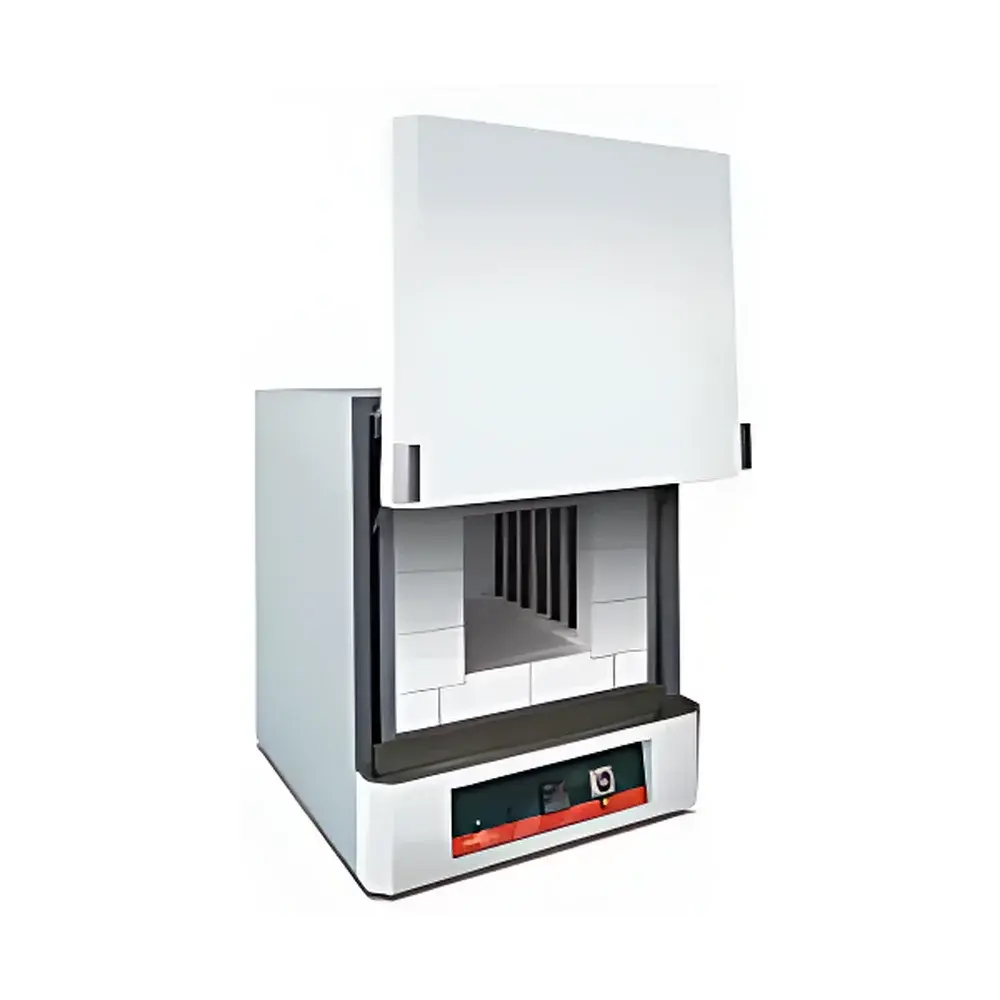
Thermconcept High-Temperature Muffle Furnace with SiC Heating Elements
| Brand | Thermconcept |
|---|---|
| Origin | Germany |
| Model | High-Temperature Muffle Furnace |
| Max Operating Temperature | 1400 °C / 1500 °C / 1600 °C |
| Heating Element | Silicon Carbide (SiC) rods, laterally mounted |
| Chamber Lining | Ceramic fiber insulation |
| Enclosure | Dual-wall construction with rear ventilation |
| Door Type | Top-hinged lift door with reinforced fiber seal |
| Base Lining | High-temperature ceramic fiber board |
| Standard Accessories | Ceramic hearth plate |
| Temperature Control | Solid-state relay with PID algorithm |
| Exhaust Port | Integrated vent opening on top |
| Surface Temperature | <60 °C at ambient conditions |
| Compliance | Designed to meet EN 61000-6-3 (EMC), EN 61000-6-2, and general lab safety requirements per DIN VDE 0701-1 |
Overview
The Thermconcept High-Temperature Muffle Furnace with SiC Heating Elements is an engineered laboratory furnace designed for precise, stable, and repeatable thermal processing across demanding applications in materials science, metallurgy, ceramics, and quality control laboratories. Utilizing silicon carbide (SiC) heating elements mounted laterally within a double-walled, ventilated enclosure, this muffle furnace achieves rapid heating rates and exceptional temperature uniformity—typically ±3 °C across the working zone at maximum setpoint—without direct line-of-sight exposure of samples to heating elements. The furnace operates in a true muffle configuration: the heating elements are physically isolated from the chamber cavity by ceramic fiber insulation, ensuring contamination-free thermal environments essential for ashing, sintering, heat treatment, and calcination procedures. With maximum operating temperatures of 1400 °C, 1500 °C, or 1600 °C (model-dependent), it bridges the gap between standard refractory furnaces and ultra-high-temperature systems, offering robust performance without requiring specialized infrastructure such as water cooling or inert gas purging.
Key Features
- Laterally mounted SiC heating elements ensure symmetrical radiant heat distribution and extended service life under cyclic thermal loading.
- Dual-wall steel enclosure with forced rear ventilation maintains external surface temperature below 60 °C during continuous operation at rated temperature—reducing lab ambient heat load and improving operator safety.
- Lift-type top-hinged door minimizes radiant exposure during loading/unloading and incorporates a high-density reinforced ceramic fiber gasket for tight thermal sealing and mechanical durability.
- Chamber fully lined with low-conductivity, high-purity ceramic fiber modules (alumina-silica composition), providing thermal inertia control and minimizing standby energy loss.
- Standard ceramic hearth plate (Al₂O₃ ≥95%) included—resistant to thermal shock and compatible with most inorganic sample crucibles (Pt, Al₂O₃, SiC, graphite).
- Microprocessor-based temperature controller with PID algorithm and solid-state relay output delivers ±1 °C typical stability over 24-hour dwell periods; programmable ramp/soak profiles support multi-step thermal protocols.
- Top-mounted exhaust port enables passive or active venting of combustion byproducts or process gases—compatible with optional fume extraction ducting per ISO 13857 clearance guidelines.
Sample Compatibility & Compliance
This furnace accommodates standard crucible formats (e.g., 100 mL alumina, 50 mL platinum) and supports batch processing of powders, granules, thin films, and small metallic components. Its muffle architecture prevents cross-contamination between samples and eliminates risk of element oxidation or degradation due to atmospheric interaction. All models comply with European Electromagnetic Compatibility Directive 2014/30/EU (EN 61000-6-2/-3) and Low Voltage Directive 2014/35/EU (EN 61000-6-4). While not certified to UL or CSA standards out-of-the-box, the design aligns with key aspects of ASTM E1142 (Standard Practice for Calibration of High-Temperature Furnaces) and supports GLP-compliant validation when paired with external Class 1 thermocouples and calibrated data loggers. Optional traceable calibration certificates (per ISO/IEC 17025) are available upon request.
Software & Data Management
The integrated controller supports RS485 Modbus RTU communication for integration into centralized lab automation systems (e.g., LabWare LIMS, Siemens Desigo CC). Optional PC software (Thermconcept FurnaceControl Suite) provides real-time monitoring, profile logging, alarm history export (CSV), and electronic signature-enabled audit trails compliant with FDA 21 CFR Part 11 requirements when deployed with validated user authentication and change-control workflows. Data retention includes timestamped setpoint, actual temperature, relay duty cycle, and fault codes—enabling full traceability for QA/QC documentation and regulatory submissions.
Applications
- Ash content determination per AOAC 942.05, ASTM D3174, and ISO 1171 in coal, biomass, and food matrices.
- Sintering of advanced ceramics (ZrO₂, Si₃N₄, AlN) and metal oxide powders under air or controlled atmosphere (when used with optional gas inlet kit).
- Heat treatment of tool steels and superalloys for microstructural homogenization prior to metallographic analysis.
- Calcination of catalyst precursors (e.g., Ni/Al₂O₃, Co₃O₄) and battery cathode materials (LiCoO₂, NMC).
- Residue-on-ignition testing in environmental soil and sludge analysis (EPA Method 9081B).
- Pre-firing of refractory test specimens per ASTM C20 and ISO 5017.
FAQ
What is the recommended maintenance schedule for SiC heating elements?
SiC elements require no routine replacement under normal use; however, visual inspection every 200 operational hours is advised. Avoid thermal shock—never introduce cold samples into a chamber above 800 °C.
Can this furnace be operated under inert or reducing atmospheres?
Yes—optional quartz or stainless-steel gas inlet kits (with mass flow controller interface) enable nitrogen, argon, or forming gas purging. Note: prolonged use under reducing conditions may accelerate SiC oxidation at >1300 °C.
Is third-party IQ/OQ/PQ validation support available?
Thermconcept provides detailed hardware documentation, wiring schematics, and sensor calibration templates. Certified validation partners in North America and EU offer turnkey IQ/OQ/PQ execution aligned with GMP Annex 15 and ISO 13485 requirements.
How does the dual-wall design impact energy efficiency?
Compared to single-wall furnaces of equivalent volume, the ventilated double-wall structure reduces surface heat loss by ~40%, lowering average power consumption during 12-hour holds at 1500 °C by approximately 18% (measured per EN 60068-2-2).
Are custom chamber dimensions or voltage configurations supported?
Yes—Thermconcept offers engineering consultation for non-standard chamber volumes (up to 30 L), 208 V / 240 V / 400 V three-phase variants, and integration-ready mounting frames for cleanroom or glovebox installations.
Related Products



