
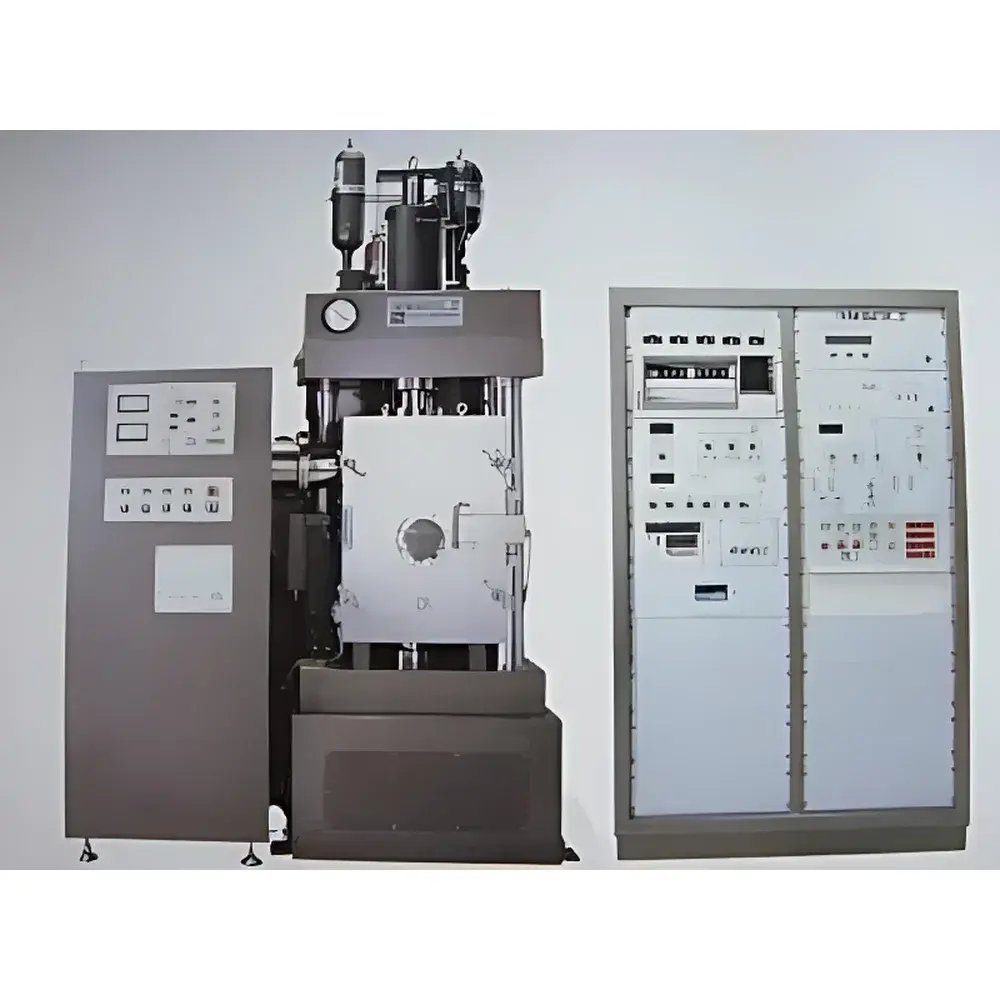
Thermecmaster-Z 100 kN Uniaxial Hot Deformation Simulator
| Origin | Japan |
|---|---|
| Manufacturer Type | Authorized Distributor |
| Origin Category | Imported |
| Model | Thermecmaster-Z, 100 kN, 1000 mm/s |
| Max. Load Capacity | 100 kN |
| Heating Range | RT to 1600 °C |
| Max. Heating Rate | 70 °C/s (tensile specimen) |
| Max. Cooling Rate | 300 °C/s (water quench, tensile) |
| Temperature Control Accuracy | ±3 °C (static) |
| Uniform Temperature Zone | ±5 mm from specimen center (all modes) |
| Atmosphere Control | Vacuum (≤1.3×10⁻² Pa), N₂, Ar, He |
| Cooling Media | Inert gas or deionized water |
| Loading Speed Range | 1×10⁻³ to 1×10³ mm/s |
| Stroke | 100 mm |
| Control Modes | Displacement, Load, and Hybrid (switching time: 1 ms) |
| Data Acquisition | Synchronized LED-based non-contact dilatometry, real-time load/displacement/temperature logging |
Overview
The Thermecmaster-Z 100 kN Uniaxial Hot Deformation Simulator is a high-precision, fully integrated thermo-mechanical testing system engineered for quantitative simulation of hot working processes under controlled thermal and mechanical boundary conditions. It operates on the principle of uniaxial compression, tension, or plane-strain deformation synchronized with rapid, programmable thermal cycles—enabling direct experimental replication of industrial thermomechanical processing routes such as hot rolling, forging, and controlled cooling. The system uniquely combines dual-mode heating (high-frequency induction + direct electrical resistance heating) to achieve exceptional temperature uniformity across complex specimen geometries while minimizing thermal gradients between tooling and sample. Its core architecture integrates servo-hydraulic actuation with real-time closed-loop control of load, displacement, and temperature—allowing precise execution of multi-stage deformation protocols (up to 14 segments) within sub-millisecond switching fidelity. Designed for metallurgical research and process development laboratories, it supports full compliance with ASTM E209, ISO 6892-2, and JIS Z 2241 standards for elevated-temperature mechanical testing.
Key Features
- Dual heating system: High-frequency induction (for rapid surface heating and skin-effect compensation) and direct resistive heating (for volumetric energy input), enabling independent thermal profiling of specimen surface vs. bulk.
- Non-contact LED-based dilatometry: Synchronized with piston motion to track dimensional changes (e.g., diameter reduction during compression) with sub-micron resolution—critical for accurate strain calculation and phase transformation onset detection.
- Programmable inert-gas or vacuum atmosphere control: Achieves base vacuum ≤1.3×10⁻² Pa (1×10⁻⁴ Torr) via diffusion pump; enables oxidation-sensitive experiments on reactive alloys (e.g., Ti, Mg, Ni-based superalloys).
- Multi-media quenching capability: Switchable cooling nozzles deliver N₂, Ar, He, or deionized water with programmable start timing, flow rate, and duration—supporting continuous cooling transformation (CCT) and time-temperature-transformation (TTT) studies.
- Real-time hybrid control architecture: Seamless switching (<1 ms) between displacement-controlled, load-controlled, and mixed-mode operation—essential for simulating transient deformation behavior during dynamic recrystallization or dynamic recovery.
- Automated data acquisition and synchronization: All signals—including load, displacement, thermocouple voltage (type K or S), dilatometer output, and atmosphere pressure—are sampled at ≥1 kHz and time-stamped with microsecond precision.
Sample Compatibility & Compliance
The Thermecmaster-Z accommodates standard cylindrical specimens (typically Ø6–12 mm × 12 mm height for compression; Ø4–8 mm × 30–50 mm for tension) fabricated from ferrous and non-ferrous alloys, including steels, aluminum alloys, titanium grades, nickel-based superalloys, and refractory metals. Specimen geometry is compatible with ASTM E209 Annex A1 (hot compression test specimens) and ISO 6892-2 Annex B (elevated-temperature tensile specimens). All thermal and mechanical calibrations are traceable to NIST or JCSS standards. The system meets GLP-compliant data integrity requirements: audit trails record all parameter changes, user logins, and calibration events; raw binary data files include embedded metadata (timestamp, operator ID, protocol version) and are stored in vendor-neutral HDF5 format for long-term archival and third-party analysis.
Software & Data Management
The proprietary ThermecSoft™ platform provides a deterministic real-time operating environment (RTOS-based) for experiment sequencing, closed-loop control, and post-test analysis. It supports creation of multi-step thermal-mechanical programs—including ramp/soak/cool cycles, load-hold sequences, and strain-rate jumps—with conditional branching based on real-time sensor feedback (e.g., initiate quench upon reaching peak temperature). Post-acquisition modules enable automated generation of true stress–true strain (S–S) curves, flow stress modeling (e.g., Arrhenius-type constitutive equations), and CCT diagram construction via derivative analysis of dilatometric and thermal data. Export options include CSV, MATLAB .mat, and ASTM E1432-compliant XML formats. Software validation documentation (IQ/OQ/PQ reports) and 21 CFR Part 11 compliance packages (electronic signatures, role-based access control, data encryption) are available upon request.
Applications
- Constitutive modeling of hot deformation behavior for finite element simulation of metal forming processes.
- Quantification of dynamic recrystallization kinetics, including critical strain, peak stress, and grain size evolution under varying Zener-Hollomon parameters.
- CCT/TTT diagram construction for advanced high-strength steels (AHSS), dual-phase steels, and precipitation-hardened alloys.
- Evaluation of hot ductility and cracking susceptibility during near-solidus deformation (e.g., slab casting, continuous casting).
- Thermo-mechanical processing route optimization for additive manufacturing feedstock conditioning and powder metallurgy consolidation.
- Phase transformation analysis during hot deformation—e.g., austenite-to-ferrite transformation in low-carbon steels or γ→α′ martensitic transition in Ti-6Al-4V.
FAQ
What specimen geometries are supported?
Standard compression specimens: Ø6–12 mm × 12 mm; tension specimens: Ø4–8 mm × 30–50 mm; plane-strain specimens per ASTM E209 Annex A2.
Can the system perform isothermal deformation tests?
Yes—temperature is stabilized to ±3 °C prior to deformation initiation, with active feedback control maintaining setpoint throughout loading.
Is vacuum-compatible dilatometry available?
The LED dilatometer operates reliably under vacuum (≤1.3×10⁻² Pa) and inert atmospheres using quartz or mica viewports.
How is thermal uniformity verified?
Uniformity is validated per ISO 15184 using embedded thermocouples at multiple radial/axial positions; documented reports confirm ±5 mm zone compliance per specimen type.
Does the system support third-party data analysis tools?
All raw data exports include time-synchronized channels in open-format HDF5 and CSV, fully compatible with Python (NumPy/Pandas), MATLAB, and Thermo-Calc interfaces.



