
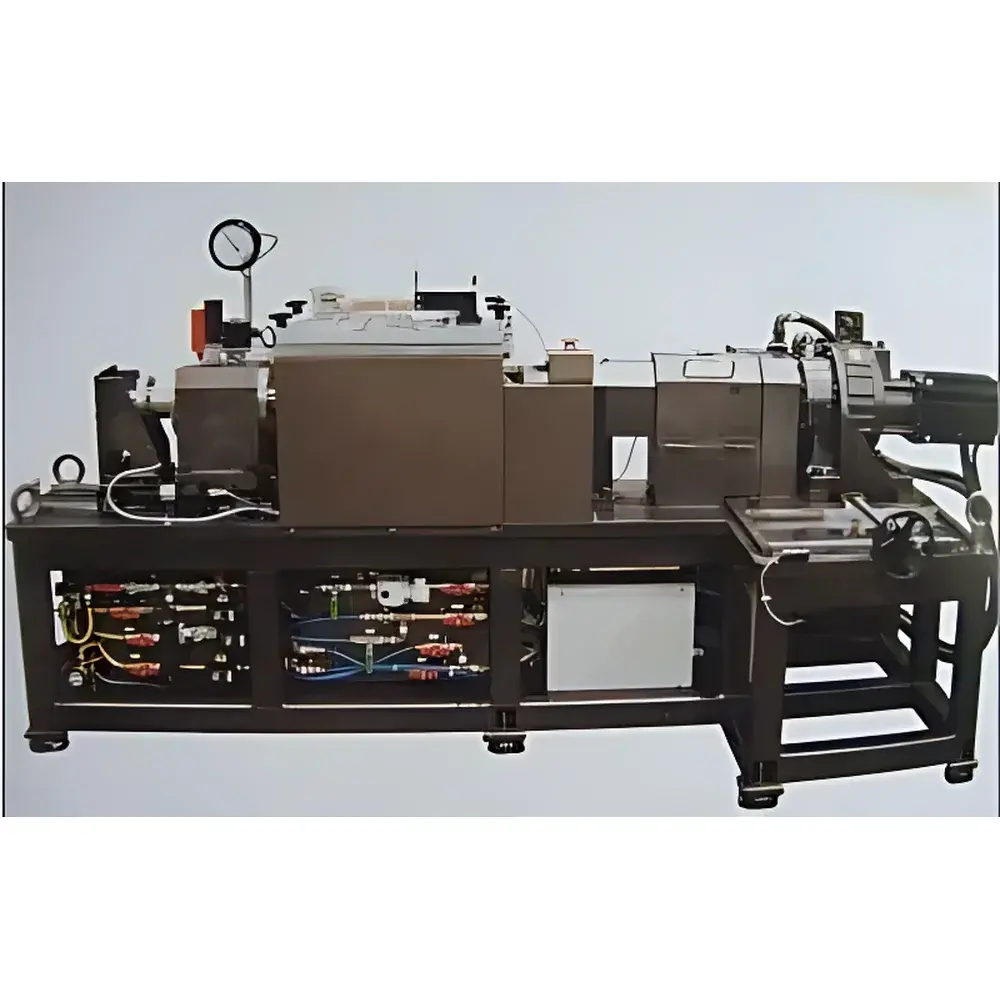
Thermecmaster-TS Torsional Hot Deformation Simulator
| Origin | Japan |
|---|---|
| Manufacturer Type | Authorized Distributor |
| Origin Category | Imported |
| Model | Thermecmaster-TS |
| Price | USD 940,000 (FOB Yokohama) |
Overview
The Thermecmaster-TS Torsional Hot Deformation Simulator is a high-precision, vacuum-compatible thermomechanical testing system engineered for quantitative simulation of hot working processes in metallic materials—particularly steels, titanium alloys, and nickel-based superalloys. It implements torsional deformation under precisely controlled thermal conditions using high-frequency induction heating and servo-driven rotational actuation. Unlike conventional uniaxial compression or tensile simulators, the Thermecmaster-TS applies pure shear strain via torsion, enabling representative simulation of industrial rolling, forging, and extrusion where shear-dominated microstructural evolution governs recrystallization kinetics, dynamic precipitation, and phase transformation behavior. The system operates from ambient temperature up to 1400 °C (below material melting point), with real-time synchronized acquisition of torque, angular displacement, axial displacement, and surface temperature—allowing derivation of flow stress, strain, strain rate, work hardening rate, and thermal history-coupled constitutive response.
Key Features
- High-frequency induction heating (up to 1400 °C) with R-type thermocouple feedback control ensuring ±3 °C temperature stability across the 12 mm gauge length
- Torsional actuation via AC servo motor with ±50 N·m torque capacity and 1024 P/R rotary encoder resolution for precise strain and strain-rate control (up to 10 s⁻¹)
- Integrated coaxial quenching: programmable inert gas (He, Ar, N₂) or water cooling with controllable cooling rates—up to 50 °C/s (He) or 300 °C/s (water) between 1000–500 °C
- Ultra-high vacuum capability (≤10⁻² Torr) with gas-purge option for oxidation-sensitive experiments; compatible with inert atmosphere processing (Ar, N₂, He)
- Modular architecture: independent vacuum pumping station, RF generator with impedance matching unit, dual-channel pattern generator, and multi-channel signal conditioning amplifiers (torque, angle, displacement, temperature)
- Gauge-length adaptable sample holder accommodating variable specimen geometry and post-deformation recovery studies
Sample Compatibility & Compliance
The Thermecmaster-TS accepts cylindrical specimens (typically Ø8–12 mm × 15–25 mm), compatible with standard ASTM E209, ISO 6892-2, and JIS Z 2241 hot torsion test protocols. Its vacuum and inert-gas environments meet ASTM F86 requirements for surface-sensitive metallurgical analysis. Temperature calibration traceability follows ISO/IEC 17025-accredited procedures using NIST-traceable R-type thermocouples. All data acquisition complies with GLP and GMP principles, supporting audit-ready timestamped binary and ASCII logging for regulatory submissions (e.g., FDA 21 CFR Part 11–compliant metadata tagging available via optional software module).
Software & Data Management
The proprietary Windows-based control and analysis suite provides real-time closed-loop control of heating, deformation, and cooling profiles. Raw signals—including torque (±50 N·m), angular position (0.035° resolution), axial displacement (±10 mm), and temperature (0–1600 °C)—are sampled at ≥1 kHz and processed in-situ to compute instantaneous flow stress (σ = τ·r/J), equivalent strain (γ = r·θ/L), and strain rate (dγ/dt). Post-test analysis includes stress–strain curve generation, Arrhenius-type activation energy calculation, Avrami modeling of recrystallization kinetics, and time–temperature–transformation (TTT) diagram construction. Data export supports CSV, MATLAB (.mat), and HDF5 formats; all files include embedded metadata (operator ID, calibration timestamps, environmental logs).
Applications
- Hot torsion testing per ASTM E209 for flow curve determination and constitutive modeling (e.g., Johnson–Cook, Sellars–Tegart equations)
- In-situ investigation of dynamic recrystallization (DRX), metadynamic recrystallization (MDRX), and static recrystallization (SRX) kinetics
- Phase transformation studies during controlled cooling (e.g., austenite → ferrite, bainite, martensite in steels)
- Thermomechanical processing (TMP) parameter optimization for hot rolling schedules and forging die design
- Microstructure–property correlation via post-test SEM/EBSD/TEM sample preparation enabled by reproducible, contamination-free vacuum environment
- Validation of thermomechanical finite element models (e.g., DEFORM, Thermo-Calc coupling)
FAQ
What is the maximum achievable strain rate in torsional mode?
The system supports strain rates from 10⁻⁴ s⁻¹ to 10 s⁻¹, with full repeatability verified per ISO 14283 across the operational temperature range.
Can the system perform isothermal holding before or after deformation?
Yes—programmable soak steps (duration: 0.1–3600 s) are fully integrated into the thermal profile editor, with active temperature maintenance during hold periods.
Is the torque sensor calibrated traceably to national standards?
All torque transducers are factory-calibrated against NIST-traceable deadweight standards, with certificate of calibration supplied; annual recalibration service is available.
Does the software support automated test sequence execution?
Yes—the batch test manager enables unattended execution of multi-step programs (e.g., heat → hold → deform → quench → hold → cool), with email/SNMP alerts on completion or fault.
What vacuum pump configuration is included?
A two-stage rotary vane mechanical pump (base pressure ≤10⁻² Torr) is standard; optional turbomolecular pump upgrade achieves ≤10⁻⁶ Torr for ultra-high-purity experiments.



