
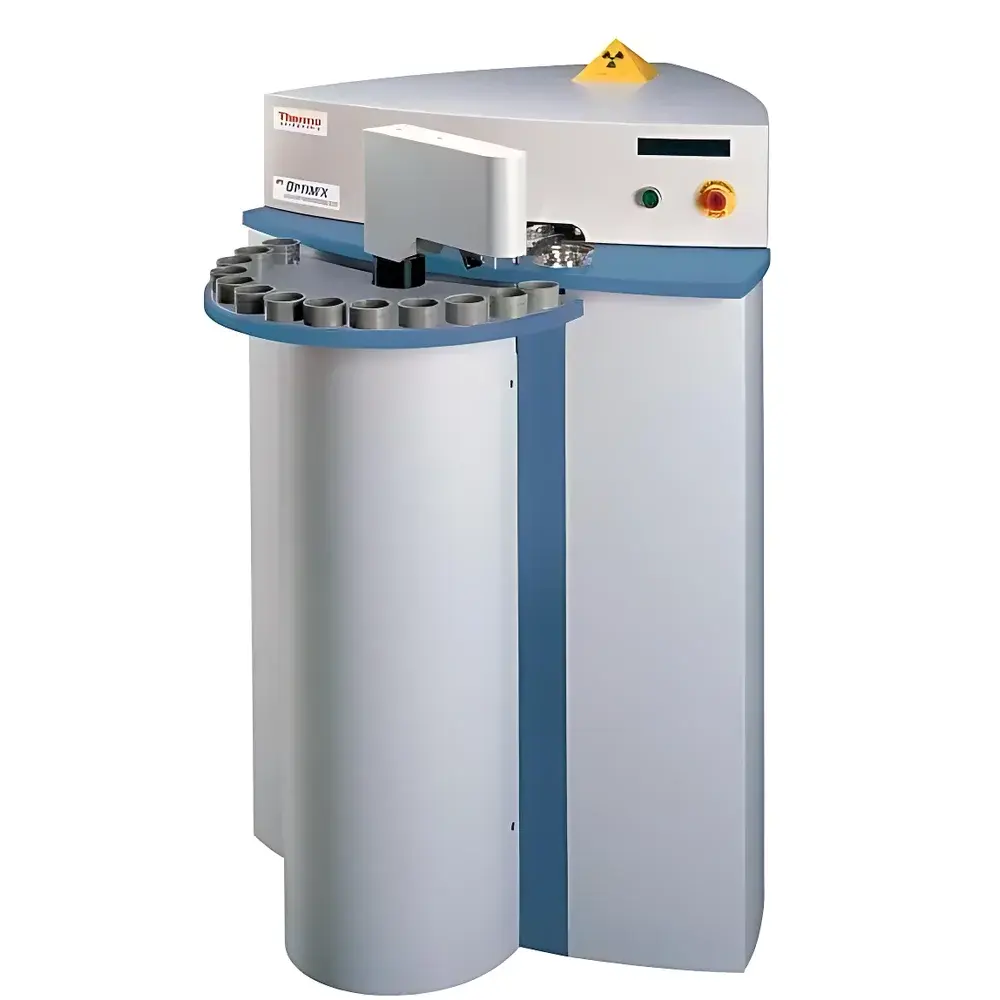
Thermo Fisher ARL OPTIM’X Wavelength Dispersive X-Ray Fluorescence Spectrometer
| Brand | Thermo Fisher |
|---|---|
| Origin | Switzerland |
| Model | ARL OPTIM'X |
| Technique | Wavelength Dispersive XRF (WDXRF) |
| Elemental Range | F (9) to U (92) |
| Configuration Options | Simultaneous multi-channel (up to 8 fixed channels) + sequential SmartGonio goniometer with 3 analyzing crystals |
| Cooling | Air-cooled (no internal/external water cooling required) |
| Detector Gas | Optional P10 or vacuum operation (no mandatory external gas supply) |
| Sample Forms | Solids, liquids, loose powders |
| Compliance | ASTM D2622, D4294, D7039 |
Overview
The Thermo Fisher ARL OPTIM’X is a high-performance wavelength dispersive X-ray fluorescence (WDXRF) spectrometer engineered for precision elemental quantification across industrial, petrochemical, geological, and regulatory-compliant quality control laboratories. Unlike energy dispersive XRF (EDXRF), WDXRF relies on Bragg diffraction from precisely aligned analyzing crystals to separate characteristic X-ray emissions by wavelength—delivering superior spectral resolution (<10 eV at Mn Kα), lower detection limits (sub-ppm for many elements), and exceptional inter-laboratory reproducibility. The ARL OPTIM'X integrates a high-intensity X-ray tube with optimized optical coupling via low-loss fused-silica fiber optics—increasing photon throughput by up to 50% compared to conventional collimator-based geometries. Its compact, air-cooled architecture eliminates dependency on external chillers or compressed gas supplies, enabling stable operation in standard laboratory environments without infrastructure retrofitting.
Key Features
- SmartGonio goniometer: Motorized, high-precision theta-theta scanning system with automated crystal selection (up to three analyzer crystals) for sequential analysis of elements from fluorine (F, Z=9) to uranium (U, Z=92).
- Modular detector configuration: Supports both flow-proportional counters (for light elements) and scintillation detectors (for mid-to-heavy elements), with optional vacuum or P10 gas operation—no mandatory external gas supply required.
- Simultaneous multi-channel capability: Up to eight fixed-channel positions accommodate dedicated crystals and detectors for rapid, interference-free analysis of priority elements (e.g., S, Cl, Ca, Fe, Ni, V in fuels).
- Dual-purpose channel integration: Two single-element fixed channels (e.g., S and Cl) can be co-mounted alongside the SmartGonio goniometer, enabling hybrid simultaneous/sequential operation to minimize total cycle time.
- Robust mechanical design: Cast aluminum frame with vibration-damped optical bench ensures long-term alignment stability and minimal recalibration frequency—even under continuous 24/7 operation.
- Low total cost of ownership: Eliminates water cooling, external gas cylinders, and high-voltage auxiliary units—reducing energy consumption, maintenance intervals, and facility footprint.
Sample Compatibility & Compliance
The ARL OPTIM’X accepts pressed pellets, fused beads, thin films, bulk solids, and homogenized liquids—requiring no destructive digestion or matrix modification for most routine applications. Its analytical performance meets or exceeds critical international standards including ASTM D2622 (sulfur in distillates), ASTM D4294 (sulfur in crude oil), ASTM D7039 (sulfur in gasoline via monochromatic WDXRF), ISO 8754 (aluminum alloys), ISO 20884 (diesel fuel sulfur), and EN ISO 15297 (cement analysis). For pharmaceutical elemental impurity testing, method validation aligns with ICH Q3D and USP /, supporting GLP/GMP audit readiness through full electronic record retention and user-access logging.
Software & Data Management
Operation is managed via Thermo Scientific OASIS software—a validated, 21 CFR Part 11-compliant platform featuring role-based access control, electronic signatures, audit trail generation, and secure data encryption. Calibration models support both empirical (standard-based) and fundamental parameters (FP) quantification, with optional PetroilQuant pre-calibrated methods for petroleum products. Data export supports ASTM E1382, LIMS integration via ASTM E1482-compliant ASCII formats, and direct reporting to enterprise QA/QC dashboards.
Applications
- Petrochemical QA/QC: Sulfur, vanadium, nickel, calcium, and chlorine in crude oil, diesel, gasoline, lubricants, and catalysts per ASTM/ISO specifications.
- Raw materials certification: Quantification of major oxides (SiO₂, Al₂O₃, Fe₂O₃, CaO, MgO, Na₂O, K₂O) in limestone, bauxite, clays, refractories, slag, and ceramic bodies.
- Environmental & food safety: Screening for toxic elements (As, Cd, Pb, Hg) and nutrients (Ca, Fe, Zn) in soils, fertilizers, animal feed, and fortified foods.
- Metallurgy & alloys: Grade identification, inclusion analysis, and trace element verification in stainless steels, aluminum alloys, and superalloys.
- Regulatory compliance: Batch release testing for elemental impurities in active pharmaceutical ingredients (APIs) and excipients per ICH Q3D thresholds.
FAQ
Does the ARL OPTIM’X require water cooling?
No—the instrument is fully air-cooled and designed for operation without internal or external chillers.
Can it analyze light elements such as sodium or fluorine?
Yes, when equipped with appropriate analyzing crystals (e.g., LiF 200, PET, or TAP) and vacuum or helium purge pathways, detection of elements from F (Z=9) to U (Z=92) is supported.
Is method transfer possible between different ARL OPTIM’X systems?
Yes—OASIS software supports standardized calibration file exchange and instrument-specific correction factor portability, ensuring consistent results across multi-site deployments.
What sample preparation methods are recommended for heterogeneous powders?
Pressed pellets using cellulose or boric acid binders, or fused beads with lithium tetraborate/lithium metaborate fluxes—both validated per ISO 29581-2 and ASTM C114 protocols.
How is compliance with 21 CFR Part 11 ensured?
Through OASIS’s built-in electronic signature workflow, immutable audit trails, user authentication, and configurable permission levels—all documented in the system validation package (IQ/OQ/PQ).





