
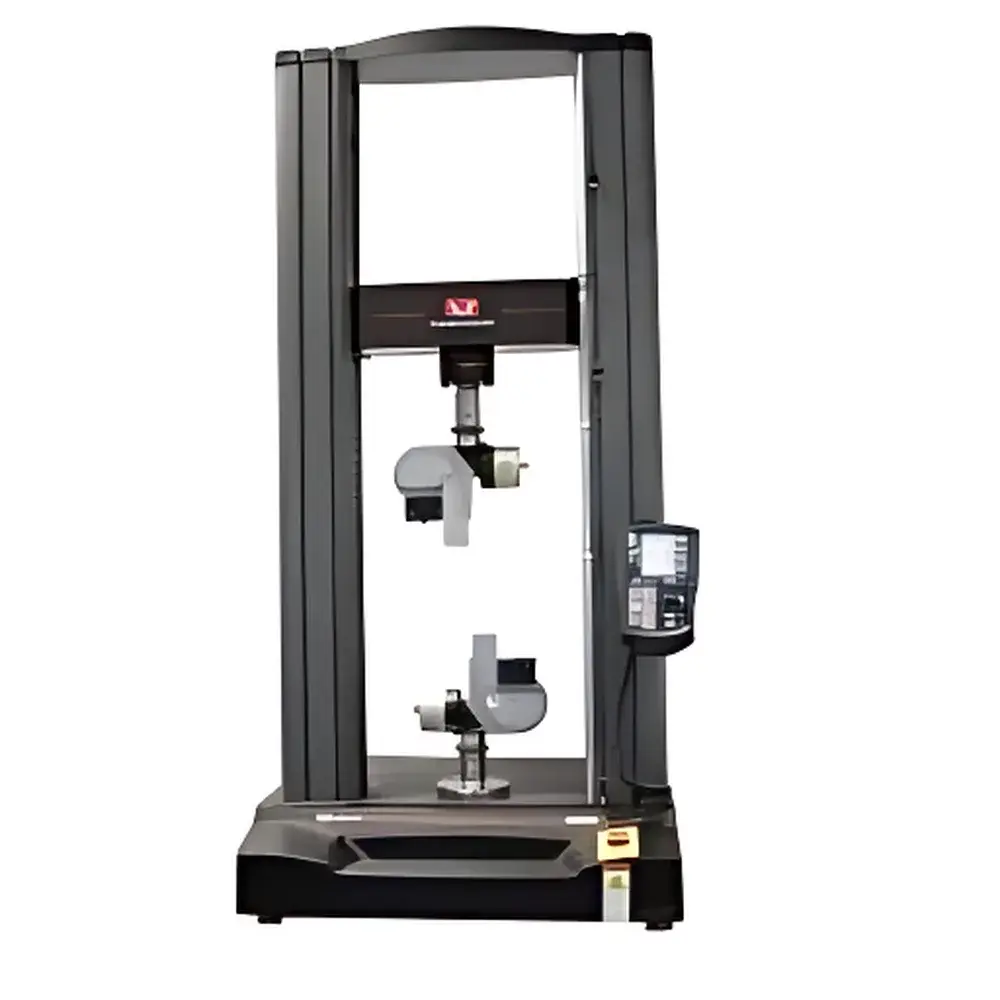
Instron 5960 Dual-Column Desktop Universal Testing Machine
| Brand | Instron |
|---|---|
| Origin | USA |
| Model | 5960 |
| Maximum Load Capacity | 50 kN (11,250 lbf / 5,000 kgf) |
| Load Frame Stiffness | ≥ 120 kN/mm |
| Speed Range | 0.001–2,500 mm/min |
| Position Resolution | ≤ 0.0001 mm |
| Data Acquisition Rate | Up to 5,000 Hz |
| Control Channels | Up to 4 integrated sensor channels |
| Interface | Built-in 10/100/1000BASE-T Ethernet |
| Compliance | ASTM E4, E8, E9, E21, ISO 7500-1, ISO 527, ISO 6892-1, USP <1041>, FDA 21 CFR Part 11 (with Bluehill software configuration) |
Overview
The Instron 5960 is a dual-column, electromechanical universal testing machine engineered for high-precision static mechanical testing across research laboratories, quality control environments, and contract testing facilities. Operating on the principle of controlled displacement or load application via a precision ball-screw-driven crosshead, the system delivers traceable force measurement through calibrated load cells and closed-loop servo control. Designed to meet and exceed international metrological requirements—including ISO 7500-1 Class 1 accuracy and ASTM E4 verification protocols—the 5960 supports tensile, compression, flexure, peel, shear, and cyclic testing of materials ranging from microfibers (diameter < 10 µm) to structural assemblies. Its rigid frame architecture minimizes deflection under load, ensuring consistent axial alignment and minimizing bending moments that compromise data fidelity—particularly critical for modulus determination and yield point analysis per ASTM E8 or ISO 6892-1.
Key Features
- High-stiffness dual-column frame with precision-ground linear bearings and preloaded guide systems, delivering axial alignment accuracy ≤ ±0.01 mm over full stroke
- Integrated Ethernet interface (10/100/1000BASE-T) enabling deterministic communication latency (< 1 ms) and seamless integration into laboratory networks without external adapters
- Real-time control panel with tactile soft-keys, programmable safety limits, and automatic specimen protection logic to prevent over-travel or overload damage
- Up to four simultaneously active sensor channels—supporting concurrent force, displacement, extensometer, and environmental sensor inputs—for multi-parameter test synchronization
- Enhanced dynamic performance: data sampling rate up to 5,000 Hz, speed accuracy ±0.1% of setpoint, and return speed up to 2,500 mm/min for rapid cycle turnaround
- Modular load cell mounting system with quick-change kits (optional), reducing sensor swap time to under 90 seconds without recalibration
Sample Compatibility & Compliance
The 5960 accommodates specimens from sub-millimeter filaments to full-scale automotive subassemblies, enabled by configurable T-slot tabletops, adjustable crosshead travel (up to 1,200 mm), and a wide range of standardized and custom fixtures—including pneumatic wedge grips, hydraulic vise clamps, and environmental chambers (−70 °C to +300 °C). All hardware and firmware comply with ISO/IEC 17025 documentation requirements for accredited testing labs. When configured with Bluehill Universal software and audit-trail-enabled user accounts, the system satisfies FDA 21 CFR Part 11 electronic record and signature criteria, as well as GLP/GMP validation prerequisites for pharmaceutical excipient or medical device material qualification per USP .
Software & Data Management
Controlled exclusively via Instron’s Bluehill Universal software platform, the 5960 supports method-driven test execution with drag-and-drop protocol builders, real-time curve overlay, and automated pass/fail evaluation against user-defined tolerances. Raw data is stored in vendor-neutral .csv and .xml formats compliant with LIMS ingestion standards; metadata—including operator ID, calibration certificate traceability, environmental conditions, and instrument firmware version—is embedded per test record. Audit trails log all parameter modifications, result exports, and user login/logout events with immutable timestamps. Optional add-ons include video synchronization (via USB3.0 camera input), DIC strain mapping integration, and automated report generation conforming to ASTM D638 or ISO 527 templates.
Applications
The system serves as a primary mechanical characterization platform for polymer formulation labs evaluating melt strength and ductility; metal suppliers validating heat-treated alloy tensile properties per ASTM E8; composite manufacturers assessing interlaminar shear strength (ASTM D2344); adhesive developers quantifying lap-shear performance (ASTM D1002); and biomedical R&D teams testing suture tensile integrity (ISO 10993-12). Its extended speed range and high-resolution positioning also support quasi-static creep testing (ISO 899-1) and low-cycle fatigue protocols when paired with optional electrodynamic actuation modules.
FAQ
What load capacities are available within the 5960 series?
The 5960 platform spans five standard configurations: 5965 (5 kN), 5966 (10 kN), 5967 (30 kN), and 5969 (50 kN). Each model shares identical control architecture, software compatibility, and accessory ecosystem.
Is the system suitable for elevated-temperature testing?
Yes—when integrated with Instron’s 3119-600 series environmental chambers or third-party ovens/furnaces with analog/digital I/O feedback, the 5960 maintains closed-loop control at temperatures up to +300 °C while logging thermal drift compensation data.
Can Bluehill software be validated for regulated environments?
Yes—Instron provides IQ/OQ documentation packages, electronic signature workflows, and 21 CFR Part 11 compliance reports upon request, supporting GxP audits for pharmaceutical, aerospace, and medical device applications.
Does the 5960 support extensometry?
Yes—it natively accepts analog and digital outputs from contact (e.g., clip-on, pneumatic) and non-contact (video, laser) extensometers via dedicated sensor channels, with automatic gauge length recognition and auto-zeroing routines.
What maintenance intervals are recommended?
Annual calibration verification per ASTM E74 is advised; preventive maintenance—including ball screw lubrication, bearing inspection, and encoder alignment check—is scheduled every 2,000 operational hours or biannually, whichever occurs first.



