
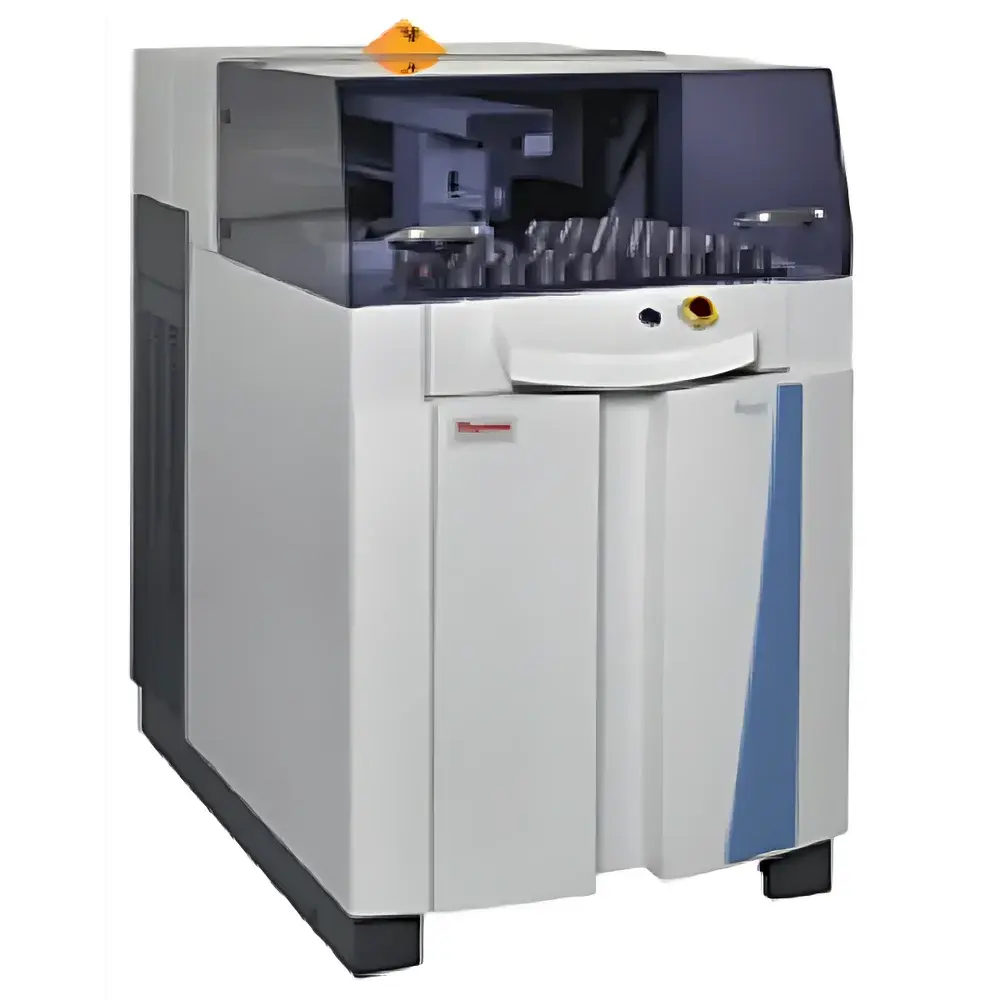
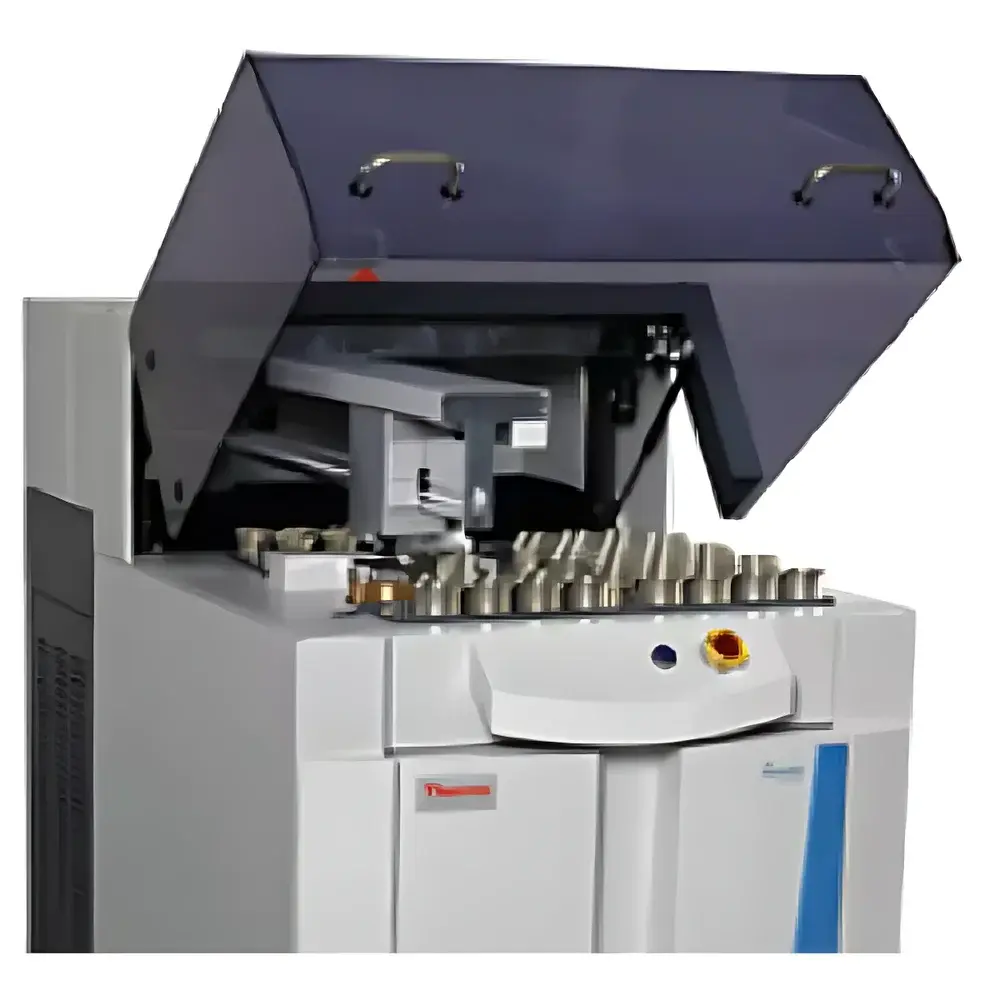
Thermo Fisher ARL PERFORM’X Sequential Wavelength Dispersive X-Ray Fluorescence Spectrometer (WDXRF)
| Brand | Thermo Fisher |
|---|---|
| Origin | Shanghai, China |
| Manufacturer Type | Authorized Distributor |
| Country of Origin | China |
| Model | ARL PERFORM'X Sequential WDXRF |
| Pricing | Upon Request |
Overview
The Thermo Fisher ARL PERFORM’X is a high-precision sequential wavelength dispersive X-ray fluorescence (WDXRF) spectrometer engineered for rigorous elemental analysis across industrial, research, and regulatory environments. Unlike energy-dispersive (EDXRF) systems, WDXRF relies on Bragg diffraction from analyzing crystals to isolate characteristic X-ray lines with superior spectral resolution—enabling accurate quantification of elements from boron (B, Z=5) to uranium (U, Z=92) at trace to major concentration levels. Its core optical architecture incorporates Ultra-Close Coupling Optics (UCCO), a patented optical path design that maximizes X-ray photon throughput and minimizes background scatter, directly contributing to enhanced peak-to-background ratios and detection limits in the sub-ppm range for light elements. The system employs a gearless, Moiré-fringe-based digital goniometer for angular positioning of analyzing crystals and detectors, delivering long-term mechanical stability and reproducibility better than ±0.0005°—critical for maintaining calibration integrity over extended operational cycles.
Key Features
- Sequential WDXRF architecture with selectable analyzing crystals (e.g., LiF, PET, TAP) and proportional counters/scintillation detectors for optimized sensitivity across the full elemental range.
- Three power configurations: ARL PERFORM’X 1500W (air-cooled, low-power), 2500W (air-cooled, mid-power), and 4200W (water-cooled, high-power) — enabling application-specific performance scaling without compromising analytical robustness.
- Integrated XY sample stage with programmable micro-spot mapping (down to 100 µm diameter), supporting spatially resolved analysis for inclusion identification, coating thickness assessment, and contamination localization.
- Automated sample handling via a high-capacity, multi-position sample changer compatible with solid discs, pressed pellets, fused beads, powders, and sealed liquid cells—designed for unattended operation over 24/7 shifts.
- Patented liquid-sample recognition system with leak-detection sensors and pressure-compensated cell sealing—ensuring operator safety and instrument protection during volatile or viscous petroleum and lubricant analysis.
- Dynamic linear range spanning 8 orders of magnitude (sub-ppm to 100 wt%), validated per ISO 22036 and ASTM E1621 for precision (RSD < 0.5% for major elements) and accuracy (recovery ≥ 95–105% across certified reference materials).
Sample Compatibility & Compliance
The ARL PERFORM’X accommodates heterogeneous sample forms—including geological digests, cement clinkers, polymer granules, metallurgical slags, and refinery feedstocks—without requiring destructive digestion in most routine cases. Solid samples are analyzed as-is or prepared via pressing or fusion, while liquids are introduced in hermetically sealed XRF cells compliant with IEC 61000-4-3 EMC standards. The platform supports full GLP/GMP compliance workflows: audit-trail-enabled software logging, electronic signatures per FDA 21 CFR Part 11, IQ/OQ documentation packages, and traceable calibration against NIST SRMs and ISO-certified CRM libraries (e.g., USGS, BAM, SARM). Pre-installed method templates align with ASTM D6443 (petroleum), ISO 12677 (cement), and ISO 21047 (steel alloys).
Software & Data Management
OXSAS v8.x serves as the unified control, acquisition, and evaluation environment—featuring embedded QuantAS™ (standardless quantitative analysis) and UniQuant™ (matrix-independent quantification using fundamental parameters). PetroilQuant™ provides factory-calibrated, type-approved methods for sulfur, vanadium, nickel, calcium, and other critical elements in fuels per ASTM D4294 and ISO 8754. All analyses generate structured XML/CSV reports with full metadata (instrument conditions, calibration history, uncertainty estimates per GUM). Data export integrates natively with LIMS platforms via ASTM E1482-compliant interfaces and OPC UA protocols. Remote diagnostics enable secure, encrypted technician access for predictive maintenance and firmware updates—minimizing downtime in regulated production labs.
Applications
- Geology & Environmental: Quantitative analysis of major oxides (SiO₂, Al₂O₃, Fe₂O₃), trace metals (As, Cd, Pb, Hg), and rare earth elements (REEs) in soils, sediments, and mine tailings per EPA Method 6200.
- Petroleum & Polymers: Sulfur speciation in diesel, wear metals in engine oils, additive profiling in synthetic lubricants, and halogen screening in flame-retardant plastics.
- Materials Science: Stoichiometric verification of functional ceramics, dopant distribution in battery cathodes, and impurity profiling in semiconductor-grade quartz.
- Forensics & Archaeometry: Non-destructive provenance studies of glass artifacts, pigment layer characterization in paintings, and gunshot residue elemental fingerprinting.
- Cement & Refractories: Rapid LOI-corrected oxide analysis for kiln feed control, alkali content monitoring for ASR mitigation, and zirconia phase quantification in monolithic linings.
FAQ
Does the ARL PERFORM’X support regulatory compliance for pharmaceutical raw material testing?
Yes—it meets ICH Q2(R2) requirements for method validation when configured with appropriate CRM traceability, documented IQ/OQ, and OXSAS audit trails.
Can it analyze light elements such as carbon, nitrogen, or oxygen?
Boron through fluorine are routinely quantified using vacuum-purged optics and specialized crystals; carbon, nitrogen, and oxygen require dedicated WDXRF configurations not standard on the PERFORM’X platform.
Is remote software support available outside business hours?
Thermo Fisher’s Global Service Network offers 24/7 remote diagnostics with SLA-backed response times for critical instrument faults.
What sample preparation is required for geological rock powders?
Typical preparation includes drying, grinding to <75 µm, and pressing into 40 mm pellets with binder—or fusion with lithium tetraborate for total digestion analysis.
How does UCCO technology improve detection limits for sodium and magnesium?
By reducing optical path length and minimizing air absorption/scatter, UCCO increases effective intensity of soft X-rays (e.g., Na Kα = 1.04 keV, Mg Kα = 1.25 keV), yielding up to 3× lower LODs versus conventional WDXRF designs.



