
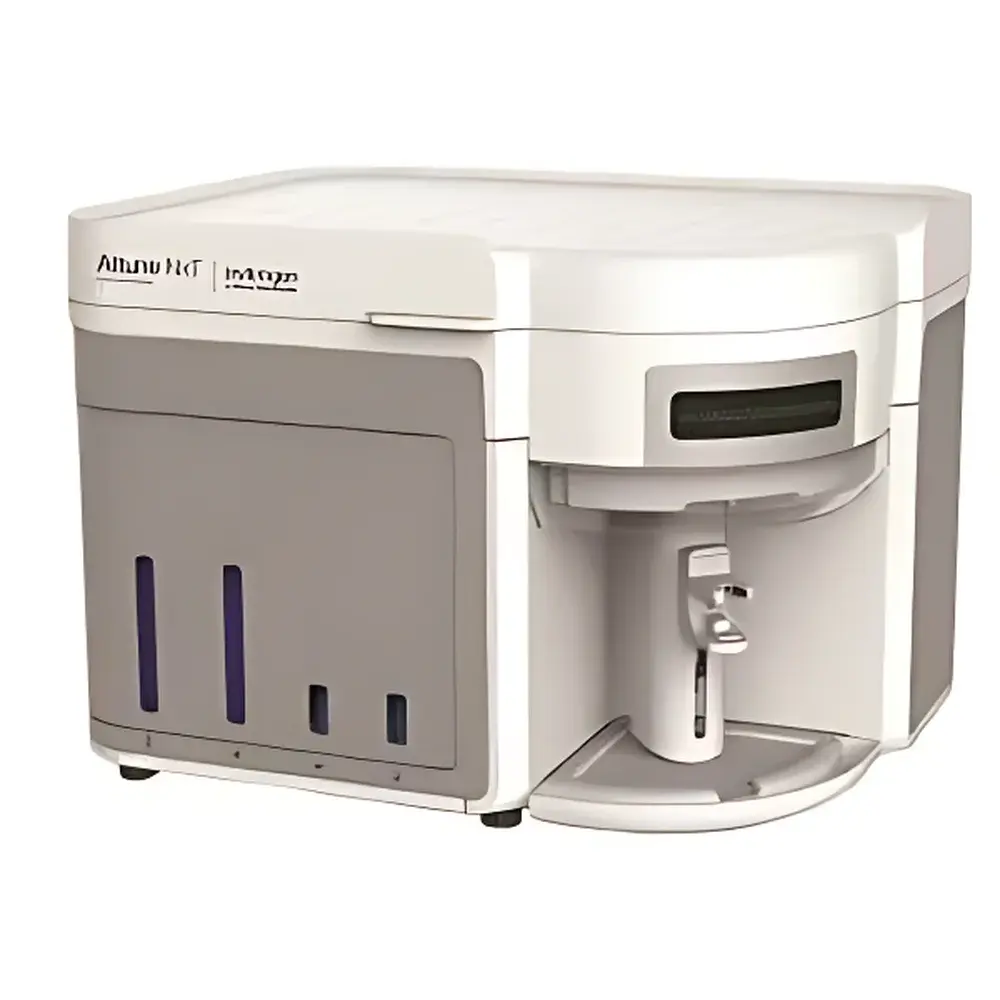
Thermo Fisher Attune NxT Flow Cytometer
| Brand | Thermo Fisher |
|---|---|
| Origin | Singapore |
| Manufacturer Status | Authorized Distributor |
| Origin Category | Imported |
| Model | Attune NxT |
| Price | Upon Request |
Overview
The Thermo Fisher Attune NxT Flow Cytometer is a benchtop flow cytometry platform engineered for high-throughput, high-fidelity cellular analysis without compromising resolution or reproducibility. Unlike conventional hydrodynamic focusing-based systems constrained by sample velocity–precision trade-offs, the Attune NxT employs patented acoustic-assisted hydrodynamic focusing—integrating ultrasonic waves (>2 MHz) with laminar sheath flow to precisely align cells along the central axis of the fluid stream, independent of sample-to-sheath ratio or flow rate. This dual-mode focusing ensures consistent optical interrogation geometry across all acquisition speeds (up to 1,000 µL/min), enabling robust signal detection with low coefficient of variation (CV), enhanced weak-signal discrimination, and improved population resolution in multicolor assays. The system operates on an injection-pump-based sampling architecture, eliminating reliance on absolute counting beads for quantitative cell enumeration—a feature critical for reducing assay cost, minimizing pre-analytical variability, and supporting GLP-compliant workflows.
Key Features
- Acoustic-assisted hydrodynamic focusing: Delivers stable, velocity-invariant core stream formation for superior precision at all flow rates (12.5–1,000 µL/min).
- 4-laser, 14-color configuration (expandable to 16 parameters): Modular optical design supports on-site laser and filter upgrades without system downtime.
- No-wash, no-lyse whole-blood analysis: Enables direct fluorescent labeling and dilution-based acquisition—preserving rare and fragile cell populations (e.g., hematopoietic stem cells, CSF-derived lymphocytes, marine phytoplankton).
- Top-hat beam profile lasers: Eliminate manual alignment; ensure uniform excitation intensity across the interrogation zone for quantitative fluorescence intensity measurement.
- High-speed acquisition engine: Capable of acquiring up to 2 × 10⁷ events per run with real-time data streaming and hardware-based pulse processing.
- Integrated volumetric counting: Injection pump calibration enables traceable, bead-free absolute cell concentration determination compliant with ISO 13847 and ASTM E2877 standards.
Sample Compatibility & Compliance
The Attune NxT accommodates diverse biological matrices—including whole blood, bone marrow aspirates, fine-needle biopsies, cerebrospinal fluid (CSF), seawater suspensions, plant protoplasts, and microbial cultures—without requirement for centrifugation, lysis, or washing steps. Its low-shear, pressure-controlled fluidics minimize mechanical stress on sensitive cells (e.g., primary T cells, induced pluripotent stem cells). The platform conforms to international regulatory expectations for analytical instrumentation: data integrity features include audit-trail-enabled software (21 CFR Part 11–ready), electronic signature support, and secure user access controls. Instrument qualification documentation supports IQ/OQ/PQ execution under GMP and GLP frameworks, and raw FCS 3.1 file output ensures interoperability with third-party analysis tools (e.g., FlowJo, Cytobank, R/Bioconductor).
Software & Data Management
Attune NxT Software (v3.x and later) provides a validated, intuitive interface for experimental setup, acquisition control, and offline analysis. Key capabilities include automated compensation matrix generation using single-stained controls or computational algorithms (e.g., spill-over compensation), real-time histogram and dot-plot rendering at >20 million events/sec refresh rate, and template-driven protocol management for SOP adherence. The Filter Configuration Manager links fluorochrome selections to instrument-specific detector channels, auto-suggesting optimal PMT voltages and gain settings based on spectral overlap profiles. All acquisition metadata—including instrument configuration, gating history, and compensation values—is embedded in FCS files, ensuring full traceability. Raw data export supports batch processing via Python SDK integration for automated QC reporting and LIMS synchronization.
Applications
- Cancer research: Rare circulating tumor cell (CTC) enumeration, tumor microenvironment phenotyping, and phospho-protein signaling profiling (e.g., p-STAT3, p-ERK).
- Immunology & immunophenotyping: Multi-parameter T/B/NK cell subset characterization from limited clinical samples (e.g., pediatric PBMCs, HIV+ cohorts).
- Stem cell biology: Human mesenchymal stromal cell (hMSC) potency assessment, side population (SP) analysis via Hoechst 33342 efflux.
- Marine & environmental microbiology: Enumeration and functional classification of phytoplankton, heterotrophic bacteria, and viral-like particles in seawater.
- Cell cycle & proliferation: Precise DNA content quantification using DAPI or PI with minimal CV drift across variable acquisition rates.
- Plant science: Protoplast viability assessment, ploidy analysis, and reactive oxygen species (ROS) detection in root tip suspensions.
FAQ
Does the Attune NxT require daily alignment or optical recalibration?
No. The top-hat beam profile lasers and fixed optical path eliminate routine alignment; only annual performance verification per ISO 21501-4 is recommended.
Can I perform absolute cell counting without counting beads?
Yes. Volumetric sampling via calibrated syringe pump enables direct calculation of cells/µL without reference microspheres.
Is the system compatible with high-sensitivity tandem dyes (e.g., PE-Cy7, APC-H7)?
Yes—optimized spectral unmixing algorithms and low-noise PMTs support stable detection of tandem dye signals even at 1,000 µL/min.
What sample volume is required for rare-event detection (e.g., <0.01% frequency)?
As little as 50 µL of whole blood can yield >10⁶ total events; acquisition of 2 × 10⁷ events ensures statistical confidence for frequencies down to 5 × 10⁻⁵.
How does acoustic focusing improve CV in cell cycle analysis?
By maintaining constant core stream width and dwell time across flow rates, acoustic focusing minimizes fluorescence intensity variance—critical for resolving G0/G1, S, and G2/M phase peaks with <3.5% CV on DNA dyes.





