
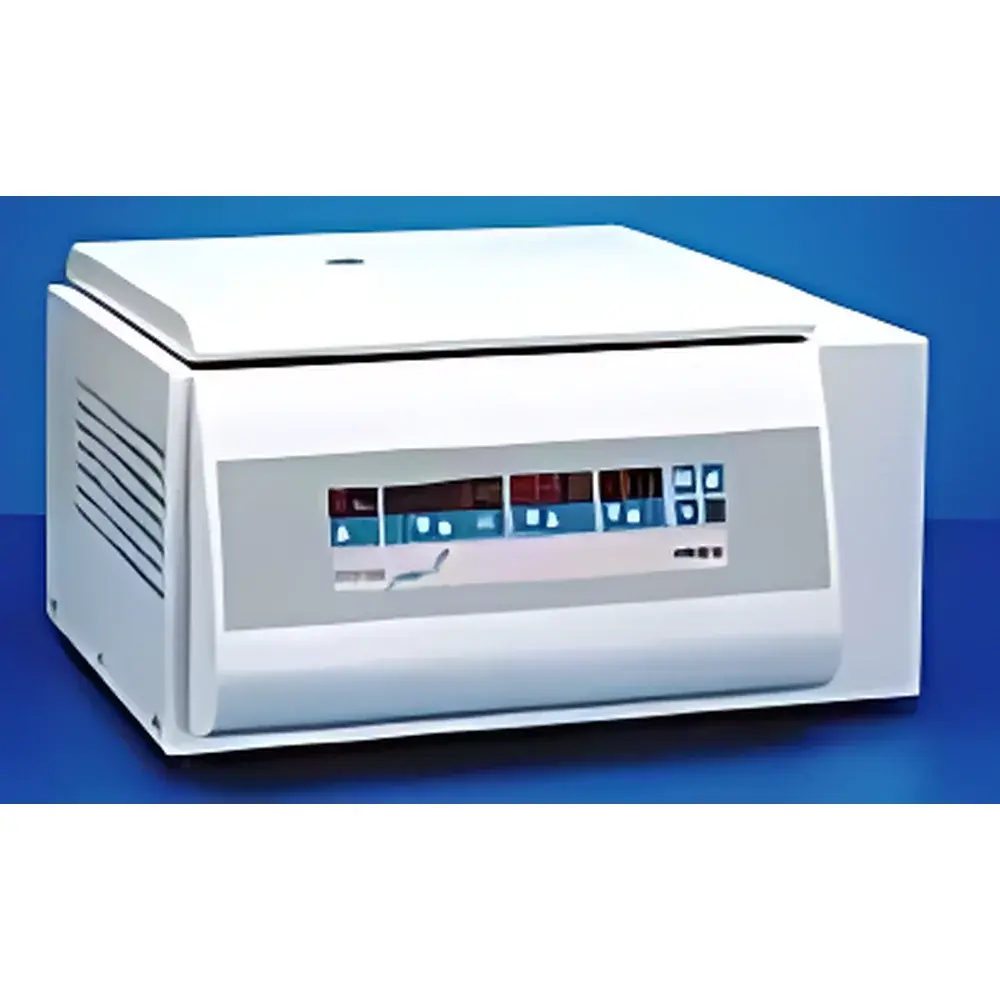
Thermo Fisher Biofuge Primo / Primo R Benchtop Centrifuge
| Brand | Thermo Fisher |
|---|---|
| Origin | USA |
| Model | Primo / Primo R |
| Centrifuge Type | Benchtop Refrigerated Centrifuge |
| Maximum Speed | 15,000 rpm |
| Maximum RCF | 21,885 × g |
| Maximum Capacity | 4 × 100 mL |
| Temperature Range | –9 °C to 40 °C |
| Acceleration/Deceleration Steps | 9 acceleration / 2 deceleration profiles |
| Noise Level | < 62 dBA |
| Timer Range | 0–9 h 59 min + continuous mode |
| Drive System | Brushless DC motor |
| Control System | EASYcontrol II microprocessor-based interface |
| Rotor Recognition | Automatic |
| Imbalance Detection | Electronic, real-time, rotor-agnostic |
| Safety Certification | EN 61010-1, EN 61010-2-020, EN 50081-1, EN 50082-1, UVV VBG 7z |
| Dimensions (H×W×D) | 315 × 380 × 475 mm |
| Weight | 40 kg |
| Power Consumption | 350 W |
| Construction | Stainless steel base, reinforced aluminum chamber |
| Rotor Compatibility | Fixed-angle (6 × 15/50 mL Falcon), horizontal (4 × 100 mL DIN, 4 × 15/50 mL Falcon, 12 × 7/15 mL blood tubes) |
Overview
The Thermo Fisher Biofuge Primo and Primo R are high-performance benchtop refrigerated centrifuges engineered for precision, reliability, and operational flexibility in demanding laboratory environments. Designed around a brushless DC motor drive system and integrated EASYcontrol II microprocessor control architecture, these instruments deliver consistent rotational dynamics across a wide operational envelope—from routine sample clarification to high-resolution separation of biomolecular complexes. The Primo operates at up to 15,000 rpm with a maximum relative centrifugal force (RCF) of 21,885 × g, while the Primo R adds active refrigeration capability, maintaining sample integrity between –9 °C and 40 °C during extended runs. Both models comply with IEC/EN safety standards (61010-1, 61010-2-020) and electromagnetic compatibility directives (EN 50081-1, EN 50082-1), supporting GLP- and GMP-aligned workflows where traceability and environmental control are essential.
Key Features
- Triple-Mode Operational Flexibility: The Primo R supports microcentrifugation (e.g., 1.5–2.0 mL tubes), high-speed pelleting (e.g., subcellular organelles), and general-purpose centrifugation—enabling one instrument to serve multiple protocol tiers without hardware reconfiguration.
- Intelligent Rotor Management: Automatic rotor recognition identifies installed configurations—including fixed-angle (6 × 15/50 mL), horizontal swing-out (4 × 100 mL DIN, 4 × 15/50 mL Falcon, or 12 × 7/15 mL blood tubes)—and enforces speed/RCF limits per rotor specification to prevent mechanical over-stress.
- Real-Time Electronic Imbalance Detection: Continuous monitoring during acceleration, steady-state rotation, and deceleration detects mass asymmetry arising from pipetting error or tube rupture; immediate shutdown prevents bearing wear, rotor deformation, or chamber damage.
- Low-Noise Engineering: Acoustic output remains below 62 dBA under full-load operation, achieved through vibration-damped mounting, aerodynamically optimized rotor housings, and precision-balanced motor assemblies—critical for open-lab or shared-core facility deployment.
- Enhanced Thermal Stability: The Primo R’s refrigeration system maintains setpoint accuracy within ±1.5 °C across the full temperature range (–9 to 40 °C), independent of ambient conditions and run duration, ensuring reproducible sedimentation kinetics for temperature-sensitive analytes (e.g., RNA, membrane proteins).
- Secure & Traceable Operation: EASYcontrol II interface logs timestamped run parameters (speed, time, temperature, RCF, rotor ID) into non-volatile memory. Recent run history is retained for audit purposes, supporting 21 CFR Part 11–compatible documentation when paired with validated LIMS integration.
Sample Compatibility & Compliance
The Biofuge Primo series accommodates standard laboratory consumables including polypropylene conical tubes (15–50 mL), DIN-standard 100 mL bottles, vacuum blood collection tubes (7–15 mL), and microcentrifuge tubes (0.2–2.0 mL). Its reinforced aluminum chamber and stainless steel base meet structural requirements for Class II biosafety containment applications. Third-party certification to EN 61010-2-020 confirms suitability for centrifuging infectious agents under BSL-2 conditions. All rotors are manufactured to ISO 15189-relevant dimensional tolerances and undergo dynamic balancing per ISO 1940-1 Grade G2.5. The system supports compliance with ASTM D1298 (density separation), USP (dissolution testing support), and ISO 13485 (in vitro diagnostic manufacturing environments).
Software & Data Management
EASYcontrol II provides an intuitive, icon-driven interface with dual-line LCD display showing real-time RPM, RCF, elapsed time, remaining time, temperature, and acceleration/deceleration status. No external PC or proprietary software is required for basic operation; however, optional RS-232 or USB connectivity enables automated parameter export to laboratory information management systems (LIMS) or electronic lab notebooks (ELN). Run data—including rotor-specific calibration offsets, thermal ramp profiles, and imbalance event timestamps—are stored in a tamper-resistant internal log accessible via front-panel navigation. Audit trail functionality satisfies GLP requirements for method validation and equipment qualification documentation.
Applications
- Pelleting of mammalian cells, bacteria, and yeast for downstream lysis and nucleic acid extraction
- Clarification of crude lysates prior to chromatography or electrophoresis
- Isolation of mitochondria, nuclei, and synaptic vesicles using differential centrifugation protocols
- Concentration of viral particles and exosomes from cell culture supernatants
- Routine serum/plasma separation in clinical chemistry and immunoassay workflows
- Preparative separation of polymer nanoparticles and colloidal suspensions in materials science labs
FAQ
What is the difference between the Primo and Primo R models?
The Primo R includes a compressor-based refrigeration system enabling temperature-controlled runs from –9 °C to 40 °C; the standard Primo is non-refrigerated and operates at ambient temperature.
Can the Primo R be used for BSL-2 applications?
Yes—its third-party biosafety certification (EN 61010-2-020) and sealed rotor chamber design support safe handling of Risk Group 2 biological agents when used with appropriate biosafety-certified rotors and lids.
Does the system support RCF-based method programming?
Yes—users may directly input target RCF values, and the microprocessor automatically calculates and regulates the corresponding RPM based on the detected rotor radius.
How many recent runs are stored in memory?
The EASYcontrol II interface retains the last 10 complete run records, each including date/time stamp, rotor ID, speed, temperature, duration, and any detected anomalies.
Is rotor calibration required before first use?
No—factory-calibrated rotors are pre-programmed with geometric identifiers; automatic recognition eliminates manual calibration steps. However, periodic verification against NIST-traceable tachometers is recommended per laboratory quality policy.



