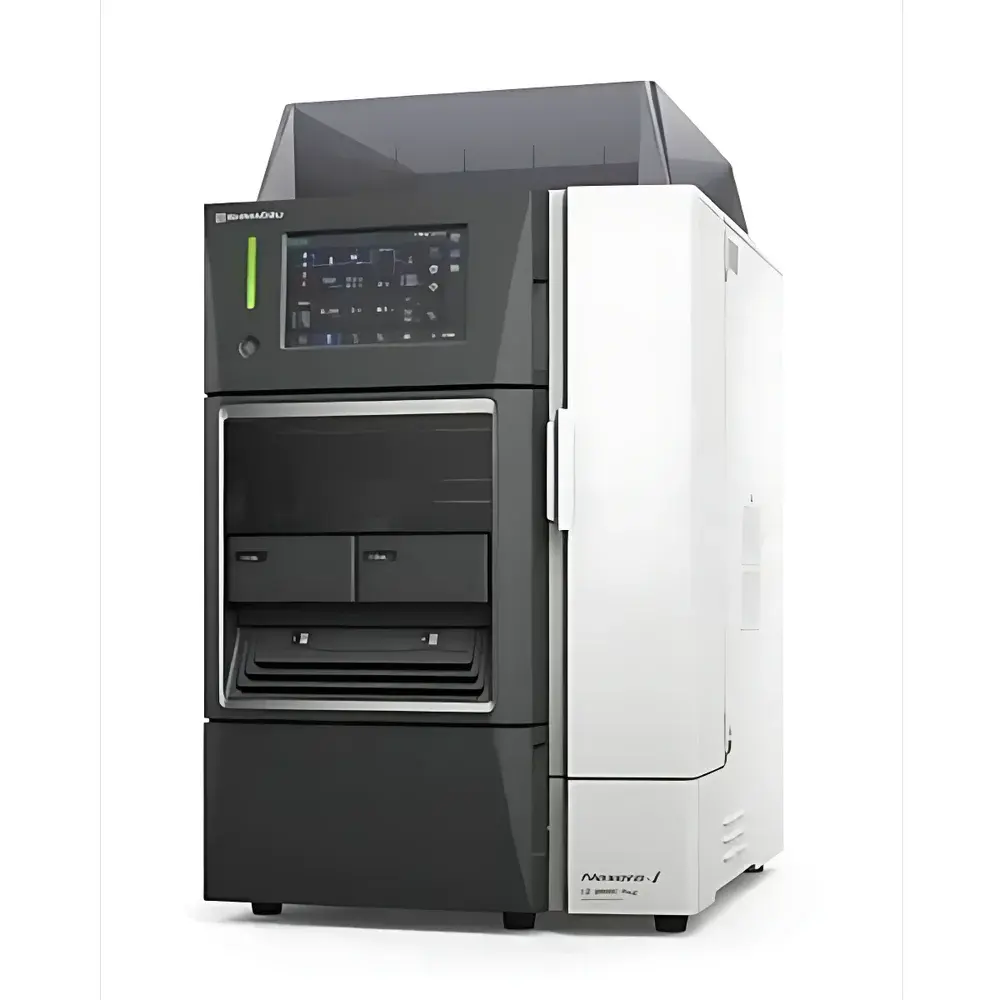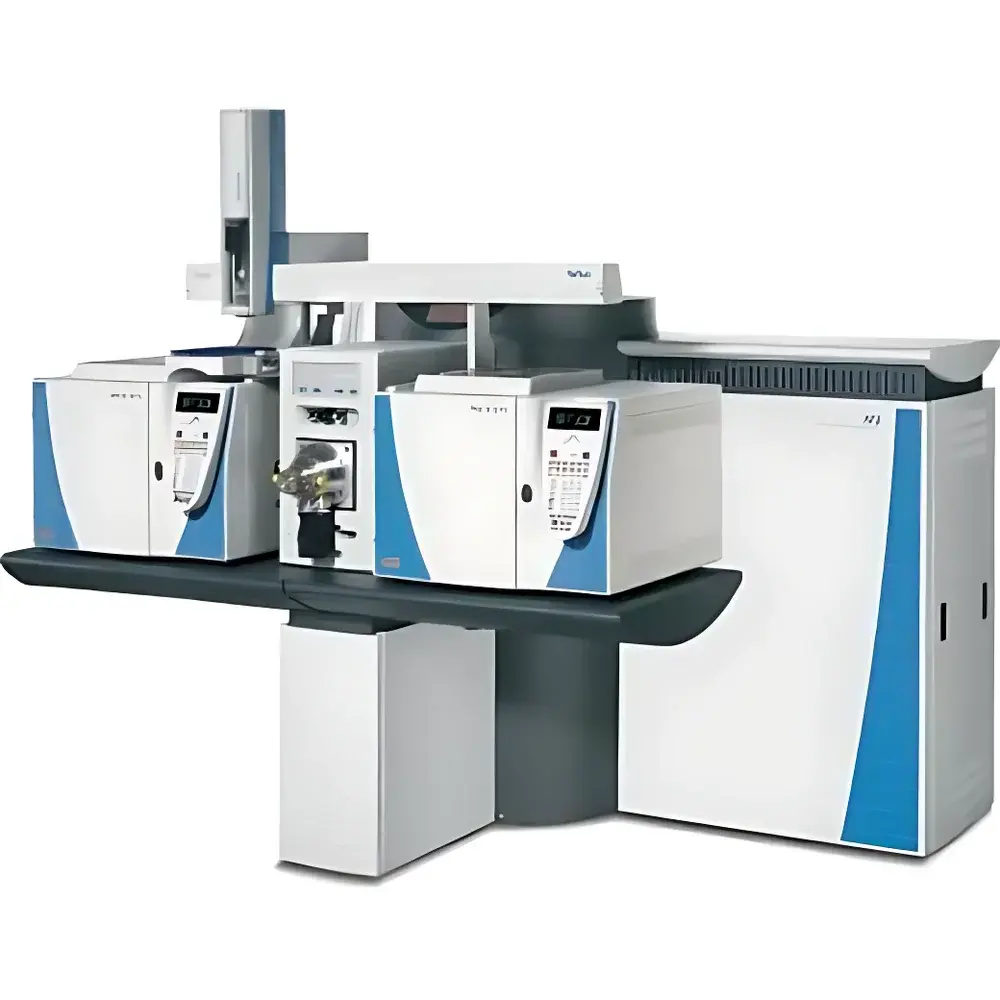
Thermo Fisher DFS High-Resolution Magnetic Sector Gas Chromatography Mass Spectrometer (Used)
| Brand | Thermo Fisher |
|---|---|
| Origin | USA |
| Model | DFS High-Resolution Magnetic Sector GC/MS |
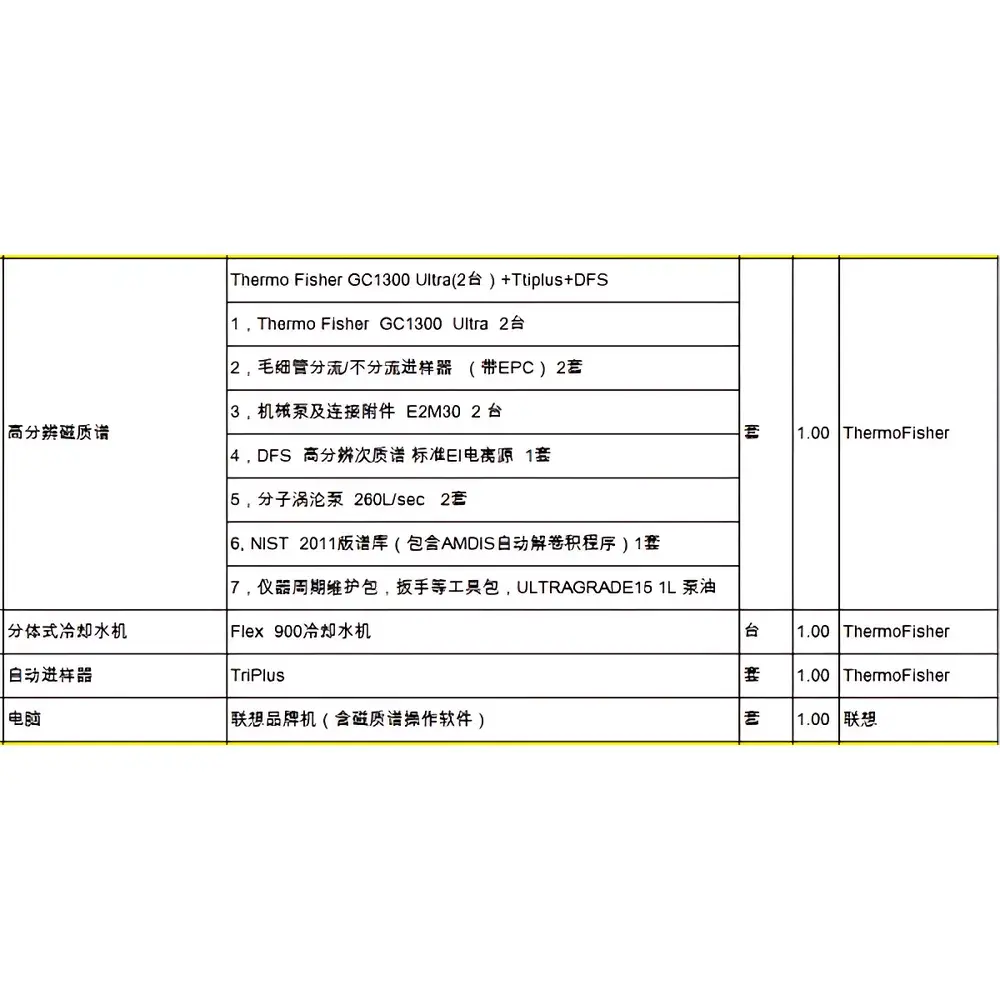
| Configuration | Dual-Trace 1300 GC + TriPlus RSH Autosampler |
| Detector | Dual-mode Faraday Cup / Secondary Electron Multiplier (SEM) |
| Mass Resolution | Up to 10,000–100,000 (M/ΔM, 10% valley) |
| Mass Accuracy | < 1 ppm (with internal lock mass) |
| Ion Source | Removable, maintenance-optimized EI/CI source |
| Vacuum System | Pneumatic valve–locked ion box |
| Compliance | Fully compatible with EPA Methods 1613, 23, 8270, USP <1225>, ISO/IEC 17025, and GLP/GMP audit trails (when configured with Thermo Xcalibur 3.1+ and 21 CFR Part 11–enabled software modules) |
Overview
The Thermo Fisher DFS is a high-resolution magnetic sector gas chromatography mass spectrometer (GC/MS), engineered for definitive elemental composition assignment, ultra-trace environmental analysis, and regulatory-grade quantification. Unlike quadrupole or time-of-flight instruments, the DFS employs double-focusing geometry—combining a high-precision toroidal electrostatic analyzer (ESA) and a radial pole-piece magnet—to achieve mass resolution exceeding 100,000 (M/ΔM, 10% valley) with sub-ppm mass accuracy. This architecture enables unambiguous distinction between isobaric interferences (e.g., 79Br37Cl2+ vs. 81Br35Cl2+ in dioxin analysis) and delivers detection limits in the low femtogram (fg) range for target analytes such as PCDD/Fs, PCBs, and brominated flame retardants. As the only commercially available magnetic sector GC/MS capable of simultaneous dual-GC operation via a shared ion source, the DFS supports orthogonal separation strategies without hardware reconfiguration—critical for method robustness in accredited laboratories.
Key Features
- Radial laminated magnet design ensuring field homogeneity and long-term flux stability over extended acquisition periods
- Field-calibrated mass scale: calibration remains invariant across scan speed, ion polarity (EI/CI), and ionization mode—eliminating repeated recalibration during multi-method sequences
- High-transmission toroidal ESA with active voltage compensation, optimized for both sensitivity and resolving power
- Dual-detection system: switchable Faraday cup for high-abundance ions and extended-dynamic-range secondary electron multiplier (SEM) with >107 gain stability and >5-year operational lifetime
- Pneumatically sealed ion box: enables hot-swap replacement of ion sources or filaments under vacuum—reducing instrument downtime to under 15 minutes
- Modular dual-Trace 1300 GC integration: two independently temperature-programmed columns (e.g., 5%-phenyl vs. polyethylene glycol) can be sequentially or concurrently interrogated from a single TriPlus RSH autosampler vial
- Removable ion source assembly with tool-free access to repeller, extractor, and lens stack—designed for routine cleaning and alignment by laboratory personnel
Sample Compatibility & Compliance
The DFS accommodates volatile and semi-volatile organic compounds across matrices including soil extracts, air particulate filters, biological tissues, and wastewater concentrates. Its compliance-ready architecture supports full traceability per ISO/IEC 17025:2017 requirements, including electronic signatures, audit trail logging (via Xcalibur 3.1+), and secure user role management. When operated with EPA-approved methods—including Method 1613 (dioxins/furans), Method 23 (PCBs), and Method 8270 (semivolatiles)—the system meets data quality objectives for accreditation bodies such as NELAC, UKAS, and DAkkS. All vacuum interlocks, detector gain logs, and mass calibration records are automatically timestamped and archived within the acquisition database.
Software & Data Management
Controlled exclusively through Thermo Scientific™ Xcalibur™ software (v3.1 or later), the DFS integrates native support for automated tuning, mass calibration, and resolution optimization. The “Auto-Resolution Setup” algorithm adjusts ESA and magnet voltages in real time to maintain user-defined resolution without manual intervention. Quantitative workflows leverage Quan Browser for batch processing, isotopic pattern fitting (e.g., for 13C-labeled internal standards), and matrix-matched calibration curves. Raw data files (.RAW) are stored in vendor-neutral formats compliant with ASTM E1947 and FDA 21 CFR Part 11 when enabled—supporting long-term archival, third-party reprocessing, and regulatory submission packages.
Applications
The DFS serves as the reference platform for congener-specific analysis of polychlorinated dibenzo-p-dioxins (PCDDs), dibenzofurans (PCDFs), and dioxin-like PCBs in environmental monitoring programs mandated by the EU POPs Regulation, US EPA, and Japan’s MHLW. Its ability to resolve co-eluting isomers—such as 2,3,7,8-TCDD from non-toxic analogues—ensures legally defensible reporting at sub-pg/g levels. In agrochemical QA/QC, the DFS quantifies fungicides like tolylfluanid with linear dynamic range spanning five orders of magnitude (10 fg–100 pg on-column) and relative standard deviations < 3% (n = 6). Additional validated applications include forensic toxicology (e.g., steroid profiling), petrochemical fingerprinting (biomarker ratios), and impurity identification in pharmaceutical intermediates per ICH Q3 guidelines.
FAQ
Is this a factory-refurbished unit or a dealer-certified used instrument?
This DFS system has undergone comprehensive functional validation by Thermo Fisher–authorized service engineers, including magnet shimming, ESA voltage mapping, vacuum integrity testing, and full mass calibration verification against NIST-traceable standards. It carries a 12-month limited warranty covering electronics, detectors, and vacuum components.
Can the DFS operate under GLP-compliant conditions?
Yes—when deployed with Xcalibur 3.1+ and configured with 21 CFR Part 11–enabled security settings (electronic signatures, audit trail activation, and permission-based access control), the system satisfies GLP audit requirements for regulated laboratories.
What GC models are supported for dual-inlet operation?
Only Thermo Scientific Trace 1300 Series GCs are mechanically and electronically certified for dual-GC integration with the DFS. Compatibility requires firmware version 2.5 or higher and dedicated interface cables supplied by Thermo Fisher.
Does the system include original documentation and calibration certificates?
Yes—each unit ships with its complete factory service history, original installation qualification (IQ) report, and a post-validation certificate issued by the certifying engineer, including measured resolution, mass accuracy, and detection limit data for 2,3,7,8-TCDD.
Is remote diagnostics supported?
All DFS systems include embedded Ethernet connectivity and Thermo Remote Assist capability, allowing authorized service personnel to initiate secure, encrypted diagnostic sessions with customer consent—minimizing on-site dispatch frequency.