
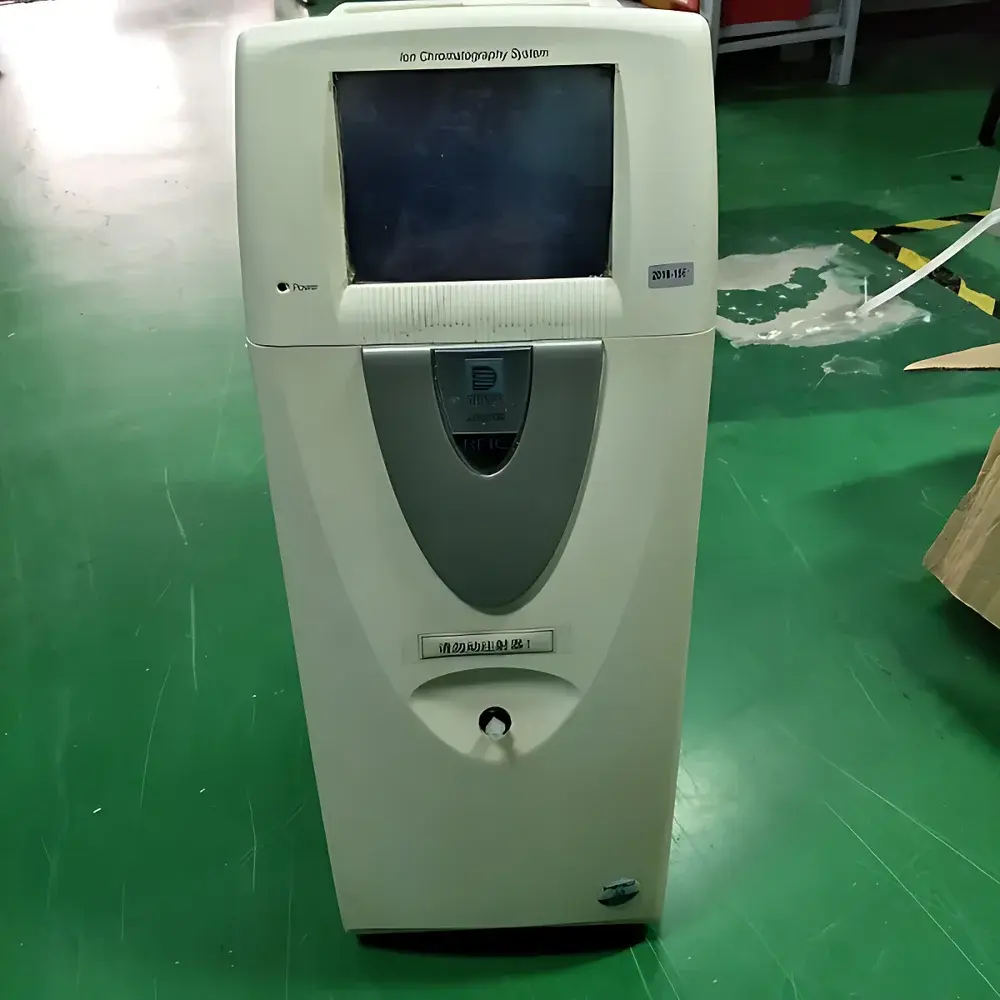
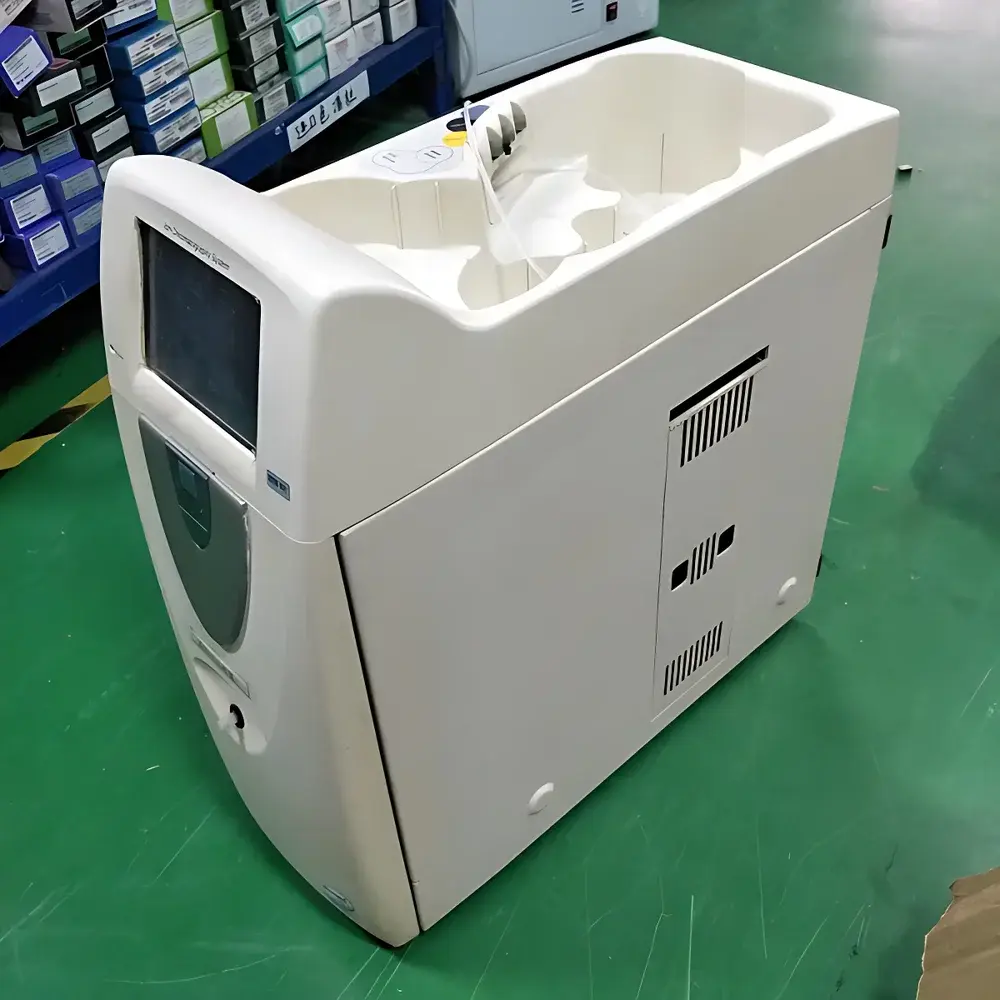
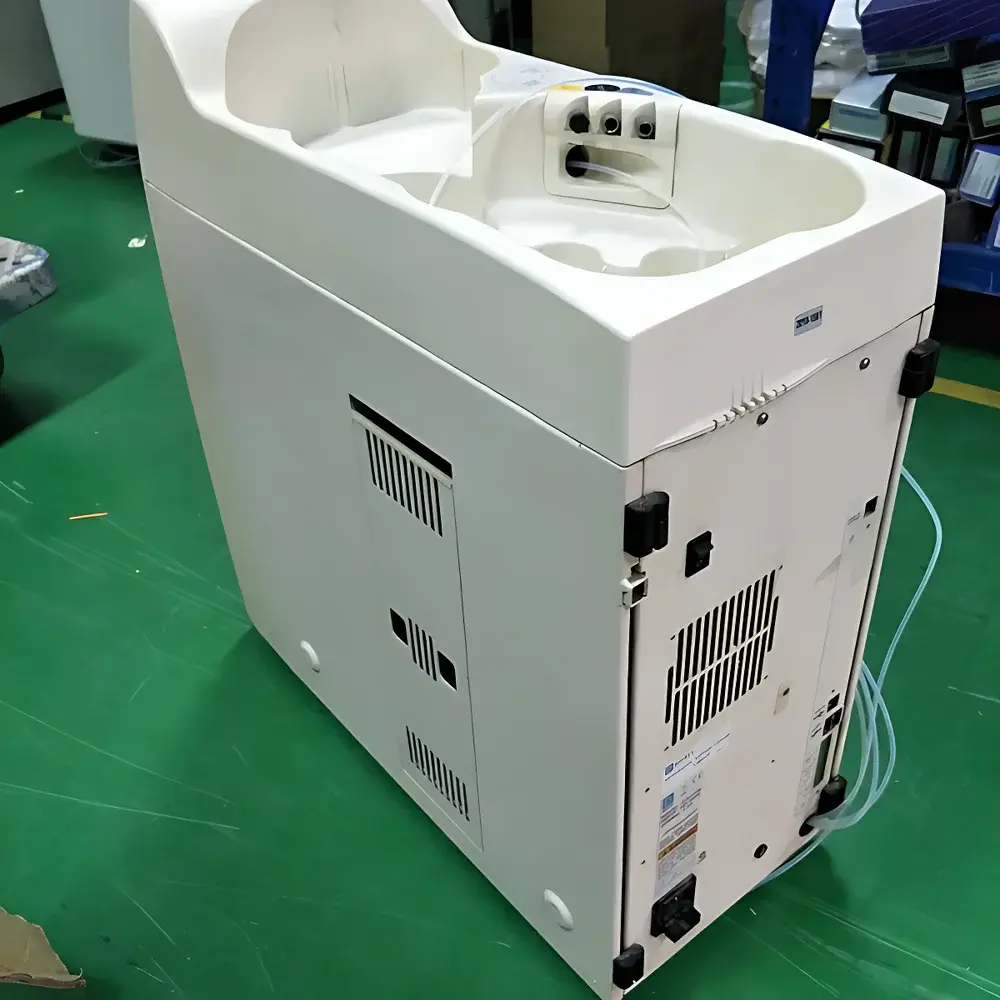
Thermo Fisher Dionex ICS-2100 Refurbished Ion Chromatograph
| Brand | Thermo Fisher |
|---|---|
| Origin | USA |
| Model | ICS-2100 |
| Instrument Type | Laboratory Benchtop IC System |
| Pump Pressure Rating | Up to 35 MPa (5,000 psi) |
| Flow Rate Range | 0.00–5.00 mL/min |
| Eluent Flow Range | 0.1–3.0 mL/min |
| Operating Temperature Range | 30–60 °C |
| Temperature Reproducibility | ±0.2 °C |
| Eluent Concentration Range | 0.1–100 mM |
| Column Compatibility | 2 mm and 4 mm internal diameter columns |
| Detector | Suppressed Conductivity Detection (with SRS-300 continuous regeneration micro-membrane suppressor) |
| Data Acquisition Interface | USB 2.0 |
| Software Platform | Chromeleon 6.8 Chromatography Data System (CDS) |
| Compliance | Designed for GLP/GMP environments |
Overview
The Thermo Fisher Dionex ICS-2100 is a refurbished, high-performance benchtop ion chromatograph engineered for precise, reproducible separation and quantification of inorganic anions, cations, organic acids, amines, and carbohydrates in diverse sample matrices. Built upon the foundational architecture of the original Dionex platform, this system integrates two proprietary Reagent-Free Ion Chromatography (RFIC™) technologies: the RFIC-EG (Eluent Generation) module for on-demand, high-purity eluent synthesis from deionized water, and the RFIC-ESP (Electrolytic Sample Preparation) module for automated, reagent-free sample pretreatment—including online filtration, matrix elimination, neutralization, and analyte concentration. Its dual-piston, PEEK-based high-pressure pump delivers pulse-free flow across a wide range (0.00–5.00 mL/min), enabling method flexibility across 2 mm and 4 mm column formats without hardware modification. The system operates under precise thermostatic control (30–60 °C, ±0.2 °C reproducibility), ensuring retention time stability critical for regulated environments.
Key Features
- RFIC-EG module: Generates KOH, MSA, or NaOH eluents continuously from ultrapure water—eliminating manual preparation, inter-operator variability, and chemical handling hazards.
- RFIC-ESP module: Enables programmable, valve-switched electrolytic sample conditioning—supporting inline dilution, pH adjustment, and matrix removal for complex environmental, food, and pharmaceutical samples.
- SRS-300 continuous regeneration suppressor: Provides stable, low-noise suppressed conductivity detection with extended lifetime and minimal maintenance.
- Full-PEEK fluidic path: Chemically inert construction resists corrosion from strong acids, bases, and organic modifiers—ensuring compatibility with gradient elution and long-term system integrity.
- Integrated 7-inch color touchscreen interface: Allows direct instrument control, real-time status monitoring, and method parameter adjustment without external PC dependency.
- TTL-compatible expansion ports: Support seamless integration of auxiliary pumps, switching valves, or fraction collectors for method scalability and future upgrades.
- Leak detection sensors: Provide immediate notification of fluidic anomalies, enhancing operational safety and data continuity.
Sample Compatibility & Compliance
The ICS-2100 accommodates aqueous samples ranging from ultra-pure water (e.g., semiconductor rinse water per ASTM D512/D4327) to high-salinity brines, digested biological tissues, and acid-digested environmental solids. Its RFIC-ESP capability permits direct injection of turbid or particulate-laden samples following inline filtration. The system meets design requirements for ISO/IEC 17025-accredited laboratories and supports analytical workflows aligned with EPA Methods 300.0, 300.1, 317.0, and 321.8; USP ; and ISO 14912 for water conductivity and ionic impurity profiling. When deployed with Chromeleon 6.8 CDS in networked, role-based access mode—including electronic signatures, audit trail logging, and user-defined permission sets—the platform satisfies FDA 21 CFR Part 11 data integrity expectations for regulated QC/QA applications.
Software & Data Management
Chromeleon 6.8 Chromatography Data System serves as the native software environment, offering intuitive sequence setup, real-time peak integration, customizable reporting templates, and automated calibration curve generation. It natively supports multi-channel detection (conductivity, UV/Vis, electrochemical), enables method transfer between ICS platforms, and exports data in ASTM E1381-compliant formats (e.g., .cdf, .csv, XML). Audit trail functionality records all user actions—including method edits, integration parameter changes, and result approvals—with timestamps, operator IDs, and reason-for-change fields. Data backups are configurable to network drives or NAS devices, and raw files are stored with embedded instrument metadata for full traceability.
Applications
- Environmental: Quantification of F⁻, Cl⁻, NO₂⁻, Br⁻, NO₃⁻, PO₄³⁻, SO₄²⁻, and AsO₄³⁻ in drinking water, wastewater, and soil leachates per EPA protocols.
- Pharmaceutical: Counterion analysis (Na⁺, K⁺, Ca²⁺, Mg²⁺) in APIs and excipients; residual acetate or citrate in biologics formulations.
- Food & Beverage: Determination of preservatives (sorbate, benzoate), sweeteners (acesulfame-K, saccharin), and inorganic anions in dairy, beverages, and infant formula.
- Power Generation: Trace chloride and sulfate monitoring in boiler feedwater and steam condensate to prevent corrosion per ASTM D4582 and IAPWS guidelines.
- Academic Research: Speciation studies of transition metal complexes, polyphosphate hydrolysis kinetics, and carbohydrate profiling using pulsed amperometric detection (PAD) add-ons.
FAQ
Is the ICS-2100 compatible with both 2 mm and 4 mm column formats?
Yes—the system’s flow path and detector cell are optimized for interchangeable use with 2 mm and 4 mm ID columns without hardware adaptation.
Does the refurbished unit include factory recalibration and performance verification?
All refurbished ICS-2100 systems undergo full functional testing, baseline noise assessment, retention time precision validation (<0.1% RSD), and suppressor efficiency verification against NIST-traceable standards.
Can Chromeleon 6.8 support 21 CFR Part 11 compliance out-of-the-box?
Chromeleon 6.8 provides the necessary technical controls (audit trails, e-signatures, permissions), but full Part 11 compliance requires proper installation qualification (IQ), operational qualification (OQ), and documented procedural controls within the user’s quality system.
What maintenance intervals are recommended for the SRS-300 suppressor and EG cartridge?
SRS-300 suppressors typically operate >2,000 hours under standard conditions; EG cartridges (e.g., EGC III KOH, 074532) are rated for ~2,000 mL of generated eluent—both monitored via Chromeleon’s consumables tracking dashboard.
Is remote diagnostics supported?
Yes—when connected to a secure LAN, Chromeleon supports remote desktop-assisted troubleshooting and firmware updates via authenticated vendor access, subject to site IT policies.





