
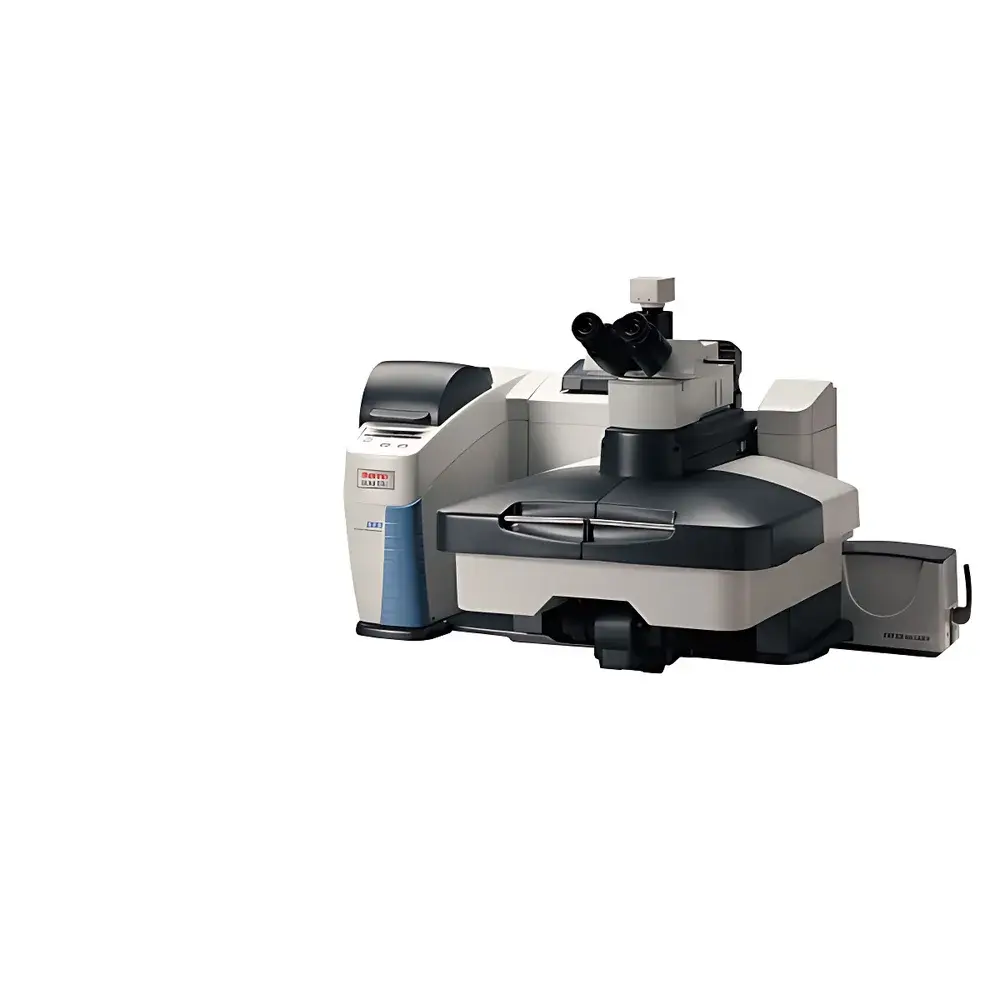
Thermo Fisher DXR3xi Micro-Raman Imaging Spectrometer
| Brand | Thermo Fisher |
|---|---|
| Origin | USA |
| Manufacturer | Thermo Fisher Scientific |
| Type | Imported Instrument |
| Model | DXR3xi |
| Instrument Category | Confocal Micro-Raman Spectrometer |
| Spectral Range | 50–9000 cm⁻¹ |
| Spectral Resolution | 1 cm⁻¹ |
| Spatial Resolution | 350 nm |
| Excitation Wavelength | 455 nm (optional lasers available) |
| Spectral Reproducibility | ±0.1 cm⁻¹ |
Overview
The Thermo Fisher DXR3xi Micro-Raman Imaging Spectrometer is a high-performance confocal Raman microscope engineered for precision chemical imaging and spatially resolved molecular characterization. Built upon a robust optical platform integrating a research-grade inverted or upright microscope with a high-throughput spectrograph and thermoelectrically cooled CCD detector, the system operates on the principle of inelastic light scattering—where monochromatic laser excitation induces vibrational mode shifts in molecular bonds, generating a fingerprint-like Raman spectrum unique to each chemical species. Its confocal architecture enables depth-sectioning capability with sub-micron axial resolution, making it ideal for layered materials, thin films, particulates, and heterogeneous samples. Designed for both routine quality control and advanced academic research, the DXR3xi delivers quantitative spectral fidelity across the full range of 50–9000 cm⁻¹ with <1 cm⁻¹ resolution and ±0.1 cm⁻¹ long-term wavenumber stability—critical for comparative spectral libraries, polymorph identification, and stress/strain mapping in crystalline lattices.
Key Features
- Automated optical alignment and wavelength calibration—no manual tools or external reference standards required; self-correcting optics ensure consistent spectral accuracy over time.
- Tool-free modular configuration: Rapid interchange of excitation lasers (e.g., 455 nm, 532 nm, 633 nm, 785 nm), edge filters, and diffraction gratings via intuitive software-guided hardware recognition.
- Real-time parameter optimization: Live preview of spectral intensity, focus quality, and signal-to-noise ratio directly on the acquisition interface before data collection begins.
- High-precision motorized XYZ stage with autofocus algorithm optimized for rough or tilted surfaces—enabling reproducible focal plane tracking during large-area chemical mapping.
- Class I laser safety certified microscope body; optional fiber-coupled modules and external probes classified as Class 3B—requiring appropriate laser safety eyewear and administrative controls per ANSI Z136.1 and IEC 60825-1.
- Integrated OMNIC™xi software with embedded chemometric tools (PCA, cluster analysis, spectral unmixing) and batch-processing workflows compliant with GLP/GMP documentation requirements.
Sample Compatibility & Compliance
The DXR3xi accommodates a broad range of solid, powder, and thin-film specimens—including conductive and insulating materials—without vacuum or conductive coating. Its non-destructive, label-free measurement modality supports regulatory-compliant analysis in pharmaceutical development (aligned with USP , ICH Q5A), materials science (ASTM E1840, ISO 20743), and geological sample screening (ASTM D7218). The instrument’s firmware and OMNIC™xi software support audit trail functionality, electronic signatures, and 21 CFR Part 11 compliance when deployed in regulated environments. All calibration routines are traceable to NIST-traceable Raman shift standards, and spectral reproducibility meets ISO/IEC 17025 validation criteria for analytical instrumentation.
Software & Data Management
OMNIC™xi provides a unified environment for acquisition, processing, visualization, and reporting. It supports multi-modal correlation—overlaying Raman maps with optical microscopy images, AFM topography, or SEM-EDS elemental distributions. Data export conforms to JCAMP-DX and HDF5 formats for third-party analysis (e.g., Python-based scikit-learn pipelines or MATLAB chemometrics). Automated report generation includes metadata embedding (instrument parameters, user ID, timestamp, environmental conditions), digital signature fields, and customizable templates aligned with internal SOPs or external regulatory submissions. Raw spectral datasets are stored with lossless compression and version-controlled metadata tagging to ensure full data provenance and FAIR (Findable, Accessible, Interoperable, Reusable) principles.
Applications
- Nanomaterials: Characterization of carbon nanotubes, graphene layer count, defect density (D/G ratio), and strain distribution in 2D heterostructures.
- Pharmaceuticals: Polymorph screening, API-excipient interaction mapping, counterfeit drug detection, and coating uniformity assessment in tablets.
- Materials Science: Phase identification in alloys and ceramics, residual stress analysis in welds and coatings, and degradation monitoring in polymer composites.
- Geosciences: Mineral phase discrimination in thin sections, fluid inclusion analysis, and microfossil organic content profiling.
- Academic Research: In situ reaction monitoring, electrochemical interface studies, and biological tissue sectioning with molecular histopathology correlation.
FAQ
What laser wavelengths are supported natively on the DXR3xi?
The base configuration includes a 455 nm diode laser; optional integrated lasers include 532 nm, 633 nm, and 785 nm—all automatically recognized and calibrated by OMNIC™xi upon installation.
Is the system compatible with external detectors or custom spectrometers?
No—the DXR3xi is a fully integrated turnkey platform; its spectrograph, detector, and optical train are factory-aligned and not designed for third-party detector substitution.
Can OMNIC™xi generate reports compliant with FDA submission requirements?
Yes—when configured with audit trail, electronic signature, and user access control modules, OMNIC™xi meets 21 CFR Part 11 technical and procedural criteria for regulated laboratories.
What is the minimum spot size achievable under confocal conditions?
At 455 nm excitation and with optimal objective selection (e.g., 100× oil immersion), the lateral resolution is specified at ≤350 nm, consistent with diffraction-limited performance.
Does the system support time-resolved or kinetic Raman measurements?
While not a dedicated transient spectrometer, the DXR3xi supports rapid single-spectrum acquisition (down to ~10 ms per spectrum) and sequential mapping for quasi-static process monitoring, such as thermal degradation or solvent evaporation kinetics.




