
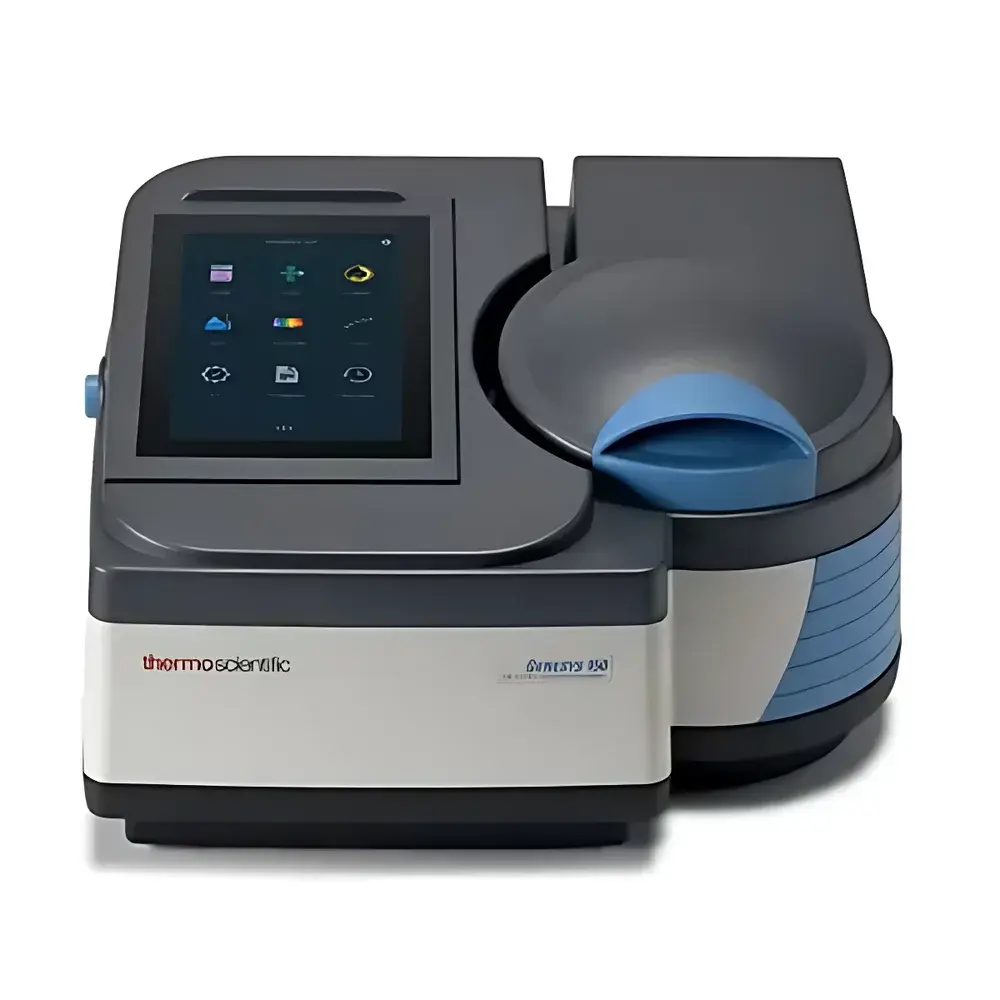
Thermo Fisher GENESYS™ 140/150 UV-Visible Spectrophotometer
| Brand | Thermo Fisher |
|---|---|
| Origin | Shanghai, China |
| Manufacturer Type | Authorized Distributor |
| Product Origin | Domestic (China) |
| Model | GENESYS™ 140/150 UV-Visible Spectrophotometer |
| Pricing | Available Upon Request |
| Display | 7-inch high-resolution capacitive touch screen |
| Connectivity | Built-in Ethernet |
| Ambient Light Tolerance | Yes — designed for operation with sample compartment open |
| Sample Compartment | Removable, washable base with magnetic positioning and retention |
| Max Cuvette Pathlength | 100 mm |
| Optional Accessories | 8-cell auto-changer, 4-cell changer (for long-path cuvettes), Peltier-controlled single-cuvette holder (20–60 °C) |
Overview
The Thermo Fisher GENESYS™ 140/150 UV-Visible Spectrophotometer is a dual-wavelength-range benchtop instrument engineered for quantitative absorbance, transmittance, and concentration measurements across the ultraviolet (190–350 nm) and visible (350–1100 nm) spectral regions. Utilizing a fixed-grating monochromator with a tungsten-halogen lamp (visible) and deuterium arc lamp (UV), the system delivers stable photometric performance with high wavelength accuracy (±1.0 nm) and repeatability (±0.2 nm). Its optical design incorporates a low-stray-light double-beam architecture, enabling real-time reference compensation and minimizing baseline drift during extended acquisitions. The instrument is calibrated traceably to NIST-traceable standards and supports both single-beam and ratio-mode operation—ideal for routine QC verification, kinetic assays, and spectral scanning in regulated and academic environments.
Key Features
- 7-inch high-resolution capacitive touchscreen interface with intuitive icon-driven navigation—no external PC required for method execution or data review.
- Onboard method storage (up to 200 user-defined methods), including preconfigured templates for DNA/RNA quantification (A260/A280), protein assays (Bradford, BCA), and enzyme kinetics (time-scan mode).
- Integrated data management: direct export of spectra, tables, and reports to USB flash drives in CSV, PDF, and XML formats; supports timestamped audit trails compliant with GLP documentation requirements.
- Robust sample compartment design: magnetically secured, removable stainless-steel base allows rapid cleaning and accommodates cuvettes from 10 mm to 100 mm pathlength without re-alignment.
- Ambient light tolerance validated per ASTM E275—enables reliable measurement under typical laboratory lighting conditions, even with the lid open during sample loading or alignment checks.
- Optional temperature-controlled accessories include a Peltier-based single-cuvette holder (20–60 °C, ±0.2 °C stability) and motorized multi-cell changers (4-position and 8-position), supporting thermal stability studies and high-throughput screening workflows.
Sample Compatibility & Compliance
The GENESYS™ 140/150 accepts standard 12.5 × 12.5 mm square cuvettes, round 16 mm OD cells, and macro cells up to 100 mm pathlength. All optical surfaces use fused silica windows and precision-aligned quartz optics to ensure UV transmission integrity. The system meets IEC 61010-1 safety standards and complies with electromagnetic compatibility (EMC) requirements per EN 61326-1. For regulated laboratories, onboard software supports 21 CFR Part 11–compatible user authentication, electronic signatures (via optional network integration), and immutable audit logs—including operator ID, method version, date/time stamps, and raw spectral metadata. It is routinely deployed in ISO/IEC 17025-accredited testing labs and fulfills method validation criteria outlined in USP , EP 2.2.25, and ASTM E169–22.
Software & Data Management
Instrument control and data analysis are fully embedded within the firmware—no proprietary desktop software installation is required. The onboard OS provides real-time spectral visualization, peak detection, derivative analysis, and multi-point calibration (linear, quadratic, and cubic). Data files include full spectral metadata (wavelength array, detector response, slit width, integration time) and support post-acquisition reprocessing. When connected via Ethernet or optional Wi-Fi adapter, the spectrophotometer appears as a network resource compatible with Thermo Fisher’s Chromeleon™ CDS or third-party LIMS platforms using standard HTTP RESTful APIs. Exported CSV files adhere to ASTM E1421 conventions for spectral data interchange, ensuring interoperability with Python (SciPy), MATLAB, and R-based analytical pipelines.
Applications
This platform serves as a foundational tool in university teaching laboratories for Beer–Lambert law verification, equilibrium constant determination, and spectral identification exercises. In R&D settings, it supports formulation development (e.g., dye stability under thermal stress), catalyst characterization (UV-Vis diffuse reflectance preprocessing), and biopolymer conformational analysis (temperature-dependent denaturation curves). Its reliability in ambient-light conditions makes it suitable for pilot-scale process monitoring stations where environmental controls are limited. Pharmaceutical QC labs use it for excipient purity checks, dissolution profile analysis (per USP ), and raw material identity verification against pharmacopeial reference spectra.
FAQ
Is the GENESYS™ 140/150 compliant with 21 CFR Part 11?
Yes—when deployed on a secure network with role-based user accounts and enabled audit trail logging, it satisfies electronic record and signature requirements for FDA-regulated environments.
Can the instrument perform kinetic measurements?
Yes—it supports time-scan mode with user-defined intervals from 0.1 s to 60 min per point, storing up to 10,000 time points per run.
What is the wavelength accuracy specification?
Wavelength accuracy is ±1.0 nm (as verified with holmium oxide and didymium filters per ASTM E387), with repeatability of ±0.2 nm over 24 hours.
Does it support fiber-optic probe measurements?
No—the optical design is optimized for cuvette-based transmission geometry; fiber coupling is not supported in this configuration.
Is NIST-traceable calibration available?
Yes—factory calibration uses NIST-traceable holmium oxide (UV/VIS) and neutral density filters; users may perform optional recalibration using certified reference materials.






