
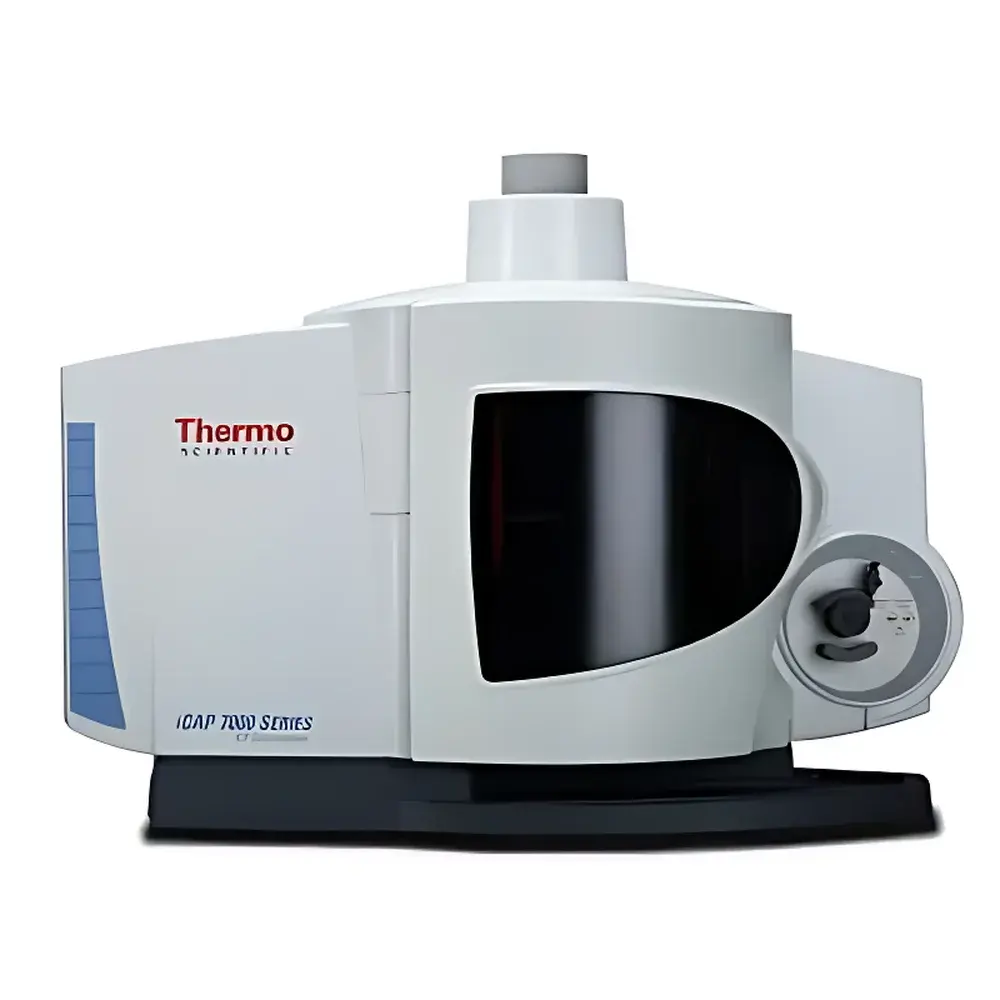
Thermo Fisher iCAP 7000 Series Inductively Coupled Plasma Optical Emission Spectrometer
| Brand | Thermo Fisher |
|---|---|
| Origin | United Kingdom |
| Manufacturer Type | Original Equipment Manufacturer (OEM) |
| Product Origin | Imported |
| Model | iCAP 7000 |
| Instrument Type | Full-Spectrum Simultaneous ICP-OES |
| Price Range | USD 135,000 – 162,000 (estimated FOB UK) |
Overview
The Thermo Fisher iCAP 7000 Series is a full-spectrum simultaneous inductively coupled plasma optical emission spectrometer (ICP-OES) engineered for high-precision elemental analysis across diverse sample matrices. Operating on the fundamental principle of atomic emission spectroscopy, the instrument atomizes and excites sample aerosols within a high-temperature argon plasma (~6,000–10,000 K), causing constituent elements to emit characteristic wavelengths of ultraviolet and visible light. A high-resolution echelle optical system coupled with a back-thinned, deep-depletion charge-coupled device (CCD) detector captures the entire spectral range (130–850 nm) simultaneously—enabling true multi-element detection without sequential wavelength scanning. Designed and manufactured in the United Kingdom by Thermo Fisher Scientific, the iCAP 7000 series integrates robust plasma source architecture, optimized nebulization efficiency, and intelligent thermal management to deliver exceptional signal stability, low background noise, and high signal-to-noise ratios—critical for trace-level quantification down to sub-ppt levels in complex environmental, pharmaceutical, and industrial samples.
Key Features
- Full-spectrum simultaneous detection: Captures all elemental emission lines in a single exposure, eliminating dwell-time penalties and enabling rapid multi-element analysis (≤1 minute per sample).
- Compact footprint: The smallest form factor among commercially available benchtop ICP-OES systems, optimized for space-constrained laboratories without compromising optical path length or resolution.
- Enhanced Matrix Tolerance (EMT) plasma torch: Features a unique quartz torch geometry and optimized gas flow dynamics to minimize polyatomic interferences and sustain stable plasma operation with high-dissolved-solid-content samples (e.g., brines, digested soils, pharmaceutical excipients).
- Modular, tool-free sample introduction: Interchangeable nebulizers (e.g., MicroMist, SeaSpray), spray chambers (cyclonic, Scott-type), and peristaltic pump tubing allow rapid configuration for aqueous, organic, or high-salt matrices—all with automatic pneumatic gas-line recognition and pressure calibration.
- Integrated RF generator with real-time impedance matching: Delivers stable 1.5 kW output power with <±0.1% frequency regulation, ensuring consistent plasma energy delivery across variable sample loads and extended operational cycles.
Sample Compatibility & Compliance
The iCAP 7000 supports liquid, solid (via laser ablation), and semi-solid (slurry) sample introduction. It complies with ASTM D1976, ISO 11885, USP /, and EPA Methods 200.7, 200.8, and 6010E for regulated environmental and pharmaceutical testing. Its hardware and software architecture support GLP/GMP compliance requirements—including audit-trail-enabled user authentication, electronic signatures, and secure data archiving—as validated under FDA 21 CFR Part 11 guidelines when deployed with Qtegra ISDS in controlled environments.
Software & Data Management
Qtegra Intelligent Scientific Data Solution (ISDS) serves as the unified control and processing platform. It provides method-driven workflows—from automated calibration curve generation and internal standard correction to matrix-matched standard addition and interference correction algorithms (e.g., VUV background subtraction, line-ratio deconvolution). Pre-validated application methods for soil digestion, drinking water, catalyst leachates, and biological fluids reduce method development time by >70%. All raw spectra, processed results, and instrument logs are stored in an encrypted, timestamped database with configurable retention policies and export to LIMS via ASTM E1384-compliant XML or CSV formats.
Applications
The iCAP 7000 delivers reliable quantitative analysis of over 70 elements—including alkali metals, transition metals, rare earths, and metalloids—in applications such as: monitoring trace heavy metals (As, Cd, Pb, Hg) in wastewater per EU Directive 2000/60/EC; verifying elemental impurities in active pharmaceutical ingredients (APIs) per ICH Q3D; characterizing catalyst composition in petrochemical R&D; quantifying nutritional minerals (Ca, Mg, Fe, Zn) in fortified foods; and performing geochemical fingerprinting of geological samples via LA-ICP-OES coupling. Its speed, precision (RSD <0.5% at 10× detection limit), and robustness make it suitable for both routine QC laboratories and academic research settings requiring high-throughput elemental screening.
FAQ
What sample introduction options are supported?
Aqueous solutions via concentric glass or PFA nebulizers; organic solvents using specialized vaporization chambers; solid samples via integrated laser ablation (with optional NWR imageLA or UP213 systems); and slurries using high-efficiency cyclonic chambers.
Does the system support regulatory compliance for pharmaceutical testing?
Yes—when configured with Qtegra ISDS v3.5+, it meets 21 CFR Part 11 requirements for electronic records and signatures, including role-based access control, audit trail logging, and secure data export protocols required for USP validation.
How does the EMT torch improve analysis of high-matrix samples?
The EMT torch design increases plasma robustness through optimized argon sheath gas flow and tapered injector geometry, reducing carbon deposition and oxide formation while maintaining excitation efficiency—enabling direct analysis of seawater, acid digests with >20% HNO₃, and digested biomass without dilution.
Is spectral interference correction automated?
Yes—Qtegra ISDS includes real-time, user-configurable interference correction using multi-line fitting, background modeling, and empirical correction factors derived from certified reference materials.
What maintenance intervals are recommended for routine operation?
Nebulizer and torch cleaning every 8–10 hours of plasma runtime; CCD detector temperature calibration monthly; RF matching network verification quarterly; and full optical alignment annually—per Thermo Fisher’s Preventive Maintenance Schedule (PMS-ICP7K-EN).




