
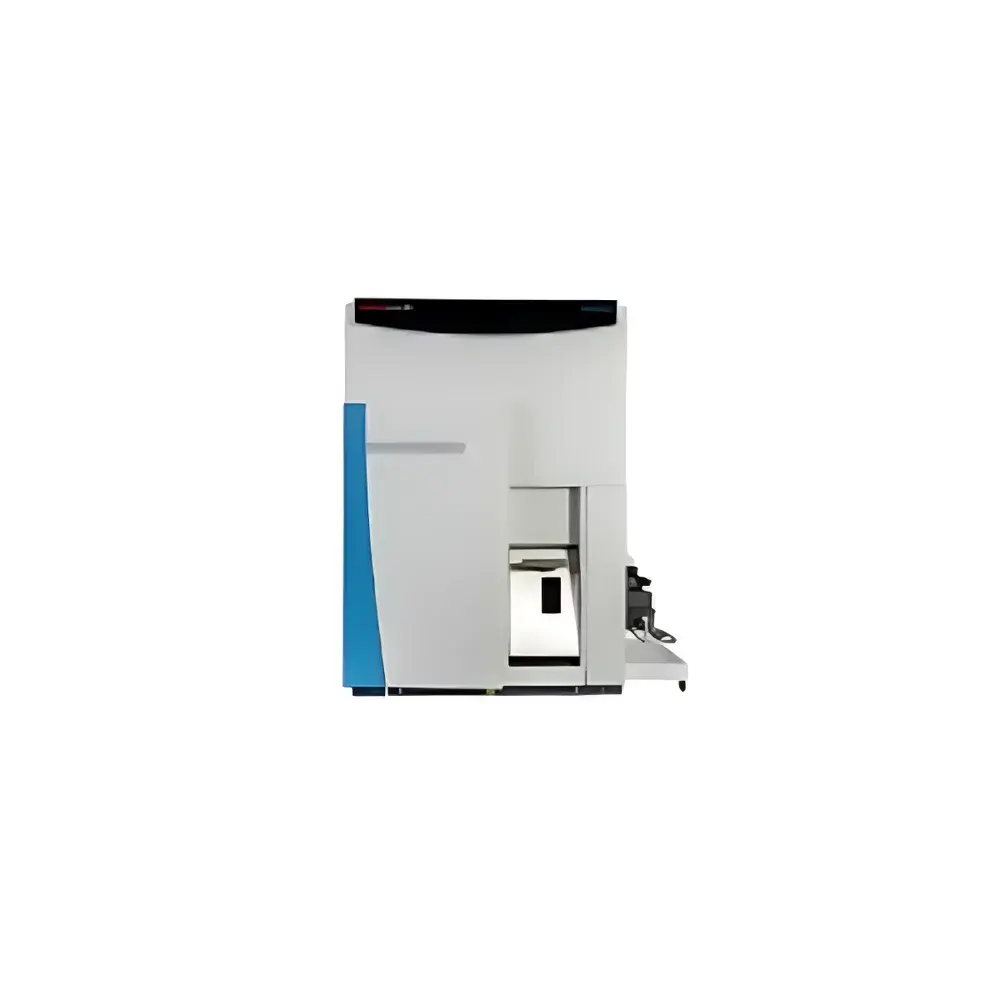
Thermo Fisher iCAP MSX Single-Quadrupole Inductively Coupled Plasma Mass Spectrometer
| Brand | Thermo Fisher |
|---|---|
| Origin | Shanghai, China |
| Manufacturer Type | Authorized Distributor |
| Regional Classification | Domestic (China-manufactured) |
| Model | iCAP MSX |
| Configuration | Single-Quadrupole ICP-MS |
| Energy Efficiency | Enhanced power management & reduced standby consumption |
| Packaging | FSC-certified materials, minimal plastic, recyclable transport crates |
| Unit Size | Each |
Overview
The Thermo Fisher iCAP MSX is a single-quadrupole inductively coupled plasma mass spectrometer engineered for high-sensitivity elemental analysis across diverse sample matrices—including environmental waters, geological digests, clinical biofluids, and semiconductor-grade reagents. It operates on the fundamental principle of ionizing analytes in a high-temperature Ar plasma (~7,000–10,000 K), followed by mass separation via a robust, temperature-stabilized flat-plate quadrupole mass filter and detection using a high-gain electron multiplier. Unlike multi-collector or triple-quadrupole configurations, the iCAP MSX prioritizes operational simplicity, rapid method deployment, and consistent quantitative performance for routine laboratories performing regulatory-compliant trace metal analysis (e.g., EPA Method 200.8, ISO 17294-2, ASTM D5673). Its plasma interface features an optimized ion optics path with low-pressure collision cell technology—enabling effective removal of polyatomic interferences (e.g., 40Ar16O+, 40Ar12C+) through kinetic energy discrimination (KED) in helium mode without compromising sensitivity for mid-to-high mass elements.
Key Features
- QCell collision/reaction cell with single-mode He-KED operation for selective interference removal while maintaining >80% transmission efficiency for isotopes above m/z 70
- Flat-plate quadrupole design with active thermal stabilization, delivering mass resolution ≤0.75 amu (10% valley) and long-term mass calibration stability (<±0.05 amu over 24 h)
- Automated sample introduction system featuring self-tightening peristaltic pump tubing, auto-aligned torch-to-sampler gas connections, and motorized torch positioning for reproducible plasma coupling
- Front-access ion optics chamber with tool-free interface door, enabling cone cleaning in <90 seconds without venting the vacuum system
- Intelligent consumables monitoring: real-time tracking of torch life, cone hours, and detector usage with configurable alerts aligned to GLP-mandated maintenance logs
- Energy-efficient architecture compliant with IEC 62301:2011 (standby power <0.5 W) and shipped in responsibly sourced, fully recyclable packaging
Sample Compatibility & Compliance
The iCAP MSX accommodates liquid samples introduced via standard nebulizers (e.g., PFA microflow, Meinhard A3) and supports integration with laser ablation (LA-ICP-MS) and hydride generation (HG-ICP-MS) accessories. It meets key regulatory requirements for environmental and food testing laboratories, including full alignment with US EPA 200.8 validation criteria for detection limits (sub-femtogram levels for Cd, Pb, U), linear dynamic range (>108), and precision (RSD <3% at 10× method detection limit). Data integrity is supported by audit-trail-enabled software compliant with FDA 21 CFR Part 11 and EU Annex 11 for electronic records and signatures.
Software & Data Management
Controlled by Thermo Scientific Qtegra Intelligent Scientific Data Solution (ISDS) v3.5+, the platform provides template-driven workflow automation—from instrument startup and tuning to calibration curve generation and QC reporting. All method parameters, raw spectra, and processing steps are stored in a relational database with immutable timestamps and user-authenticated change logs. Export formats include ASTM E1382-compliant .csv, .xlsx, and .cdf (netCDF) for LIMS integration. Optional modules support automated isotope ratio drift correction and certified reference material (CRM) matching against NIST SRM databases.
Applications
- Regulatory environmental testing: quantification of As, Cd, Cr, Hg, Pb, U in drinking water, wastewater, and soil extracts per ISO 17294-2 and EPA 200.8
- Geochemical fingerprinting: multi-element analysis of rock digests and sediment cores for rare earth element (REE) patterns and provenance studies
- Pharmaceutical quality control: residual catalyst screening (e.g., Pd, Pt, Rh) in APIs per ICH Q2(R2) guidelines
- High-purity material certification: sub-ppt detection of metallic impurities in electronic-grade acids and silicon wafers
- Clinical research: longitudinal monitoring of essential/toxic elements (e.g., Se, Zn, Al) in serum and urine cohorts
FAQ
Does the iCAP MSX support reaction gas modes (e.g., NH3, O2) in the QCell?
No—the QCell is configured exclusively for helium KED mode; it does not support reactive gas chemistry.
Is the instrument compatible with external laser ablation systems?
Yes, via standard ICP-MS interface protocols (e.g., TTL synchronization, analog voltage input for ablation timing); compatible with most commercial 193 nm and 213 nm Nd:YAG LA systems.
What vacuum system architecture is used?
Dual-stage turbomolecular pumping: 300 L/s primary pump for the interface region and 70 L/s secondary pump for the mass analyzer chamber, achieving base pressure <5×10⁻⁸ mbar.
Can method files be transferred between iCAP RQ and iCAP MSX platforms?
No—method compatibility is limited to same-generation iCAP MSX instruments due to hardware-specific tuning parameter mapping.
What is the recommended maintenance interval for sampler and skimmer cones?
Under typical aqueous matrix usage (10% HNO3 digests), cones require cleaning every 40–60 operating hours; lifetime exceeds 500 hours with proper matrix matching and regular KED optimization.
Related Products




