
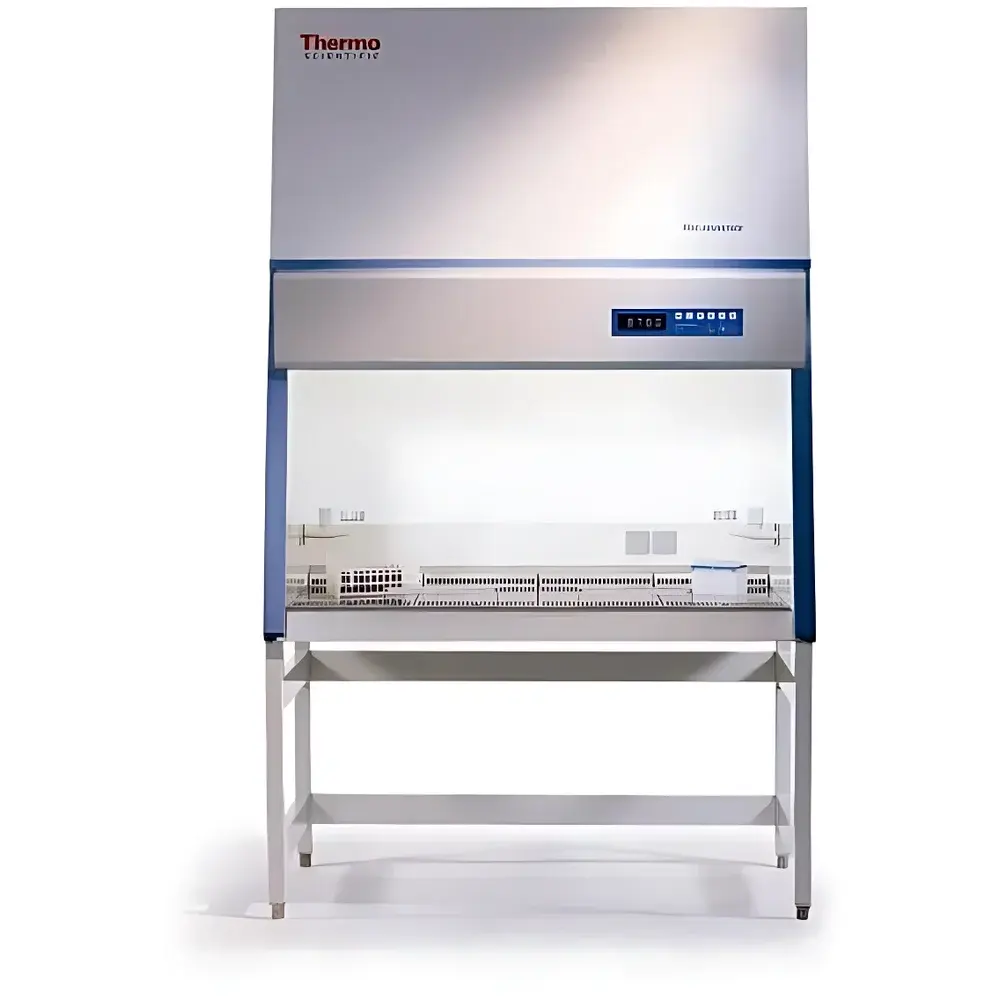
Thermo Fisher MSC-Advantage Class II Biological Safety Cabinet
| Brand | Thermo Fisher |
|---|---|
| Origin | Germany |
| Manufacturer | Yes |
| Import Status | Imported |
| Model | MSC-Advantage |
| Instrument Type | Class II Biological Safety Cabinet |
| External Dimensions (L×W×H) | 1300 × 1580 × 870 mm |
| Internal Dimensions (L×W×H) | 1200 × 780 × 630 mm |
| Filter Efficiency | >99.999% for 0.3 µm particles |
Overview
The Thermo Fisher MSC-Advantage is a certified Class II, Type A2 biological safety cabinet engineered for precision containment of low-to-moderate risk biological agents (BSL-1 to BSL-2+). It operates on the principle of laminar airflow combined with dual-fan, dual-path air management—30% of total air volume is exhausted externally via dedicated ducting, while 70% is recirculated through a high-efficiency particulate air (HEPA) filter after passing through the work area. This configuration ensures simultaneous operator protection, product protection, and environmental protection in accordance with ISO 14644-1 Class 5 (ISO Class 5) cleanroom-equivalent conditions within the work chamber. Designed and manufactured in Germany, the MSC-Advantage complies fully with EN 12469:2000—the European standard governing performance, construction, and testing requirements for biological safety cabinets—and meets IEC 61010-1 and EN 61010-1 for electrical safety in laboratory equipment.
Key Features
- Dual independent DC brushless motors: One drives the downward (inflow) airstream; the other controls the horizontal (recirculation/exhaust) airflow—enabling real-time, autonomous regulation of face velocity and downflow velocity without cross-interference.
- Redundant dual-sensor sash position monitoring: Two independent optical or capacitive sensors continuously verify sash height; if one fails, the system defaults to a fail-safe sash position and triggers an audible/visual alarm.
- Energy-optimized operation: Achieves up to 60% lower power consumption and thermal output (260 W heat dissipation at 25 °C) versus conventional Class II cabinets, enabled by intelligent fan modulation and zero-leak vacuum-sealed side walls.
- Full-height sliding sash: Allows operators to lower the tempered, explosion-resistant glass sash to forearm level—facilitating full interior decontamination from outside the protected zone without head entry.
- Integrated UV timer and remote alarm interface: Supports scheduled UV irradiation cycles and transmits status alerts (e.g., sash deviation, airflow anomaly, filter saturation) via dry-contact or Ethernet-enabled outputs for lab-wide monitoring systems.
- Vacuum-bonded side panels: Seamless, hole-free construction eliminates potential leakage paths—even under mechanical impact—ensuring integrity of the negative-pressure containment envelope.
Sample Compatibility & Compliance
The MSC-Advantage supports routine handling of cell cultures, primary tissues, recombinant DNA constructs, and low-risk viral vectors. Its work area (1800 × 495 × 780 mm) accommodates standard biosafety workflows including pipetting, centrifugation (with compatible mini-centrifuges), and sterile transfers. All structural and aerodynamic performance parameters are validated per EN 12469 Annex B test protocols—including inflow velocity mapping (≥0.50 m/s at 200 mm sash opening), downflow uniformity (±15% across work surface), and HEPA filter leak testing (DOP/PAO scan at ≤0.01% penetration). Certification documentation includes CE marking, conformity to EU Machinery Directive 2006/42/EC, and compliance with GLP-relevant operational traceability requirements.
Software & Data Management
The embedded microcontroller provides continuous logging of critical operational parameters—including real-time inflow/downflow velocity, cumulative UV lamp hours, total runtime, sash position history, and fault codes—with timestamped entries stored in non-volatile memory. Data export is supported via USB port (CSV format) for integration into LIMS or quality management systems. The control interface displays Performance Evaluation Report (PER) metrics aligned with EN 12469-defined pass/fail thresholds, supporting internal audit readiness and FDA 21 CFR Part 11–compliant electronic records when paired with institutional authentication protocols.
Applications
- Aseptic preparation of mammalian and insect cell culture media and reagents
- Handling of genetically modified organisms (GMOs) requiring BSL-2 containment
- Preparation of clinical diagnostic specimens prior to PCR or sequencing workflows
- Pharmaceutical QC microbiology—media fill simulations and sterility testing support
- Training environments where ergonomic access and repeatable containment validation are essential
FAQ
What certification standards does the MSC-Advantage meet?
It is fully compliant with EN 12469:2000, IEC 61010-1, and EN 61010-1, and carries CE marking for use in EU laboratories.
Can the cabinet operate safely with the sash fully closed?
Yes—when fully closed, the downflow automatically reduces to 30% of nominal velocity, maintaining filter integrity and enabling rapid restart without recalibration.
Is external ducting required?
For Type A2 operation, hard-ducted exhaust is mandatory; however, the unit supports optional thimble connection or dedicated roof-mounted blower configurations.
How often must the HEPA filters be replaced?
Filter service intervals depend on usage intensity and ambient particulate load; typical replacement occurs every 3–5 years, verified via annual certified airflow and integrity testing.
Does the MSC-Advantage support connectivity to building management systems (BMS)?
Yes—via configurable relay outputs and Modbus RTU over RS-485, enabling integration with centralized HVAC and alarm infrastructure.




