
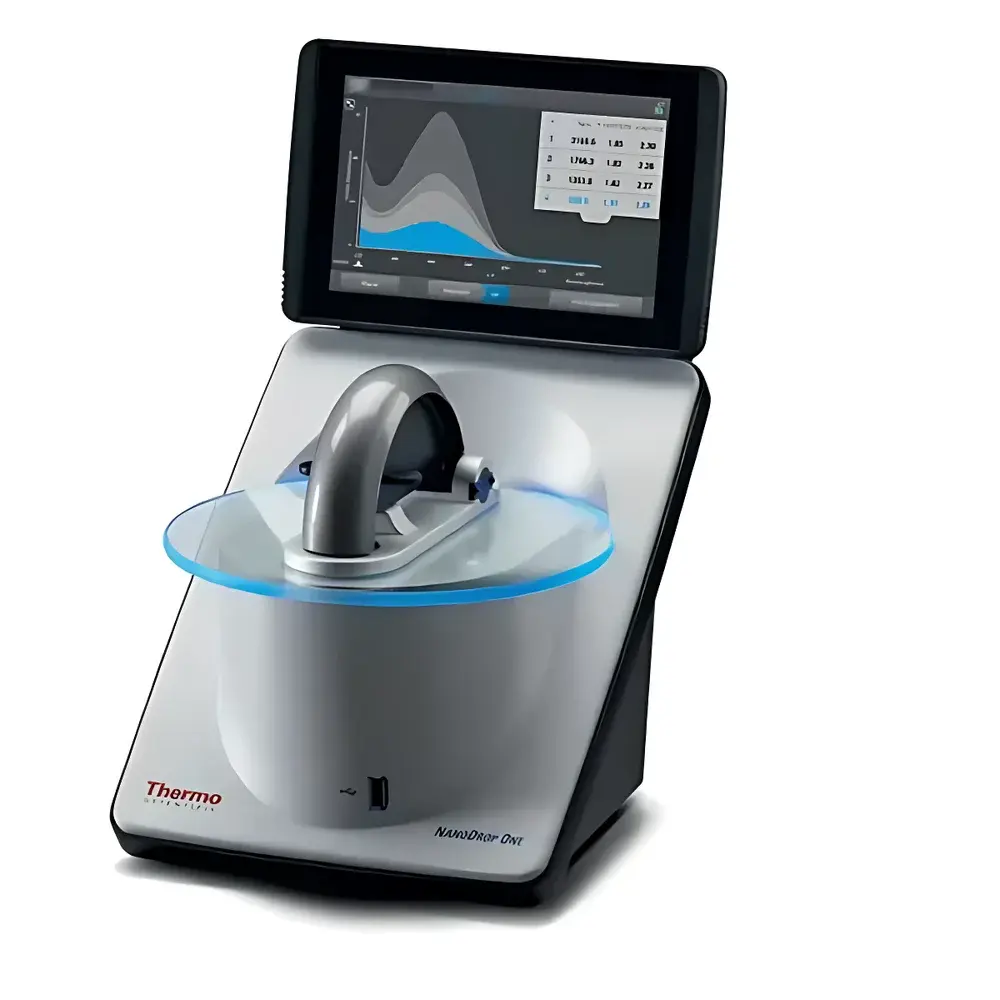
Thermo Fisher NanoDrop™ One/OneC Microvolume UV-Vis Spectrophotometer
| Brand | Thermo Fisher |
|---|---|
| Origin | Shanghai, China |
| Manufacturer Type | Authorized Distributor |
| Country of Origin | China |
| Model | NanoDrop™ One/OneC |
| Price | Upon Request |
| Certifications | CE, UL/CSA |
| Connectivity | 3× USB-A, Ethernet, Bluetooth™, Wi-Fi (OneC only) |
| Detector | 2048-pixel CMOS linear image sensor |
| Display | 7″ HD color touchscreen (1280 × 800 px) |
| Light Source | Xenon flash lamp |
| Spectral Bandwidth | ≤1.8 nm FWHM (at Hg 254 nm) |
| Wavelength Range | 190–850 nm |
| Optical Path | Auto-adjusting from 0.030 to 1.0 mm |
| Absorbance Accuracy | ±3% at 0.97 A, 302 nm (25°C, Abs/mm) |
| Absorbance Range (10-mm equivalent) | 0–550 A (microvolume base), 0–1.5 A (cuvette) |
| Measurement Time | 8 seconds |
| Repeatability | ±0.002 A or 1% CV (whichever is greater |
| Sample Temperature Control | 37°C (cuvette mode only) |
| Power Consumption | 12–18 W (operational), 5 W (standby) |
| Weight | 3.6 kg (7.9 lb) |
| Dimensions (L×W×H) | 20 × 25.4 × 32.3 cm (8 × 10 × 12.7 in.) |
| Supported Languages | English, French, German, Spanish, Polish, Chinese, Japanese, Korean |
| Compatible Peripherals | DYMO LabelWriter 450 printer, Bluetooth keyboard/mouse, barcode scanner |
| Applications | Nucleic acid quantification (A260, A260/A280, A260/A230), labeled nucleic acids, protein A280/A205, Pierce 660, Bradford, BCA, Lowry assays, OD600, kinetic studies, custom UV-Vis methods |
Overview
The Thermo Fisher NanoDrop™ One/OneC Microvolume UV-Vis Spectrophotometer is a benchtop analytical instrument engineered for rapid, accurate, and reagent-free quantification and quality assessment of nucleic acids and proteins using microvolume absorbance spectroscopy. It operates on the principle of surface tension–mediated sample retention—where 1–2 µL of undiluted sample is suspended between an optical pedestal and a fiber optic probe—enabling direct measurement across a broad spectral range (190–850 nm) without cuvettes or capillaries. This design eliminates dilution errors, minimizes sample consumption, and delivers high reproducibility with an auto-adjusting optical path (0.030–1.0 mm). The integrated xenon flash lamp provides stable, pulsed illumination with ≤1.8 nm spectral bandwidth (FWHM at 254 nm), ensuring compliance with fundamental photometric requirements outlined in ISO 8579-1 and ASTM E275 for spectrophotometric performance verification.
Key Features
- Microvolume measurement capability (1–2 µL) with no sample dilution or cuvette required
- Auto-ranging optical pathlength (0.030–1.0 mm) dynamically optimized per measurement
- High-resolution 2048-pixel CMOS linear array detector for precise spectral acquisition
- 7-inch capacitive multi-touch HD display (1280 × 800 px) with intuitive Android™-based interface
- Dual-mode operation: microvolume pedestal (for concentrated samples) and optional cuvette holder with temperature control (37°C)
- Integrated Wi-Fi and Bluetooth™ (NanoDrop OneC model) for secure wireless data export and peripheral pairing (e.g., DYMO LabelWriter 450, barcode scanners)
- Comprehensive pre-configured assay library—including nucleic acid purity ratios (A260/A280, A260/A230), six protein quantification methods (A280, A205, Pierce 660, Bradford, BCA, Lowry), OD600, kinetics, and custom method development
- CE and UL/CSA certified; designed to support GLP/GMP workflows through audit-trail–enabled software logging (user actions, timestamps, method parameters, raw spectra)
Sample Compatibility & Compliance
The NanoDrop One/OneC accommodates a wide range of biomolecular samples without dilution: dsDNA (detection limit: 2.0 ng/µL on pedestal; 0.2 ng/µL in cuvette), RNA, oligonucleotides, modified nucleic acids (e.g., fluorescently labeled probes), and proteins including IgG, BSA, and complex lysates. Its optical architecture meets the essential performance criteria defined in ISO/IEC 17025 for testing laboratories, and its firmware supports data integrity features aligned with FDA 21 CFR Part 11 requirements—including electronic signatures, user access controls, and immutable measurement records. All instruments undergo factory calibration traceable to NIST-standard reference materials, and routine verification can be performed using supplied quartz cuvettes and standard solutions per USP and EP 2.2.25 guidelines.
Software & Data Management
Powered by an embedded Android™ operating system, the NanoDrop One/OneC runs Thermo Fisher’s proprietary NanoDrop One Software v3.x, which enables full method customization, real-time spectral visualization, batch processing, and automated report generation (PDF/CSV). Data are stored locally on-device and can be exported via USB, network share, or cloud-synced repositories (e.g., Thermo Fisher Connect platform) with configurable encryption and role-based permissions. Audit trails capture every user interaction—including method edits, sample ID entry, and result overrides—with timestamped, non-erasable logs compliant with ALCOA+ principles (Attributable, Legible, Contemporaneous, Original, Accurate, Complete, Consistent, Enduring, Available). Instrument connectivity supports integration into LIMS environments via HL7 or RESTful API endpoints (available via optional software license).
Applications
- Quantification and purity assessment of genomic DNA, plasmid preps, PCR products, and RNA isolates
- Routine QC of oligonucleotide synthesis and CRISPR guide RNAs
- Protein concentration determination in purified fractions, cell lysates, and ELISA standards
- Monitoring thermal denaturation profiles and ligand-binding kinetics (via time-resolved A280 or A260 acquisition)
- Verification of dye labeling efficiency (e.g., Cy3/Cy5, FITC) using extinction coefficient–based calculations
- Cell culture density estimation (OD600) with built-in turbidity correction algorithms
- Custom UV-Vis method development for small molecules, nanoparticles, and polymer solutions
FAQ
Does the NanoDrop One/OneC require routine lamp replacement?
No—the xenon flash lamp is rated for over 10 years of typical laboratory use (≥1 million flashes) and requires no scheduled maintenance.
Can I validate instrument performance in-house?
Yes—built-in validation routines include wavelength accuracy checks (using mercury emission lines), photometric linearity verification (neutral density filters), and baseline stability tests—all documented in the included IQ/OQ protocol templates.
Is the NanoDrop One/OneC compatible with regulated environments (e.g., pharmaceutical QC)?
Yes—when deployed with Thermo Fisher’s NanoDrop Compliance Pack (optional), it supports 21 CFR Part 11 compliance, including electronic signatures, audit trail review, and secure user authentication.
What is the difference between NanoDrop One and OneC models?
The OneC includes integrated Wi-Fi and Bluetooth™ hardware; the One model supports only wired Ethernet and USB connectivity.
How does the instrument handle viscous or detergent-containing samples?
Surface tension–dependent sample retention may be compromised with >0.1% SDS or >10% glycerol; in such cases, cuvette mode with temperature-controlled measurement (37°C) is recommended for improved reproducibility.





