
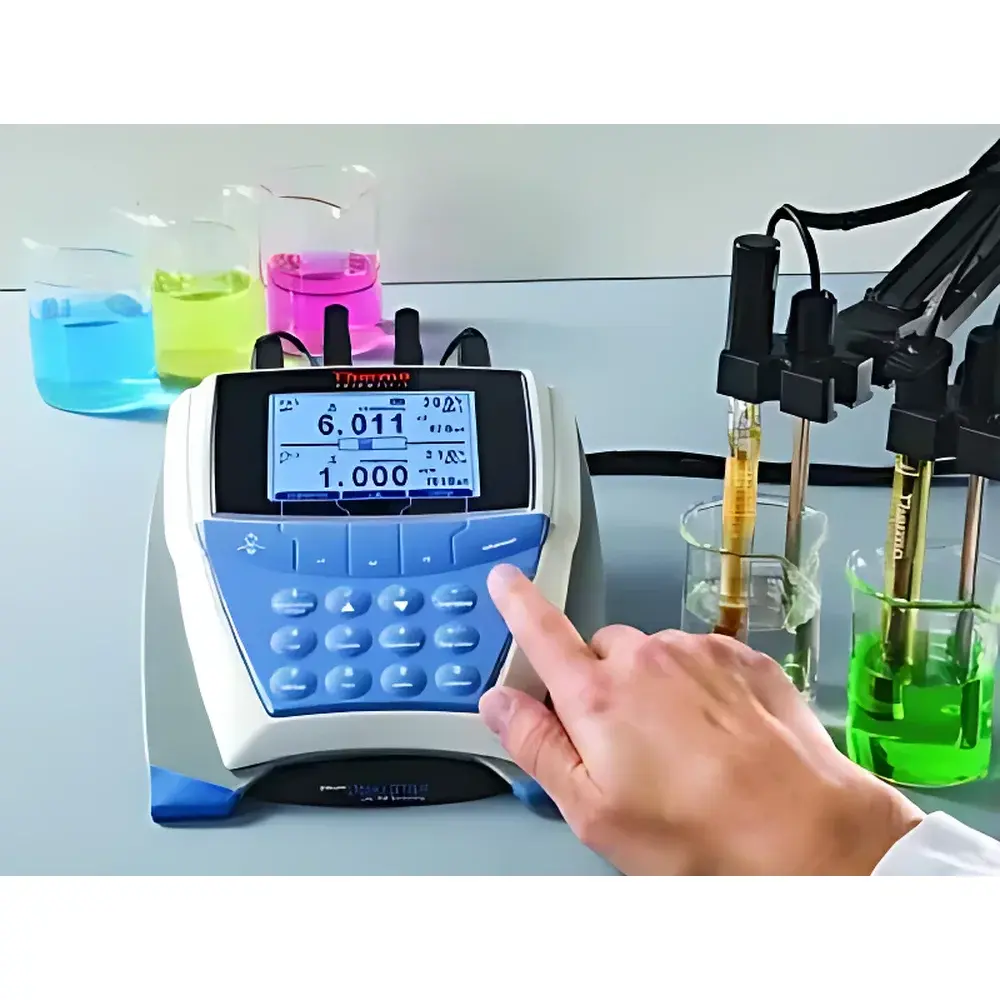
Thermo Fisher Orion Dual Star Ammonia Nitrogen Analyzer
| Brand | Thermo Fisher |
|---|---|
| Origin | USA |
| Manufacturer | Thermo Fisher Scientific |
| Product Type | Imported Instrument |
| Model | Dual Star |
| Pricing | Available Upon Request |
| Ammonia Electrode | 9512BNWP |
| Measurement Range | 0.01–17,000 ppm (as N) |
| Temperature Range | 0–50 °C |
| Electrode Slope | −54 to −60 mV/decade (at 25 ± 4 °C, ΔT < ±1 °C between solutions) |
| Repeatability | ±2% |
| Ion Concentration Resolution | 1–3 significant digits |
| pH Range | −2.000 to 19.999 |
| pH Accuracy | ±0.001 |
| ORP Range | ±1999.9 mV |
| Temperature Accuracy | ±0.1 °C |
| Data Storage | 1000 sets with timestamp |
| GLP Compliance | Yes |
| Communication | RS232 and optional USB |
| Enclosure Rating | IP54 |
| Certifications | CE, CSA, UL, TÜV, FCC Class A |
Overview
The Thermo Fisher Orion Dual Star Ammonia Nitrogen Analyzer is a dual-channel benchtop ion concentration and pH meter engineered for precise, interference-resistant quantification of ammonia nitrogen (NH₃-N) in environmental, wastewater, and drinking water samples. It operates on the potentiometric principle using a gas-sensing ammonium-selective electrode (9512BNWP), which detects gaseous NH₃ liberated from alkaline sample solutions across a hydrophobic membrane. Unlike colorimetric methods—such as Nesslerization or salicylate spectrophotometry—the electrode-based approach eliminates dependence on hazardous reagents (e.g., mercury-containing Nessler reagent), avoids complex pre-treatment steps (e.g., distillation or masking agents), and remains unaffected by sample turbidity, color, or common interferents including Fe²⁺, Mn²⁺, Ca²⁺, Mg²⁺, and volatile amines. This enables direct, rapid analysis of raw or lightly filtered aqueous matrices with measurement linearity spanning four orders of magnitude: 0.01 to 17,000 ppm NH₃-N.
Key Features
- Dual-channel architecture with independent BNC, reference electrode, and MiniDIN temperature inputs—enables simultaneous measurement of ammonia nitrogen and pH, or co-analysis of two distinct ions (e.g., NH₄⁺ and Cl⁻) using compatible ISEs.
- Integrated support for multiple ion-selective electrodes—including fluoride, nitrate, potassium, sodium, cyanide, bromide, and chloride—facilitating cross-parameter validation and multi-analyte workflows within a single platform.
- Advanced calibration routines: 2–6 point standardization with automatic buffer recognition (US, NIST, DIN), known-addition/subtraction, sample-addition/subtraction, and automated blank correction—ensuring robustness across variable matrix compositions.
- High-resolution display showing real-time ion name, concentration (in ppm, mg/L, M, or %), mV potential, and temperature—optimized for laboratory traceability and method verification.
- GLP-compliant data management: password-protected method storage (up to 10 per channel), time-stamped data logging (1000 entries), audit-ready calibration history, and configurable user access levels.
- Field-upgradable firmware via USB interface; graphical calibration curve visualization; compatibility with automated samplers for unattended batch analysis.
Sample Compatibility & Compliance
The Dual Star system accommodates a broad range of aqueous environmental samples—including raw sewage, treated effluent, surface water, groundwater, and industrial process streams—without mandatory filtration or distillation in most cases. The 9512BNWP electrode requires only pH adjustment to ≥11.5 (using NaOH) and addition of ionic strength adjuster (ISA) to minimize activity coefficient variation. Interference from high concentrations of dissolved CO₂ or volatile organic amines is mitigated through optimized sample equilibration time and controlled stirring rate. The instrument meets key regulatory and quality framework requirements: full compliance with ISO 7888 (water quality—determination of ammonium—electrode method), ASTM D1426 (standard test methods for nitrogen in water), and US EPA Method 350.1 (ammonia—ion selective electrode). Its GLP functionality—including electronic signature support, secure method locking, and full audit trail—supports validation under 21 CFR Part 11 when paired with compliant software and network infrastructure.
Software & Data Management
Data acquisition and reporting are managed through the instrument’s embedded firmware, supporting bidirectional RS232 communication for integration with LIMS or custom lab software. All stored measurements include date/time stamps, electrode ID, calibration status, operator ID (if enabled), and environmental conditions (temperature, mV). Exported datasets are ASCII-formatted for direct import into Excel, statistical packages (e.g., JMP, Minitab), or validated laboratory informatics systems. Firmware updates preserve calibration memory and user-defined methods. Optional Thermo Fisher TraceFinder™ or Orion Star™ Com software extends capabilities to automated report generation, statistical trend analysis, and multi-instrument fleet monitoring—all aligned with ISO/IEC 17025 documentation requirements.
Applications
- Regulatory compliance testing for municipal wastewater discharge permits (e.g., NPDES) and drinking water standards (e.g., WHO, EPA, EU Directive 98/83/EC).
- Process control in biological nutrient removal (BNR) systems, where real-time NH₄⁺ feedback informs nitrification/denitrification optimization.
- Research applications in limnology, aquaculture, and soil leachate studies requiring high-precision, low-detection-limit ammonium profiling.
- Educational laboratories seeking a teachable, maintenance-light platform for electrochemical sensor principles and water quality parameter interrelationships.
- Industrial hygiene monitoring of ammonia in cooling tower water, boiler feedwater, and semiconductor rinse baths.
FAQ
What sample preparation is required prior to ammonia nitrogen measurement?
Minimal preparation is needed: adjust sample pH to ≥11.5 with NaOH, add ionic strength adjuster (ISA), and allow 1–2 minutes for NH₃ equilibration. Filtration is recommended only for highly suspended or viscous samples.
Can the Dual Star measure both ammonia nitrogen and pH simultaneously?
Yes—the dual-channel design allows concurrent connection of the 9512BNWP ammonia electrode and a pH electrode, with synchronized readings displayed side-by-side.
How often must the 9512BNWP electrode membrane be replaced?
Typical membrane life is 2–4 weeks under routine use; replacement frequency depends on sample matrix cleanliness and daily usage volume. Each kit (951204) contains 20 membranes.
Is the system compliant with FDA 21 CFR Part 11 for electronic records?
The hardware supports Part 11 elements (audit trail, electronic signatures, role-based access); full compliance requires implementation of validated software, network security controls, and documented SOPs.
What is the lowest detectable concentration for ammonia nitrogen?
The practical detection limit is 0.01 ppm NH₃-N under optimized conditions (low-noise environment, calibrated electrode, stable temperature), verified per ISO 11929 for decision threshold estimation.
Related Products







