
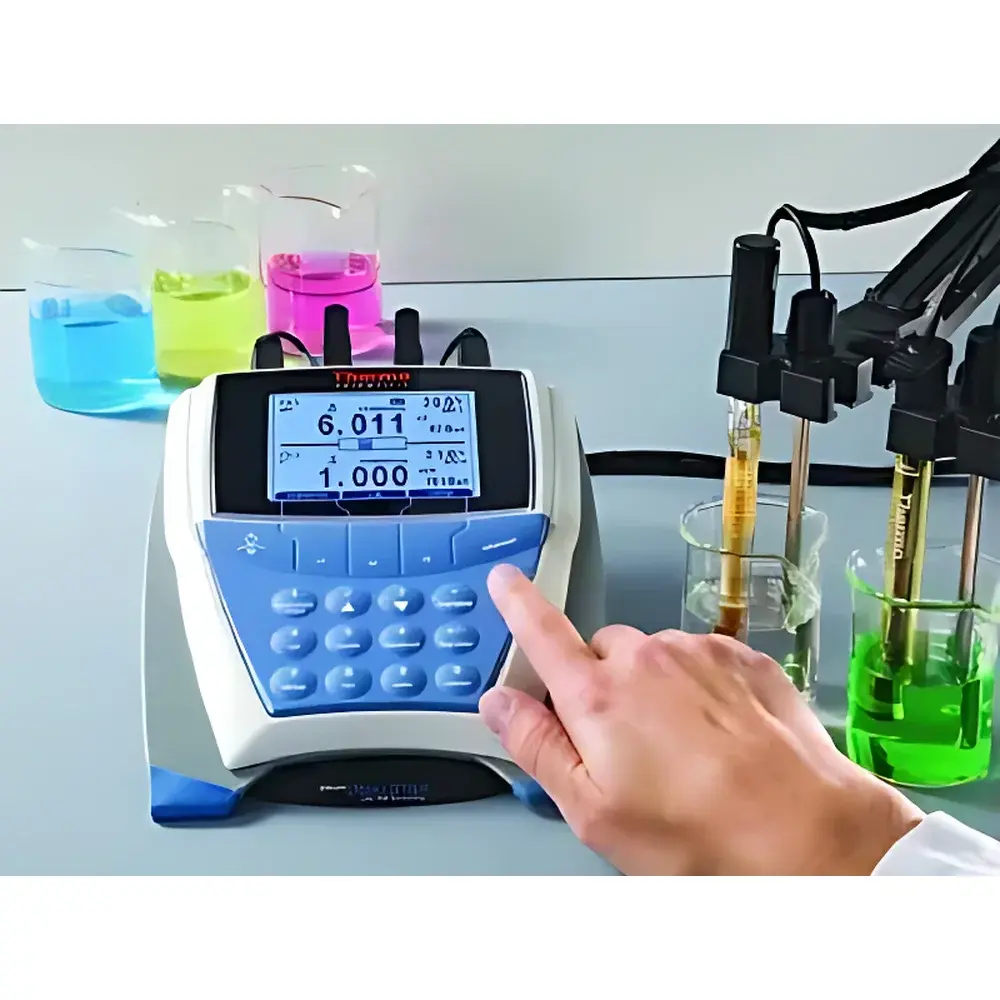
Thermo Fisher Orion Dual Star D10P-16N Silver/Sulfide Ion Concentration Meter
| Brand | Thermo Fisher |
|---|---|
| Origin | USA |
| Manufacturer | Thermo Fisher Scientific |
| Product Type | Imported Instrument |
| Model | D10P-16N |
| Pricing | Upon Request |
| Electrode | 9616BNWP Ag⁺/S²⁻ Combination Electrode |
| Measurement Range (S²⁻) | 0.003–32,100 ppm |
| pH Range | 2–12 |
| Temperature Range | 0–80°C (continuous), 80–100°C (intermittent) |
| Reproducibility | ±4% for S²⁻, ±2% for Ag⁺ |
| Sample Type | Aqueous solutions |
| Electrode Dimensions | 110 mm length × 13 mm body diameter × 16 mm cap diameter |
| Cable Length | 1 m |
| Dual Channel Capability | pH + ISE simultaneously |
| Ion Measurement Range | 0–19,999 units |
| Resolution | 1–3 significant digits |
| Relative Accuracy | ±0.1 mV or ±0.05% (whichever is greater) |
| Units | ppm, mg/L, M, %, or unitless |
| Calibration Points | 2–6 |
| pH Range | −2.000 to 19.999 |
| pH Resolution | 0.1 / 0.01 / 0.001 |
| pH Accuracy | ±0.001 |
| ORP Range | ±1999.9 mV |
| ORP Resolution | 0.1 mV |
| Temperature Range | −5 to 105°C |
| Temperature Accuracy | ±0.1°C (−5 to 99.9°C) |
| Display | Dual-channel LCD |
| Interfaces | Two BNC, two reference electrode ports, two MiniDIN (for ATC probes) |
| Method Storage | 20 user-defined methods |
| Password Protection | Yes |
| Data Storage | 1,000 readings with timestamp |
| GLP Compliance | Yes (audit trail, calibration history, operator ID) |
| Data Transfer | Bidirectional RS232 |
| Enclosure Rating | IP54 |
| Certifications | CE, CSA, UL, TÜV, FCC Class A |
| Operating Environment | 5–45°C, 5–85% RH (non-condensing) |
| Power | 4×AA batteries or universal AC adapter |
| Dimensions | 9.4 cm (H) × 17.0 cm (W) × 22.4 cm (D) |
Overview
The Thermo Fisher Orion Dual Star D10P-16N Silver/Sulfide Ion Concentration Meter is a dual-channel, benchtop potentiometric analyzer engineered for precise, trace-level quantification of sulfide (S²⁻) and silver (Ag⁺) ions in aqueous environmental and industrial samples. It operates on the principle of ion-selective electrode (ISE) potentiometry, where the 9616BNWP Ag⁺/S²⁻ combination electrode generates a Nernstian potential shift proportional to the logarithm of the target ion activity. Due to the extremely low solubility product (Ksp ≈ 6.3 × 10−50) of silver sulfide (Ag₂S), coexistence of free Ag⁺ and S²⁻ in solution is thermodynamically prohibited—making this system uniquely suited for selective, interference-resistant measurement of either ion under controlled redox and pH conditions. The instrument integrates a built-in temperature-compensated reference system and supports rigorous electrochemical protocols including standard addition (single/dual), sample addition/subtraction, and automatic blank correction—essential for accurate analysis in complex matrices such as wastewater, groundwater, leachates, and process streams.
Key Features
- Dual-channel architecture with independent BNC inputs, reference electrode ports, and ATC (Automatic Temperature Compensation) interfaces—enabling simultaneous pH and ISE measurements without cross-channel interference.
- High-stability 9616BNWP solid-state Ag⁺/S²⁻ combination electrode with integrated double-junction reference, optimized for low-conductivity and high-sulfide environments.
- Comprehensive GLP compliance: full audit trail with operator ID, method versioning, calibration history, and timestamped data logging for 1,000 entries.
- Graphical calibration curve display with real-time slope monitoring and Nernstian deviation alerts—supporting validation per ISO 17025 and EPA Method 377.1 requirements.
- Advanced method management: up to 20 stored methods, password-protected access per channel, and individual calibration memory for up to 10 electrodes per channel.
- Robust environmental rating (IP54) and safety certifications (CE, UL, CSA, TÜV, FCC Class A) ensuring reliability in regulated laboratory and field-deployable settings.
- Flexible data handling via bidirectional RS232 interface; optional USB connectivity for firmware updates and secure data export compliant with FDA 21 CFR Part 11 when paired with validated software.
Sample Compatibility & Compliance
The D10P-16N is validated for use with natural waters, municipal and industrial effluents, sediment pore waters, and digested sludge extracts. Its operational pH range (2–12) accommodates both acidic mine drainage and alkaline treatment effluents. For sulfide analysis, the system requires stabilization using Thermo Fisher’s SAOB II (Sulfide Antioxidant Buffer) to prevent oxidation of S²⁻ to elemental sulfur or polysulfides—a critical step aligned with ASTM D3777-22 and APHA Standard Methods 4500-S²⁻ E. Silver ion measurements comply with EPA Method 7196A and ISO 11047:2021 for metal speciation in water. All accessories—including 900061 (S²⁻-optimized fill solution), 941609 (5M NaNO₃ ionic strength adjuster), and 948206 (0.1 M Pb(ClO₄)₂ precipitant)—are manufactured under ISO 9001 quality systems and supplied with CoA documentation.
Software & Data Management
Data acquisition and reporting are structured around traceable, auditable workflows. Each stored reading includes date/time stamp, electrode ID, calibration status, temperature, mV potential, calculated concentration, and method identifier. The instrument supports direct export to CSV or LIMS-compatible formats via RS232. When connected to Thermo Fisher’s Orion LogR software (optional), users gain enhanced features: automated calibration report generation, statistical trend analysis across batches, outlier detection using Grubbs’ test, and electronic signature capability for 21 CFR Part 11 compliance. Firmware updates preserve all stored methods and calibration records, ensuring continuity during regulatory inspections.
Applications
- Regulatory compliance monitoring for sulfide discharge limits under Clean Water Act (CWA) NPDES permits.
- Process control in metal recovery facilities—tracking Ag⁺ concentration in cyanide leachates prior to electrowinning.
- Corrosion inhibitor evaluation in cooling water systems, where sulfide-induced pitting is a primary failure mode.
- Research on anaerobic biogeochemistry, including sulfate-reducing bacterial activity in wetland sediments.
- Validation of sulfide removal efficiency in iron-based adsorption or precipitation treatment trains.
- Support for USP and Ph. Eur. 2.2.39 monographs requiring quantitative sulfide assessment in pharmaceutical excipients.
FAQ
Can the D10P-16N measure sulfide and silver simultaneously in the same sample?
No—due to the instantaneous precipitation of Ag₂S (Ksp = 6.3 × 10−50), free Ag⁺ and S²⁻ cannot coexist at measurable concentrations. Separate analyses under controlled redox conditions are required.
Is temperature compensation mandatory for sulfide measurements?
Yes—Nernst slope varies with temperature, and sulfide hydrolysis equilibria (e.g., HS⁻/H₂S) are highly temperature-dependent. The integrated ATC ensures accurate activity-to-concentration conversion per ISO 5667-3.
What is the minimum detectable sulfide concentration with the 9616BNWP electrode?
Under optimal conditions (pH 10–12, SAOB II stabilization, low ionic strength), the practical detection limit is ~0.003 ppm (3 µg/L) S²⁻, consistent with EPA Method 377.1 performance criteria.
Does the instrument support Good Laboratory Practice (GLP) documentation requirements?
Yes—full GLP functionality includes operator login, method locking, calibration verification logs, and immutable data timestamps—all exportable for internal QA review or external audit.
Can the D10P-16N be integrated into an automated sampling system?
Yes—the RS232 interface supports command-driven operation and synchronization with third-party autosamplers (e.g., Gilson XYZ series) via ASCII protocol, enabling unattended batch analysis of up to 96 samples.







