
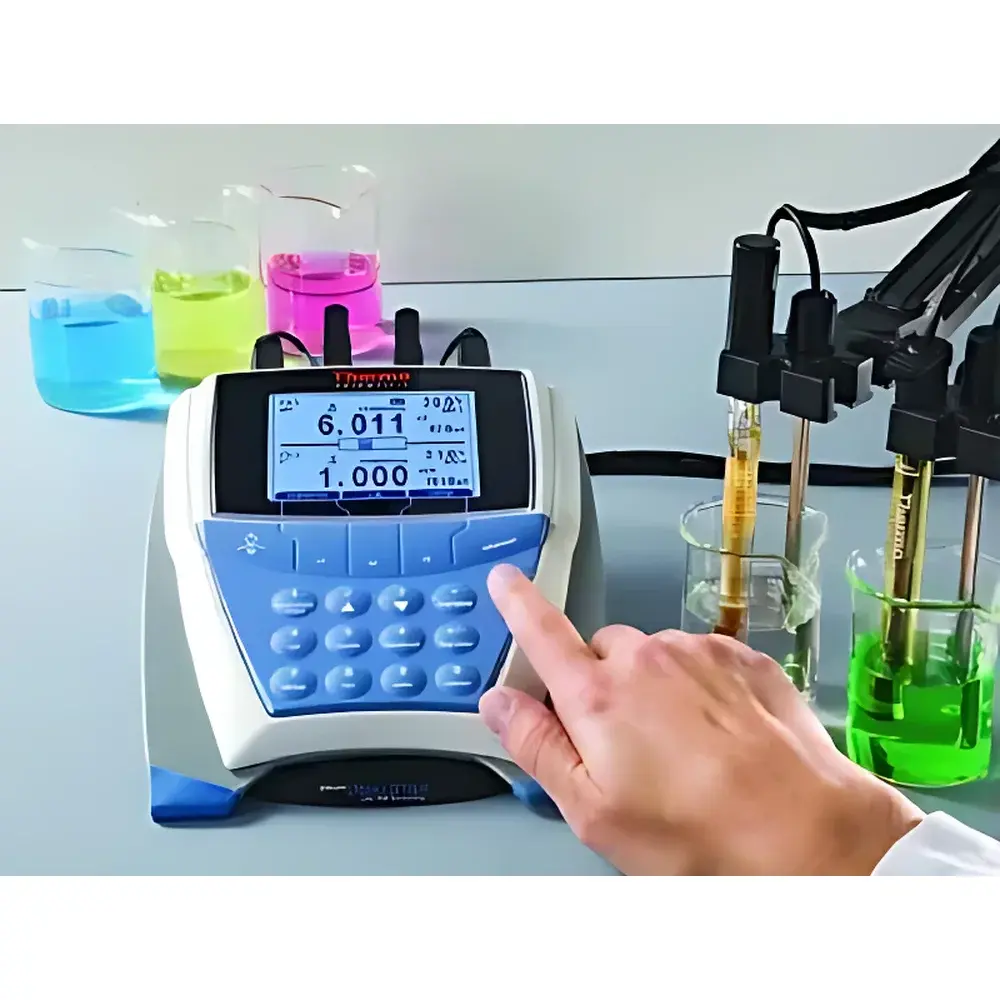
Thermo Fisher Orion Dual Star D10P-26 Cyanide Ion Analyzer
| Brand | Thermo Fisher |
|---|---|
| Origin | USA |
| Manufacturer Type | Original Equipment Manufacturer (OEM) |
| Product Category | Imported Instrument |
| Model | D10P-26 |
| Pricing | Available Upon Request |
| Electrode | 9606BNWP Cyanide Ion-Selective Electrode |
| Measuring Range (Cyanide) | 0.2–260 ppm |
| pH Range | 0–14 |
| Temperature Range | 0–80 °C |
| Repeatability | ±2% |
| Electrode Dimensions | Length 110 mm, Body Diameter 13 mm, Cap Diameter 16 mm, Cable Length 1 m |
| Main Unit Ion Concentration Range | 0–19999, Resolution: 1–3 significant digits, Accuracy: ±0.1 mV or ±0.05% (whichever is greater) |
| pH Range | −2.000 to 19.999, Resolution: 0.1/0.01/0.001, Accuracy: ±0.001 pH |
| ORP Range | ±1999.9 mV, Resolution: 0.1 mV |
| Temperature Measurement | −5 to 105 °C, Accuracy: ±0.1 °C |
| Data Storage | 1000 sets with timestamp |
| GLP Compliance | Yes |
| Connectivity | Dual RS232 (bidirectional), optional USB |
| Enclosure Rating | IP54 |
| Certifications | CE, CSA, UL, TÜV, FCC Class A |
Overview
The Thermo Fisher Orion Dual Star D10P-26 Cyanide Ion Analyzer is a benchtop dual-channel potentiometric measurement system engineered for precise, trace-level quantification of free and total cyanide in aqueous environmental and industrial samples. It operates on the principle of ion-selective electrode (ISE) potentiometry—specifically utilizing the 9606BNWP solid-state cyanide-selective electrode—which generates a Nernstian potential response proportional to the logarithm of cyanide activity in solution. Unlike colorimetric or spectrophotometric methods, this electrochemical approach eliminates interference from turbidity, colored matrices, or suspended solids, delivering robust performance across complex wastewater, surface water, leachate, and plating bath samples. The instrument complies with EPA Method 335.4 and ASTM D7282 for cyanide determination and supports both direct measurement and standardized addition techniques required for regulatory reporting under Clean Water Act (CWA) and RCRA compliance frameworks.
Key Features
- Dual-channel architecture with independent BNC, reference electrode, and ATC (Automatic Temperature Compensation) inputs—enabling simultaneous pH and cyanide monitoring or concurrent analysis of two different ions (e.g., CN⁻ and F⁻) without manual reconfiguration.
- Integrated support for standardized addition methodologies: single and double known-addition, single and double known-subtraction, and sample-addition/subtraction modes—essential for accurate quantification in low-ionic-strength or high-matrix samples where liquid junction potential errors dominate.
- Advanced GLP functionality including user-accessible password protection per method, audit-trail-capable data logging (date/time stamped), and electronic signature-ready storage—fully aligned with FDA 21 CFR Part 11 requirements when paired with compliant LIMS integration.
- Graphical calibration curve display with real-time slope and intercept diagnostics; automatic blank compensation and electrode drift correction algorithms enhance long-term measurement stability.
- High-resolution LCD with dual-parameter readout showing cyanide concentration (ppm or mg/L), mV potential, temperature, and ion name—all simultaneously—reducing operator interpretation error during field or lab workflows.
- Rugged IP54-rated enclosure suitable for humid laboratory or mobile environmental testing environments; powered by rechargeable AA batteries or universal AC adapter for uninterrupted operation during extended sampling campaigns.
Sample Compatibility & Compliance
The D10P-26 system is validated for use with natural waters, treated effluents, groundwater, industrial process streams, and hazardous waste leachates. Sample pretreatment—including distillation per EPA 414.1 or acid digestion per Standard Methods 4500-CN⁻ E—is required for total cyanide analysis. The 9606BNWP electrode exhibits minimal interference from common anions (Cl⁻, NO₃⁻, SO₄²⁻) and cations (Ca²⁺, Mg²⁺) at typical environmental concentrations. All hardware and firmware meet ISO/IEC 17025:2017 metrological traceability requirements when operated within specified temperature (5–45 °C) and humidity (5–85% RH, non-condensing) limits. Device certification includes CE (EMC & LVD), UL 61010-1, CSA C22.2 No. 61010-1, TÜV Rheinland, and FCC Class A emissions compliance.
Software & Data Management
Data acquisition and reporting are managed via built-in non-volatile memory storing up to 1000 measurement records with full metadata: date, time, operator ID, method name, electrode serial number, calibration history, and raw mV values. Export is supported via bidirectional RS232 interface (with optional USB-to-RS232 adapter) to spreadsheet-compatible formats (.csv) or LIMS platforms. Firmware updates are performed over USB using Thermo Fisher’s Orion Star Com software, which also enables remote method configuration, calibration archive review, and certificate-of-analysis generation. All stored data include GLP-compliant electronic signatures, user-defined access levels, and tamper-evident timestamps—meeting audit readiness criteria for ISO 17025-accredited laboratories and EPA-certified testing facilities.
Applications
- Regulatory compliance monitoring for cyanide discharge limits under NPDES permits and state-specific water quality standards.
- Wastewater treatment plant process control—real-time tracking of cyanide removal efficiency across oxidation, precipitation, and biological treatment units.
- Hazardous waste site characterization and landfill leachate monitoring per RCRA Subpart CC requirements.
- Electroplating and metal finishing industry QC—verification of rinse water and spent bath cyanide residuals prior to neutralization or recovery.
- Environmental forensics and emergency response—rapid field-deployable screening of suspected cyanide contamination in soil pore water or surface runoff.
- Academic and research applications involving ligand-binding studies, complexation kinetics, and speciation modeling of cyanometallic compounds.
FAQ
What sample preparation is required for total cyanide analysis?
Total cyanide requires distillation pretreatment per EPA Method 335.4 or ASTM D7282 to liberate metal-bound cyanide species prior to ISE measurement.
Can the D10P-26 be used for on-site field measurements?
Yes—the instrument’s battery operation, IP54 rating, and integrated temperature compensation enable reliable use in mobile labs or near-point-of-collection sampling locations.
Does the 9606BNWP electrode require frequent recalibration?
Calibration is recommended before each analytical batch and after electrode cleaning or prolonged storage; typical stability allows 8–12 hours of continuous use between calibrations under controlled conditions.
Is the system compatible with automated samplers?
Yes—via RS232 command protocol, the D10P-26 integrates with third-party auto-samplers for unattended multi-sample analysis sequences.
How does the instrument handle low-conductivity samples?
The system includes programmable ionic strength adjustment (ISA) mode and supports addition of 10 M NaOH ISA (951011) to stabilize liquid junction potential and ensure Nernstian response in deionized or rainwater matrices.
Related Products







