
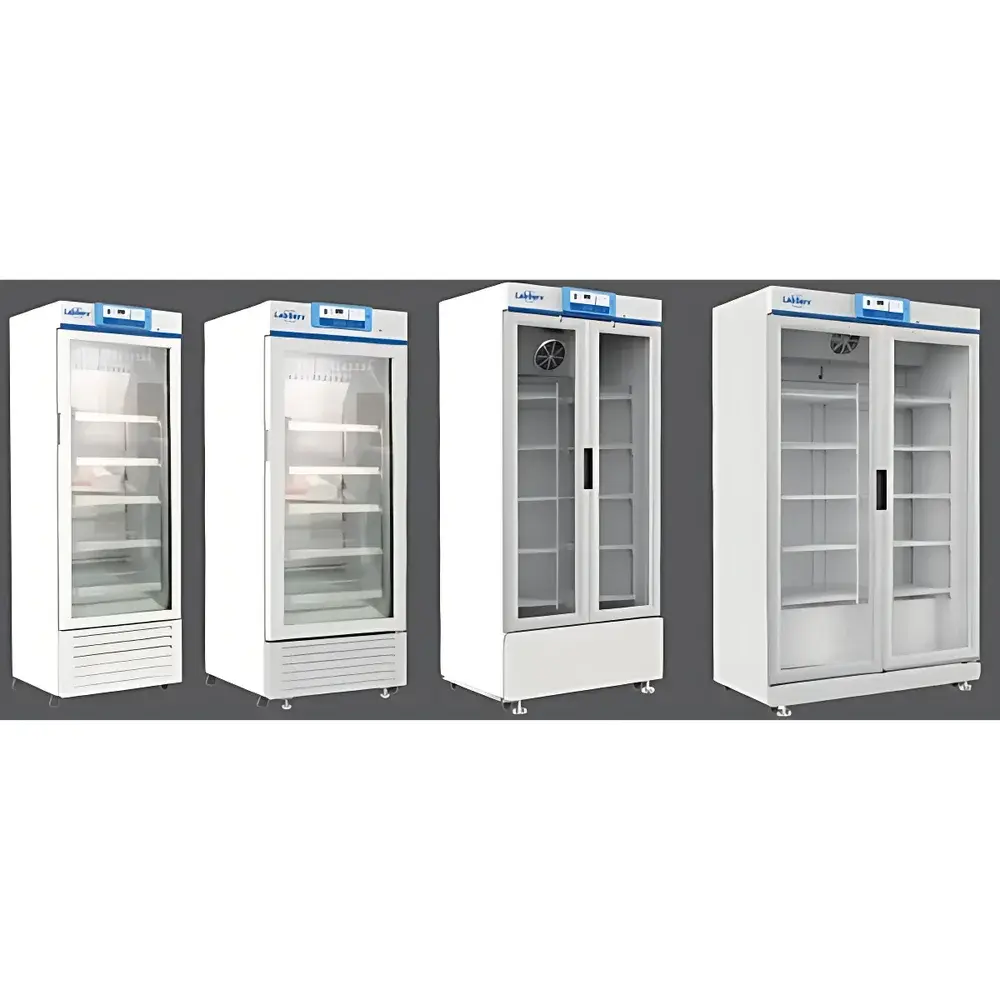
Thermo Fisher PL8300 Series Inverter-Controlled Laboratory Refrigerators and Freezers
| Brand | Thermo Fisher |
|---|---|
| Model | PL8300 Series |
| Temperature Ranges | +2 °C to +8 °C (Refrigerator), −20 °C (Freezer) |
| Refrigerant | Hydrocarbon (R600a) |
| Compressor | Imported Inverter Compressor |
| Evaporator & Condenser | Copper-Fin Tube Design |
| Insulation | High-Density Polyurethane Foam with Cyclopentane Blowing Agent |
| Fan System | German EBM EC Fans (Evaporator & Condenser) |
| Noise Level | <50 dB(A) (Refrigerator), <52 dB(A) (Freezer) |
| Sensor Configuration | 6-Channel Independent Temperature Monitoring (e.g., Left/Right, Top/Middle/Bottom) |
| Alarms | High/Low Temperature, Sensor Failure, Power Failure, Door Ajar |
| Data Interface | USB Port (PDF Export), Optional RS485 |
| Certifications | Compliant with IEC 61000-6-3 (EMC), IEC 61000-6-2 (Immunity), ISO 13485-aligned Design Controls |
| Standard Features | Heated Glass Door (Refrigerator), Auto-Evaporating Drain Pan, LED Interior Lighting (Switchable), Adjustable Shelves/Drawers, Casters + Leveling Feet, Anti-Icing Heater (Freezer Door Seal) |
| Optional Accessories | Padlock Kit, Thermal Printer Module |
Overview
The Thermo Fisher PL8300 Series comprises purpose-engineered inverter-controlled laboratory refrigerators (+2 °C to +8 °C) and freezers (−20 °C), designed for mission-critical storage of biologics, diagnostic reagents, clinical specimens, environmental samples, and reference standards. Unlike fixed-speed compressor systems, the PL8300 employs a high-efficiency imported inverter compressor that dynamically modulates cooling output in response to thermal load, ambient fluctuations, and door-opening events. This enables precise temperature maintenance with reduced thermal cycling, lower energy consumption (up to 30% less than conventional units per comparable duty cycle), and extended component service life. The system utilizes R600a — a natural hydrocarbon refrigerant with zero ozone depletion potential (ODP = 0) and negligible global warming potential (GWP ≈ 3) — aligned with EU F-Gas Regulation and U.S. EPA SNAP program requirements. All thermal management components — including copper-fin evaporators and condensers, EBM EC fans, and cyclopentane-blown polyurethane insulation — are selected for long-term reliability, low acoustic emission, and minimal thermal bridging.
Key Features
- Inverter-driven compressor technology ensures continuous, stepless capacity modulation for stable chamber temperatures and minimized temperature deviation (±0.5 °C uniformity, ±0.3 °C stability over 24 h under standard test conditions per IEC 60068-3-5).
- Six independent platinum resistance temperature sensors (Pt100) deployed across strategic locations — left/right, top/middle/bottom — enable real-time spatial mapping and intelligent averaging algorithms to suppress localized drift.
- Heated anti-fog glass door (refrigerator model) prevents condensation and maintains optical clarity during high-humidity operation; integrated door seal heater (freezer model) eliminates frost accumulation at gasket interfaces.
- Auto-evaporating condensate pan eliminates manual drainage; switchable LED interior lighting supports visual inspection without thermal intrusion or UV exposure.
- Comprehensive alarm architecture includes configurable audible/visual alerts for temperature excursions, sensor faults, power interruption, door open duration >30 s, and fan failure — all logged with timestamps in non-volatile memory.
- Standard USB interface supports on-device PDF report generation (including min/max/mean temperature, alarm history, and calibration verification data), compliant with basic ALCOA+ data integrity principles.
Sample Compatibility & Compliance
The PL8300 Series meets functional requirements for storing temperature-sensitive life science materials governed by WHO Technical Report Series No. 961 (Annex 9), USP , and ISO 20387:2018 (Biobanking). Its validated thermal performance supports storage of monoclonal antibodies, ELISA kits, PCR master mixes, cell culture media, and frozen plasma aliquots. The unit’s mechanical design adheres to IEC 61010-1 (Safety Requirements for Electrical Equipment for Measurement, Control, and Laboratory Use) and IEC 61326-1 (EMC for Laboratory Equipment). While not pre-certified to 21 CFR Part 11, the system provides foundational traceability features — including user-accessible audit logs, immutable timestamped event records, and exportable PDF reports — facilitating internal validation against GxP and GLP environments.
Software & Data Management
No proprietary software installation is required. Temperature logging occurs autonomously via embedded firmware. All recorded data — including 30-day rolling temperature history (1-min intervals), alarm events, and sensor diagnostics — are accessible via USB mass storage mode. Exported PDFs include digital signatures (SHA-256 hash), device serial number, operator ID field (manually entered), and UTC-synchronized timestamps. Optional RS485 interface enables integration into centralized building management systems (BMS) or LIMS using Modbus RTU protocol (addressable as slave device). Data retention remains local unless manually exported; no cloud connectivity or remote telemetry is implemented by default.
Applications
- Pharmaceutical QC laboratories storing stability-indicating reagents and reference standards under ICH Q5C conditions.
- Academic core facilities maintaining stem cell cryopreservation media, primary antibody stocks, and RNA extraction kits.
- Public health laboratories archiving environmental water samples, serological survey specimens, and vaccine cold chain intermediates.
- Hospital blood banks utilizing the −20 °C freezer for coagulation factor concentrates and platelet lysates.
- Contract research organizations (CROs) requiring auditable, reproducible cold storage for GLP-compliant toxicology studies.
FAQ
Does the PL8300 Series support IQ/OQ/PQ documentation packages?
Yes — Thermo Fisher provides standardized qualification templates (including test protocols, acceptance criteria, and blank execution records) upon request. Installation Qualification (IQ) covers physical attributes and utility connections; Operational Qualification (OQ) verifies alarm functionality, temperature uniformity, and sensor accuracy; Performance Qualification (PQ) is user-executed per defined load configuration and duration.
Can the unit be validated for use in FDA-regulated environments?
The PL8300 is engineered to support regulatory validation. Its deterministic control logic, non-volatile event logging, and exportable audit trails align with FDA guidance on computerized systems (2003) and Annex 11 (EU GMP). Full compliance requires site-specific risk assessment, documented procedures, and periodic requalification.
Is remote monitoring available?
Remote monitoring is not natively supported. However, the optional RS485 port allows integration with third-party SCADA or environmental monitoring systems (EMS) via Modbus RTU, provided the host system implements appropriate security controls and data governance policies.
What is the expected service life of the inverter compressor?
Based on accelerated life testing and field data from analogous Thermo Fisher platforms, the inverter compressor demonstrates a mean time between failures (MTBF) exceeding 60,000 hours under typical laboratory operating conditions (8 h/day, 22 °C ambient, ≤60% RH).
Are calibration certificates included with shipment?
Each unit ships with a factory-as-tested certificate listing initial temperature uniformity and stability results at three load points (empty, 50% load, full load), traceable to NIST-traceable references. UKAS or ISO/IEC 17025-accredited calibration is available as a value-added service.




