
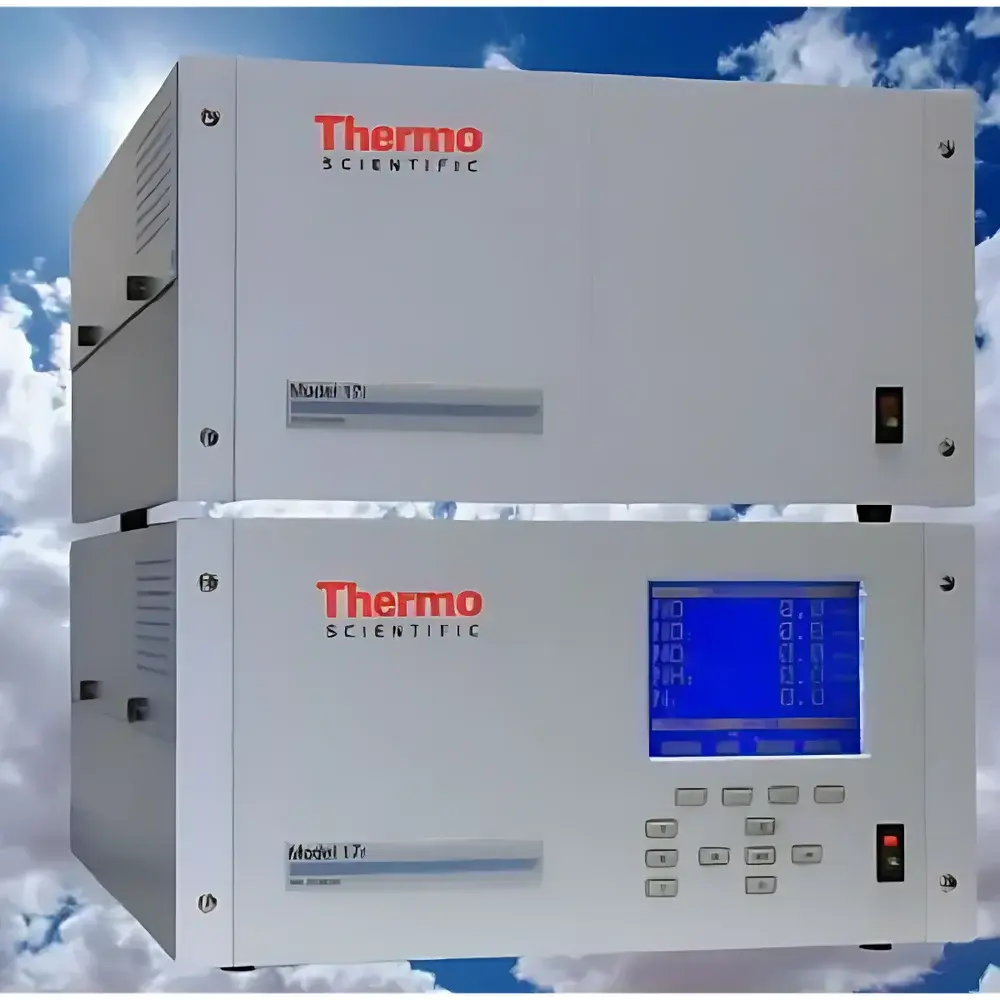
Thermo Fisher Scientific 17i Ammonia (NH₃) Analyzer
| Brand | Thermo Fisher Scientific |
|---|---|
| Origin | USA |
| Model | 17i |
| Instrument Type | Online Gas Analyzer |
| Detection Principle | Chemiluminescence (NO–O₃ Reaction) |
| Measurement Modes | NO, NOₓ, Nₜ |
| NH₃ Quantification Method | Stainless-Steel Catalytic Converter-Based Conversion to NO |
| Output Signals | Analog (0–10 V / 4–20 mA), Digital (Ethernet) |
| Data Storage | Internal Flash Memory |
| Remote Access | Yes, via Local Area Network |
| Compliance | Designed for EPA Reference Method Compliant Monitoring (e.g., EQOA-0038), Supports GLP/GMP Audit Trail Requirements (via optional software logging) |
| Operating Environment | Indoor/Outdoor Enclosure Rated NEMA 4X |
| Power Supply | 100–240 VAC, 50/60 Hz |
| Dimensions | 48.3 cm W × 17.8 cm H × 55.9 cm D (19″ Rack Mountable) |
| Weight | 22.7 kg |
Overview
The Thermo Fisher Scientific 17i Ammonia (NH₃) Analyzer is a high-performance, online chemiluminescence-based gas analyzer engineered for continuous, real-time quantification of ammonia in ambient air, stack emissions, and process streams. It operates on the well-established principle of nitrogen monoxide (NO)–ozone (O₃) chemiluminescence, adapted specifically for selective NH₃ detection through catalytic conversion. In the Nₜ mode, gaseous NH₃ and NO₂ are simultaneously converted to NO over a high-efficiency stainless-steel thermal converter (typically operated at ~650 °C), followed by reaction with ozone in the photomultiplier-equipped reaction chamber. The resulting photon emission—proportional to total reactive nitrogen (Nₜ = NO + NO₂ + NH₃)—is measured with sub-ppb sensitivity. By sequentially acquiring measurements in NO-only and NOₓ (NO + NO₂) modes, the instrument computes NH₃ concentration as the difference: [NH₃] = Nₜ − NOₓ. This differential calculation eliminates cross-interference from background NOₓ and ensures specificity in complex matrices typical of wastewater treatment plants, agricultural facilities, and industrial combustion sources.
Key Features
- Triple-mode operation (NO, NOₓ, Nₜ) enabling simultaneous derivation of NH₃, NO, NO₂, NOₓ, and total reactive nitrogen concentrations
- Dual-converter architecture: Molybdenum-based converter for NO₂-to-NO conversion (NOₓ mode); high-stability stainless-steel converter optimized for both NO₂ and NH₃ conversion (Nₜ mode)
- Ultra-low detection capability: 1 ppb limit of detection (LOD) with 0.5 ppb RMS zero noise (120-s averaging), validated per EPA Performance Specification 2 (PS-2) protocols
- Configurable time constants (0.1–30 s) for dynamic response optimization across varying sampling conditions
- Integrated Ethernet interface supporting remote configuration, real-time data streaming, and secure firmware updates over LAN/WAN
- Onboard flash memory (≥2 GB) for long-term, timestamped storage of raw channel signals, diagnostic logs, and calibration history
- 19-inch rack-mountable chassis with NEMA 4X-rated enclosure for deployment in controlled indoor environments or weather-protected outdoor shelters
- Comprehensive analog I/O: Isolated 0–10 VDC and 4–20 mA outputs assignable to any measured parameter (e.g., NH₃, NOₓ, or system status)
Sample Compatibility & Compliance
The 17i accepts sample gas at flow rates of 0.5–1.5 L/min, with inlet pressure tolerance of −10 to +5 kPa(g). It is compatible with standard ¼″ OD PTFE or stainless-steel sample lines and integrates seamlessly with certified sample conditioning systems (e.g., Nafion dryers, particle filters, and heated lines for moisture-sensitive applications). The analyzer meets the functional requirements of U.S. EPA Conditional Test Procedure EQOA-0038 for NH₃ monitoring and supports compliance with ISO 14644-1 (cleanroom air), ISO 8573-1 (compressed air purity), and EN 14625 (ambient air quality — NH₃ measurement). When deployed in regulated environments (e.g., pharmaceutical manufacturing or municipal wastewater compliance reporting), its data integrity features—including configurable audit trails, user access levels, and electronic signature support—align with FDA 21 CFR Part 11 and EU Annex 11 expectations for computerized system validation.
Software & Data Management
Instrument control and data handling are managed via Thermo Fisher’s iSeries Command Center software (v3.2+), a Windows-based application supporting local and remote operation. The software provides full parameter configuration (converter temperature setpoints, gain calibration, span gas schedules), automated zero/span verification routines, and customizable alarm thresholds with relay output activation. All measurements are stored with UTC timestamps, instrument status flags (e.g., converter temp OK, O₃ generator health), and metadata (operator ID, calibration gas lot number). Export formats include CSV, XML, and MODBUS TCP for integration into SCADA, EMS, or LIMS platforms. Optional cloud synchronization enables secure, encrypted upload to Thermo Fisher’s centralized analytics portal for fleet-wide performance benchmarking and predictive maintenance alerts.
Applications
- Ambient air quality networks requiring speciated nitrogen compound reporting under national monitoring programs (e.g., U.S. CASTNet, European EMEP)
- Continuous emission monitoring systems (CEMS) for NH₃ slip downstream of SCR/SNCR de-NOₓ units in power generation and cement kilns
- Odor and fugitive emission studies at livestock operations, composting facilities, and rendering plants
- Process control and catalyst efficiency assessment in chemical synthesis involving ammonia oxidation or urea production
- Indoor air quality (IAQ) assessment in laboratories, animal housing, and semiconductor cleanrooms where NH₃ poses corrosion or contamination risk
- Research applications in atmospheric chemistry, including fast-response field campaigns measuring NH₃–HNO₃–NH₄⁺ partitioning
FAQ
How does the 17i distinguish NH₃ from NO₂ in the Nₜ measurement?
The 17i uses orthogonal converter selectivity: the stainless-steel converter reduces both NO₂ and NH₃ to NO, while the molybdenum converter reduces only NO₂. By subtracting the NOₓ signal (Mo-converter active) from the Nₜ signal (SS-converter active), NH₃ concentration is derived without direct spectroscopic interference.
Is the stainless-steel converter replaceable in the field?
Yes—the converter assembly is a user-serviceable module with standardized flange connections and thermocouple interface; replacement requires no factory recalibration.
What is the recommended calibration frequency for regulatory compliance?
Per EPA PS-2 guidance, daily zero/span checks are advised; full multi-point calibration is recommended every 7–14 days depending on sample matrix severity and required data quality objectives.
Can the 17i operate unattended for extended periods?
Yes—when installed with uninterruptible power supply (UPS), conditioned sample gas, and remote monitoring enabled, the 17i supports >30-day unattended operation with automated diagnostics and email/SNMP alerting.
Does the analyzer support automatic correction for barometric pressure and temperature?
Yes—integrated environmental sensors provide real-time compensation for reported concentrations in both ppb and µg/m³ units, traceable to NIST standards.
Related Products







