
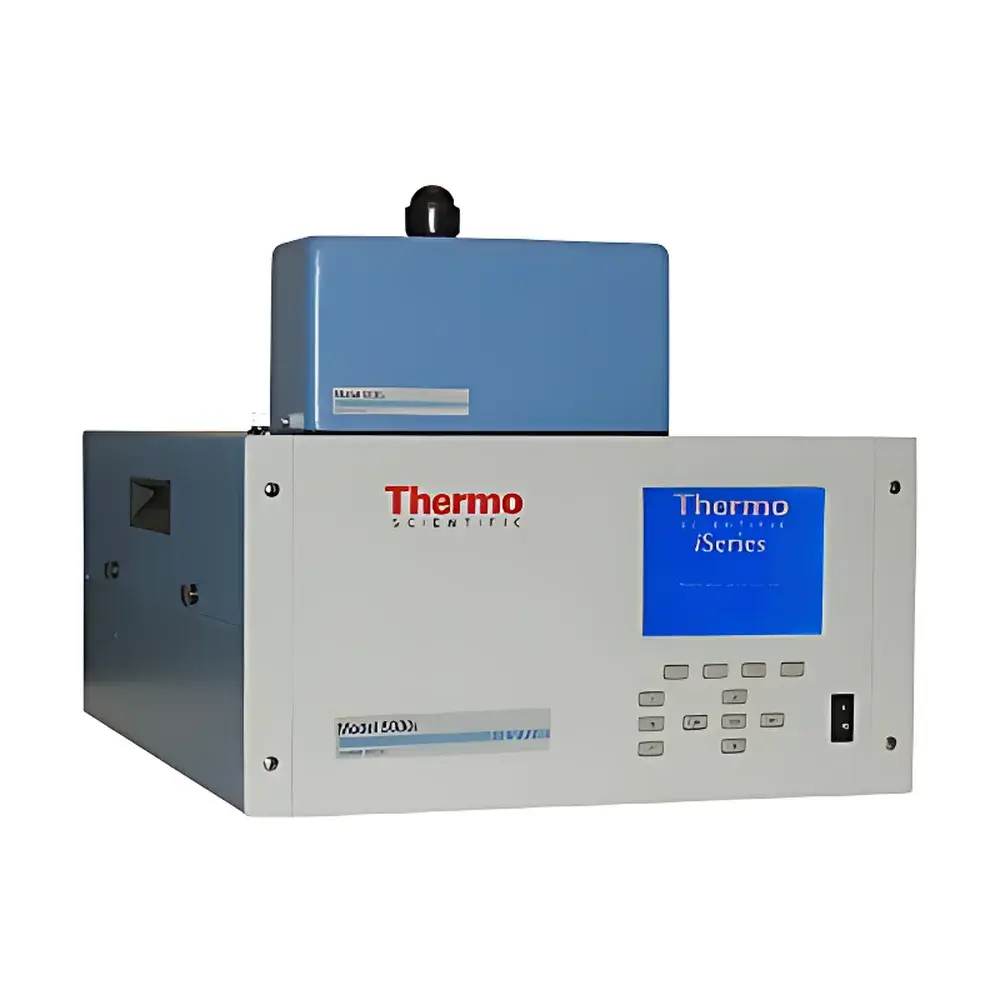
Thermo Fisher Scientific 5030i SHARP Particulate Matter Monitor
| Brand | Thermo Fisher Scientific |
|---|---|
| Origin | USA |
| Manufacturer | Thermo Fisher Scientific |
| Model | 5030i (SHARP) |
| Measurement Method | Beta-ray attenuation with simultaneous optical scattering |
| Measured Parameters | PM₁₀ and PM₂.₅ |
| Measurement Ranges | 0–100, 0–1000, 0–2000, 0–3000, 0–5000, 0–10000 µg/m³ |
| Sampling Flow Rate | 16.67 L/min (1.0 m³/h) |
| Minimum Detection Limit | 1 µg/m³ (1-hour average) |
| Accuracy | ±2 µg/m³ for concentrations <80 µg/m³ |
| Flow Stability | ±5% (calibrated against NIST-traceable diaphragm standards) |
| Data Output Interval | 1 second |
| Beta Source | ¹⁴C, activity <3.7 MBq (<100 µCi) |
| Optical Source | IR LED, 6 mW, 880 nm |
| Heating System | Dynamic heated inlet (programmable temperature control) |
Overview
The Thermo Fisher Scientific 5030i SHARP (Synchronized Hybrid Aerosol Real-time Particulate) Monitor is an EPA-designated Federal Reference Method (FRM) and Federal Equivalent Method (FEM) compliant instrument engineered for continuous, high-fidelity measurement of ambient PM₁₀ and PM₂.₅ mass concentrations. It employs a dual-technology hybrid approach—integrating beta-ray attenuation (β-ATN) as the primary gravimetric reference method with real-time optical scattering (880 nm IR LED) for dynamic compensation and enhanced temporal resolution. Unlike conventional single-method monitors, the 5030i continuously correlates optical signal response with beta-derived mass on the same filter tape, enabling minute-by-minute mass calibration without manual intervention or external reference standards. This synchronized architecture ensures traceable accuracy across wide concentration ranges (0–10,000 µg/m³), while maintaining compliance with U.S. EPA PS-11 and PS-15 performance specifications, ISO 10473:2022, and EU EN 12341:2014 requirements for ambient particulate monitoring.
Key Features
- Dual-sensor real-time synchronization: Simultaneous β-ray attenuation and 880 nm infrared light scattering on identical filter media enables algorithmic correction for volatile particle loss and humidity-induced bias.
- Dynamic heated inlet system: Programmable temperature control minimizes semi-volatile organic compound (SVOC) evaporation during sampling, improving mass recovery for urban and industrial aerosols.
- Automated filter tape advancement: Motor-driven tape transport updates the sampling medium based on user-defined time intervals or mass loading thresholds—reducing operator dependency and ensuring consistent filter exposure.
- Modular hardware architecture: Field-replaceable optical module, beta source assembly, and flow control unit support rapid maintenance and future-proof firmware/hardware upgrades without full-system recalibration.
- Enhanced human-machine interface: Context-sensitive soft keys, intuitive menu navigation, and multilingual display (English, Spanish, French, German) streamline operation in multi-regional deployments.
- Robust flow metrology: Mass flow controller calibrated against NIST-traceable diaphragm standards maintains ±5% volumetric stability over temperature and pressure variations (−30 °C to +50 °C, 60–106 kPa).
Sample Compatibility & Compliance
The 5030i is validated for outdoor ambient air monitoring in regulatory networks (e.g., U.S. EPA AQS, EEA AirBase), industrial fence-line applications, and research-grade aerosol characterization. Its design accommodates standard 47-mm quartz or Teflon-coated glass fiber filters, compatible with subsequent laboratory analysis (e.g., IC, ICP-MS, OC/EC thermal-optical analysis). The instrument meets U.S. EPA equivalency criteria under 40 CFR Part 53 for PM₂.₅ and PM₁₀, satisfies ISO/IEC 17025:2017 metrological traceability requirements when operated within certified environmental chambers, and supports audit-ready data logging aligned with GLP and 21 CFR Part 11 principles—including electronic signature capability, secure user access levels, and immutable audit trails for all configuration changes.
Software & Data Management
Instrument control and data acquisition are managed via Thermo Fisher’s proprietary EnviroPro™ software suite (v4.2+), supporting local USB/RS-232 connectivity and standard Ethernet (TCP/IP) communication with IPv4/IPv6 dual-stack support. Raw beta counts, optical scatter intensity, flow rate, temperature, pressure, and filter position are timestamped at 1-second intervals and stored internally (≥30 days at 1-min resolution). Data export formats include CSV, NetCDF, and EPA-compatible .DAT files. Remote diagnostics, firmware updates, and parameter reconfiguration are enabled through secure HTTPS-based web interface or SNMP v3 integration into centralized SCADA or EMS platforms. All data streams support optional TLS 1.2 encryption and configurable retention policies compliant with regional data sovereignty regulations.
Applications
- Ambient air quality monitoring networks requiring FRM/FEM-compliant PM data for regulatory reporting (e.g., National Ambient Air Quality Standards compliance).
- Source apportionment studies where high-temporal-resolution PM₂.₅/PM₁₀ ratio tracking aids in distinguishing combustion, dust, and secondary aerosol contributions.
- Industrial hygiene assessments near cement plants, smelters, or construction sites where transient high-concentration events (up to 10,000 µg/m³) must be captured without range switching artifacts.
- Long-term trend analysis in climate research programs demanding low detection limits (1 µg/m³ over 1 hour) and interannual calibration stability.
- Mobile monitoring platforms—its vibration-resistant chassis, wide operating temperature range, and low power consumption (≤120 W) facilitate deployment on trailers, towers, and unmanned aerial systems (UAS)-compatible ground stations.
FAQ
What regulatory standards does the 5030i meet for PM₂.₅ and PM₁₀ monitoring?
It is designated as an EPA FEM for both PM₂.₅ (EQPM-0619-225) and PM₁₀ (EQPM-0619-226), and complies with ISO 10473:2022, EN 12341:2014, and China’s HJ 653-2013 technical specifications.
How does the SHARP algorithm improve data accuracy compared to standalone beta or optical methods?
By continuously regressing optical scatter signals against beta-derived mass on the same filter spot, it corrects for non-absorbing particle composition shifts, humidity effects, and loading-dependent optical saturation—yielding stable calibration without periodic manual verification.
Is the ¹⁴C beta source safe for unattended operation in public spaces?
Yes. With activity <3.7 MBq (<100 µCi) and fully shielded internal housing meeting IAEA SSG-46 and NRC 10 CFR 30 requirements, it poses no radiological hazard during normal operation or routine maintenance.
Can the 5030i output raw beta count data for independent algorithm development?
Yes. Full-resolution beta pulse counts, optical voltage outputs, and environmental metadata are accessible via serial or Ethernet in real time, enabling third-party model integration and research-level signal processing.
What maintenance intervals are recommended for long-term field deployment?
Filter tape replacement every 30 days (standard mode); optical window cleaning every 90 days; annual NIST-traceable flow calibration and beta source activity verification per ISO/IEC 17025 QA protocols.







