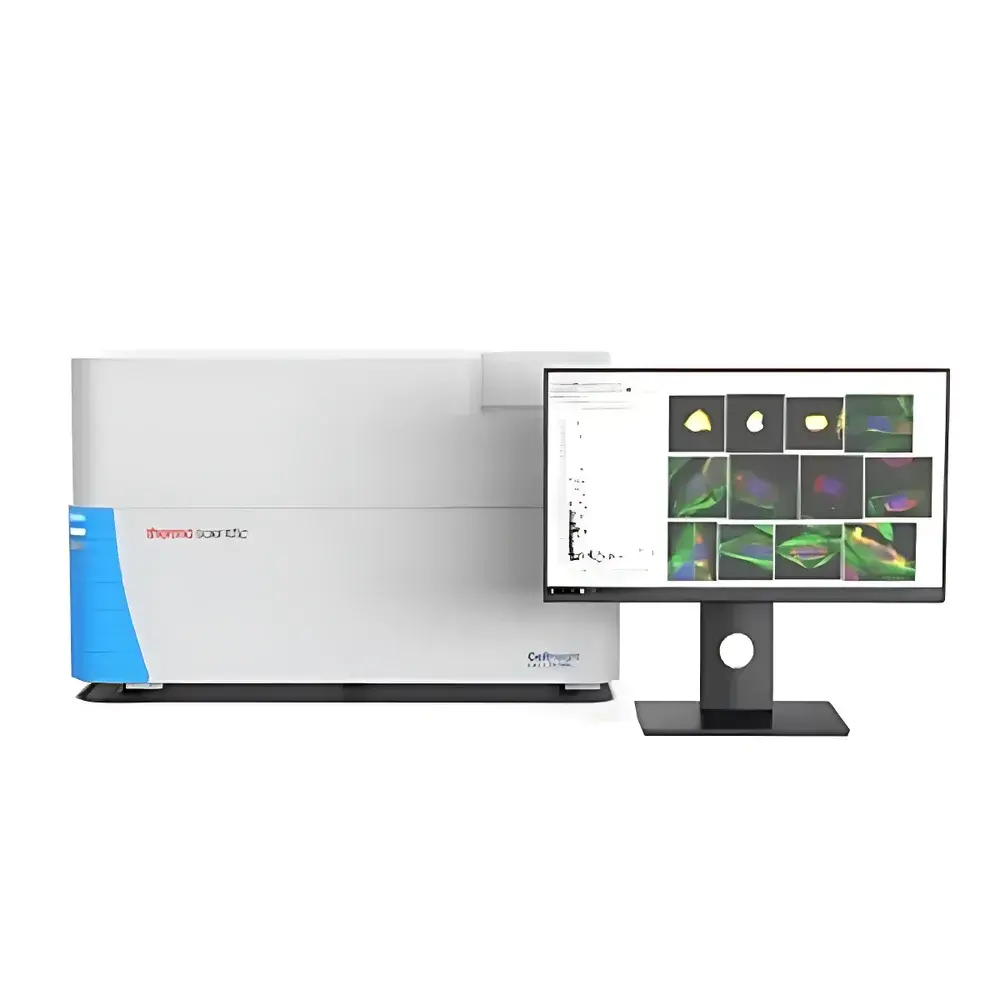
Thermo Fisher Scientific CellInsight CX7 LZR Pro Laser Confocal High-Content Screening (HCS) System
| Brand | Thermo Fisher Scientific |
|---|---|
| Origin | Shanghai, China |
| Manufacturer Type | Authorized Distributor |
| Product Category | Domestic (China-manufactured) |
| Model | CellInsight CX7 LZR Pro |
| Pricing | Available Upon Request |
| Camera | Back-illuminated sCMOS with 95% peak QE and -20°C cooling |
| Objective Lens | Olympus X-line |
| Imaging Modes | Widefield + Confocal (laser-based) |
| Fluorescence Channels | 7-color laser-excited |
| Brightfield Channels | 5-color |
| Confocal Channels | 7-color |
| Excitation Wavelengths | UV to NIR (7 lines) |
| Plate Compatibility | SBS-standard microplates (6–1536-well) and microscope slides |
| Software | HCS Studio 5.0 with >40 validated life science applications |
| Auto-focus | Dual-mode (software + laser-based), label-agnostic |
| Throughput Features | EurekaScan Finder dual-pass detection for spheroids/tissues/rare events |
| Environmental Control Support | Optional live-cell incubation modules |
| Plate Handling | Compatible with Orbitor RS robotic plate handler (optional) |
| Regulatory Status | For Research Use Only (RUO) |
Overview
The Thermo Fisher Scientific CellInsight CX7 LZR Pro is a laser-based, high-throughput high-content screening (HCS) platform engineered for quantitative, multi-parametric cellular analysis in both fixed and live-cell experimental paradigms. Leveraging confocal and widefield imaging modalities within a single integrated architecture, the system employs solid-state lasers with seven discrete excitation wavelengths spanning ultraviolet to near-infrared (UV–NIR) spectra—enabling robust multiplexed fluorescence detection without spectral crosstalk or filter wheel latency. Its optical design incorporates Olympus X-line high-numerical-aperture objectives optimized for signal-to-noise ratio and axial resolution, while the back-illuminated sCMOS camera delivers 95% peak quantum efficiency and thermoelectric cooling to –20°C, ensuring low-noise acquisition across dynamic intensity ranges. Unlike conventional spinning-disk or point-scanning confocal systems, the LZR Pro implements laser line scanning with real-time adaptive focus control—reducing phototoxicity in live-cell assays and maintaining consistent z-stack fidelity across heterogeneous sample topographies.
Key Features
- Laser-driven illumination architecture supporting simultaneous 7-channel fluorescence excitation (355, 405, 445, 488, 561, 640, and 785 nm) with precise power modulation and shutter synchronization
- Dual-mode autofocus: software-guided contrast-based focusing for brightfield and label-free applications, plus laser-reflection-based focus lock for fluorescently labeled specimens—ensuring reproducible z-positioning across plates and time-lapse experiments
- EurekaScan Finder dual-pass scanning algorithm enabling rapid identification of 3D structures—including organoids, spheroids, tissue sections, and rare-event cell populations—without pre-defined segmentation masks
- HCS Studio 5.0 software suite with over 40 pre-validated, application-specific analysis modules (e.g., nuclear morphology, mitochondrial network quantification, neurite outgrowth, phagocytosis kinetics, and FirePlex®-HT immunoassay workflows)
- Flexible hardware expandability: native support for optional environmental control modules (temperature, CO2, humidity) and integration with Orbitor RS robotic microplate handlers for unattended 24/7 operation
- SBS-compliant plate handling: compatible with standard microplates from 6- to 1536-well formats as well as standard glass microscope slides—accommodating diverse assay formats including adherent, suspension, and 3D culture models
- Smart acQuisition (iQ) engine delivering real-time image quality assessment and adaptive parameter adjustment during acquisition—minimizing rescans and accelerating time-to-data
Sample Compatibility & Compliance
The CellInsight CX7 LZR Pro supports a broad spectrum of biological sample types, including monolayer cultures, co-cultures, primary cells, iPSC-derived lineages, 3D spheroids and organoids, cryosections, and FFPE tissue slices. Its optical path is calibrated for compatibility with Molecular Probes™ dyes, Alexa Fluor® conjugates, DAPI, Hoechst, SYTOX®, and other widely used fluorophores. All hardware and firmware comply with IEC 61000-6-3 (EMC emissions) and IEC 61000-6-2 (immunity) standards. The system operates under ISO 9001-certified manufacturing conditions at the Thermo Fisher Shanghai facility. While designated “For Research Use Only” (RUO), HCS Studio 5.0 includes audit-trail logging, user-access controls, and electronic signature support—facilitating alignment with GLP and internal SOP documentation requirements. It does not meet FDA 21 CFR Part 11 criteria for regulated clinical or diagnostic use unless validated per site-specific protocols.
Software & Data Management
HCS Studio 5.0 serves as the unified interface for instrument control, acquisition, visualization, and quantitative analysis. Its modular architecture separates acquisition workflows from analysis pipelines—allowing parallel optimization of imaging parameters and algorithm development. Raw data are stored in standardized OME-TIFF format with embedded metadata (including objective magnification, exposure time, laser power, z-step size, and channel configuration), ensuring FAIR (Findable, Accessible, Interoperable, Reusable) data principles. Batch processing supports distributed computing via optional HCS Studio Compute Server deployment. Export options include CSV, FCS (for flow-like cytometric export), and HDF5 for machine learning pipeline ingestion. Database integration is supported through ODBC-compliant connectors to LIMS or ELN platforms. All software updates undergo version-controlled release cycles with documented change logs and backward-compatible file format support.
Applications
- Phenotypic screening in drug discovery: dose–response profiling of cytotoxicity, apoptosis, autophagy, and pathway modulation using multiplexed reporter assays
- Functional genomics: CRISPR/Cas9 and siRNA screen validation with subcellular localization and morphometric readouts
- Immunooncology: T-cell activation kinetics, macrophage polarization, and tumor–immune synapse formation in co-culture models
- Neuroscience: neuronal differentiation, synaptic density mapping, and axonal transport dynamics in iPSC-derived neurons
- Toxicology: mitochondrial membrane potential collapse, lysosomal pH shifts, and oxidative stress biomarker quantification
- 3D biology: spheroid growth kinetics, invasion metrics, and hypoxia gradient mapping using ratiometric probes
- Immunoassay development: validation of FirePlex®-HT multiplex immunoassays directly on-cell or in situ
FAQ
Is the CellInsight CX7 LZR Pro compliant with FDA 21 CFR Part 11?
No—it is supplied as a research-use-only (RUO) instrument. While HCS Studio 5.0 provides audit trails and role-based access, formal Part 11 compliance requires site-specific validation, including electronic signature implementation and system suitability testing.
Can the system perform true confocal imaging on live cells without photobleaching?
Yes—its laser line-scanning approach minimizes dwell time per pixel and enables rapid z-stack acquisition. Combined with –20°C sCMOS cooling and high QE, it achieves sufficient signal fidelity at low laser power, preserving viability in extended time-lapse experiments.
What plate formats does the platform support natively?
All SBS-standard microplates (6-, 12-, 24-, 48-, 96-, 384-, and 1536-well), plus standard 1″ × 3″ microscope slides and chambered coverslips.
Does the system require external calibration for fluorescence intensity quantification?
No—each laser line is factory-calibrated for power stability and spectral output. Users may perform optional daily QC using Thermo Fisher’s Fluorescence Reference Standard Plates to verify inter-day reproducibility.
Is HCS Studio 5.0 compatible with third-party analysis tools like Python or ImageJ?
Yes—OME-TIFF exports retain full metadata and multi-channel registration; open-source libraries such as Bio-Formats, scikit-image, and DeepCell are routinely deployed for custom algorithm development and AI training pipelines.