
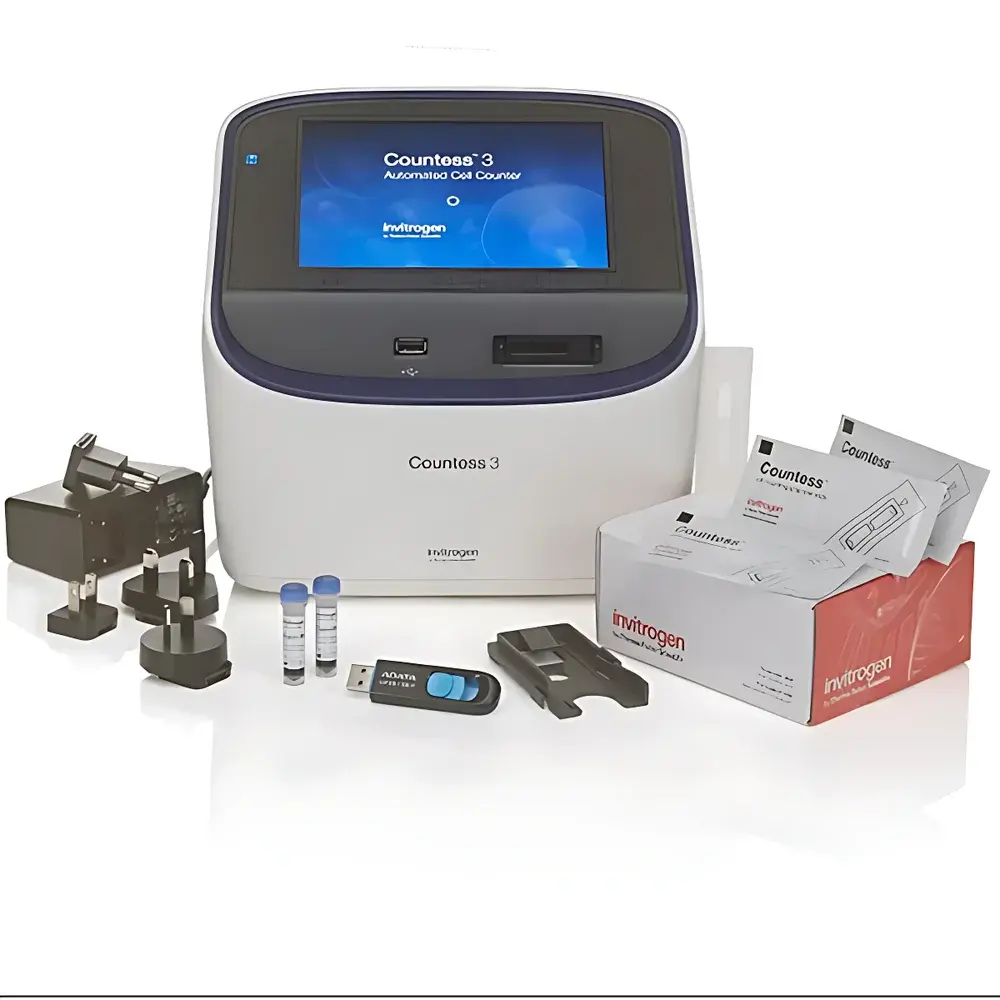
Thermo Fisher Scientific Countess 3 Automated Cell Counter
| Brand | Thermo Fisher Scientific |
|---|---|
| Origin | Shanghai, China |
| Model | Countess 3 Automated Cell Counter |
| Detection Modes | Brightfield and Fluorescence (optional FL configuration) |
| Sample Throughput | ~20 seconds per sample |
| Cell Size Range | 4–60 µm |
| Compatible Slides | Disposable and Reusable Countess Slides |
| Software | Pre-installed Countess Software v3.x with Onboard Image Capture & Analysis |
| Compliance | Designed for GLP-compliant workflows |
| Connectivity | USB, Ethernet, Optional Wi-Fi module |
Overview
The Thermo Fisher Scientific Countess 3 Automated Cell Counter is an engineered solution for rapid, objective, and reproducible cell quantification in routine and advanced cell culture laboratories. Built upon a dual-modality optical platform—supporting both brightfield and fluorescence imaging—the instrument leverages embedded machine learning algorithms trained on thousands of annotated cell morphology datasets to distinguish viable, non-viable, and aggregated cells with high specificity. Unlike traditional hemocytometer-based counting or legacy image-based counters, the Countess 3 applies adaptive thresholding, edge-aware segmentation, and focus-stabilized autofocus to deliver consistent results across diverse sample types—including primary cells, suspension lines (e.g., Jurkat, K562), adherent cells post-trypsinization, and low-contrast or debris-rich suspensions. Its measurement principle combines high-resolution CMOS imaging (2.3 MP sensor) with real-time morphometric analysis, enabling simultaneous determination of total cell concentration, viability (via trypan blue or fluorescent dyes such as propidium iodide/Calcein AM), and average cell diameter—all without manual gating or user-defined parameters.
Key Features
- Integrated machine learning engine trained specifically on mammalian cell morphology, reducing inter-operator variability inherent in manual counting.
- Auto-focus and auto-exposure optimization ensures consistent image quality across variable sample densities and staining intensities.
- Touchscreen interface with chemically resistant, flush-mounted glass surface—designed for rapid ethanol or 70% isopropanol disinfection between users.
- Onboard image storage (up to 1,000 images) with timestamped metadata, including date/time, user ID, slide type, and analysis parameters.
- Dual slide compatibility: supports both single-use disposable slides and autoclavable reusable Countess slides—reducing consumable cost by up to 60% over two-year operation.
- Embedded calculator for direct derivation of seeding density, passage ratio, and cryopreservation volume based on user-input culture vessel specifications.
Sample Compatibility & Compliance
The Countess 3 accommodates a broad spectrum of sample formats: unstained or trypan blue–stained suspensions, fluorescently labeled populations (GFP/RFP expression, Annexin V-FITC/PI apoptosis assays), and mixed cultures containing dead cells, debris, or clumps. It meets key requirements for regulated environments: onboard user authentication, configurable password policies, and optional 21 CFR Part 11–compliant software modules that enforce electronic signatures, audit trails, and data integrity controls. While not certified as a medical device, its design aligns with ISO 13485-aligned manufacturing practices and supports laboratory adherence to GLP and GMP documentation standards. All firmware updates are digitally signed and traceable via Thermo Fisher’s Secure Update Framework.
Software & Data Management
Pre-installed Countess Software v3.x provides intuitive workflow navigation, customizable report templates (PDF/CSV export), and batch analysis mode for multi-sample processing. Raw images and analysis logs are stored locally with SHA-256 hash verification to prevent tampering. Data export supports LIMS integration via standard protocols (SFTP, ODBC). For centralized management, Thermo Fisher Connect cloud services enable remote instrument monitoring, usage analytics, and secure cross-site data sharing—subject to institutional IT policy and GDPR/CCPA compliance configurations.
Applications
- Cell line maintenance: daily viability monitoring during expansion and cryopreservation preparation.
- Transfection efficiency assessment: co-staining with fluorescent reporters and viability dyes to quantify functional delivery rates.
- Apoptosis and cytotoxicity studies: dual-stain analysis using Annexin V and PI to discriminate early/late apoptotic and necrotic populations.
- Stem cell and primary cell workflows: robust performance with low-yield, heterogeneous, or fragile samples where manual counting introduces unacceptable error.
- Bioprocess development: integration into upstream biomanufacturing QC checkpoints for inoculum standardization and harvest timing decisions.
FAQ
Does the Countess 3 require calibration with standard beads or reference samples?
No—factory-calibrated optics and algorithm training eliminate routine recalibration. Users perform only a one-time slide-type registration during initial setup.
Can I use third-party counting chambers with the Countess 3?
No. Only Thermo Fisher–certified Countess disposable and reusable slides are optically and dimensionally validated for autofocus accuracy and chamber depth consistency.
Is fluorescence capability built-in or optional?
Fluorescence detection is available exclusively in the Countess 3 FL configuration, which includes LED excitation sources (470 nm, 530 nm, 590 nm) and matched emission filters—no field upgrade path exists from brightfield-only units.
How is data security handled for network-connected instruments?
All network communications use TLS 1.2+ encryption; local storage employs AES-256 full-disk encryption when enabled via administrative settings.
What regulatory documentation is provided for audit readiness?
Instrument IQ/OQ documentation kits, firmware validation reports, and 21 CFR Part 11 implementation guides are available upon request through Thermo Fisher Scientific Technical Services.




