
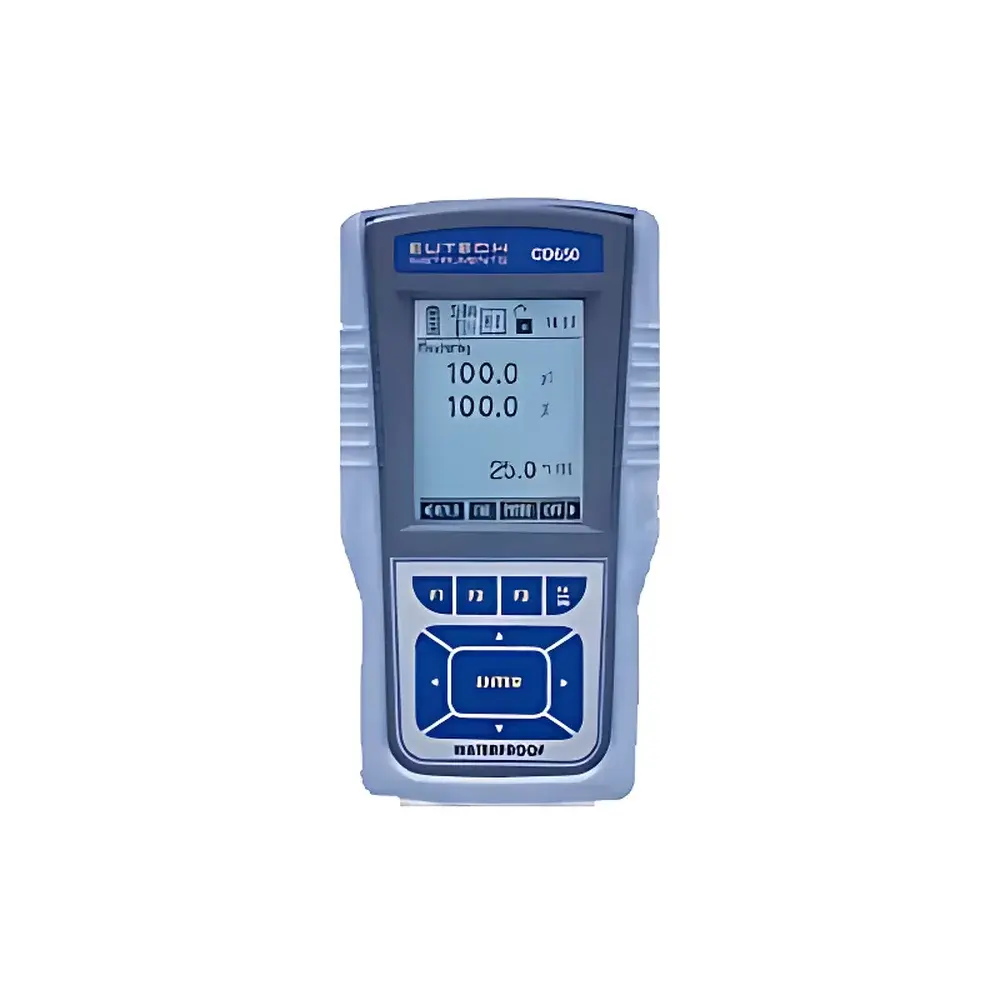
Thermo Fisher Scientific CyberScan CD650 Portable Multiparameter Water Quality Analyzer
| Brand | Thermo Fisher Scientific |
|---|---|
| Origin | USA |
| Manufacturer | Thermo Fisher Scientific |
| Product Type | Imported |
| Model | CD650 |
| Instrument Category | Portable/Handheld Water Quality Analyzer |
| Key Parameters | Conductivity / TDS / Salinity / Resistivity / Dissolved Oxygen (DO) / Temperature |
| IP Rating | IP67 |
| Calibration | Auto 4-point (Conductivity), Manual 5-point (Conductivity), Single- or Multi-point DO |
| Electrode Support | Dual- or Quad-ring conductivity cells (cell constant 0.010–10.000 cm⁻¹) |
| DO Measurement Range | 0.00–90.00 mg/L (ppm) and 0.0–600.0% saturation |
| Conductivity Range | 0–500.0 mS/cm across five auto-ranging scales |
| Temperature Range (Instrument) | −10.0–110.0 °C |
| (DO Sensor) | 0–60.0 °C |
| Resolution | 0.01 μS/cm, 0.001 mS/cm, 0.01 mg/L, 0.1 °C |
| Accuracy | ±1% full scale + 1 LSD (Conductivity/TDS/Salinity/Resistivity), ±0.2 mg/L (DO), ±0.5 °C (Temperature) |
| Data Storage | 500 measurement sets |
| GLP Compliance | Yes |
| Communication | IrDA infrared, RS232C, optional PC connectivity via CyberLink software |
| Power | 4×AAA alkaline batteries (>200 h life) or 9 V regulated adapter |
Overview
The Thermo Fisher Scientific CyberScan CD650 is a rugged, field-deployable multiparameter water quality analyzer engineered for high-precision, real-time measurement of six critical parameters in diverse aquatic environments—from freshwater streams and wastewater treatment plants to coastal estuaries and industrial process water loops. Operating on standardized electrochemical and thermometric principles, the CD650 employs dual-mode conductivity measurement (two- or four-electrode cells) with automatic range selection and temperature compensation per ASTM D1125 and ISO 7888. Dissolved oxygen is quantified using a galvanic (non-polarized) membrane electrode, eliminating pre-use polarization time and enabling immediate field deployment. Integrated barometric pressure sensing—calibrated to 450–825 mmHg (59.9–109.9 kPa)—ensures accurate DO compensation per USP and APHA Standard Methods 4500-OG. Its IP67-rated enclosure guarantees operational integrity under immersion (up to 1 m for 30 min) and dust ingress, making it suitable for routine monitoring in rain, mud, or high-humidity laboratories.
Key Features
- True multi-parameter capability: Simultaneous display of up to three parameters (e.g., conductivity, DO, temperature) with dedicated sensor inputs—BNC for pH/ORP (optional), 8-pin for DO, 6-pin for conductivity—enabling modular probe configuration.
- Five-range auto-scaling conductivity engine: Covers ultrapure water (0–2.000 µS/cm) through high-salinity brines (40.00–500.0 mS/cm), with selectable linear or pure-water temperature compensation (15–30 °C).
- Galvanic DO sensor architecture: Delivers stable, drift-free measurements without warm-up delay; supports 100% air-saturation or 0% zero-point calibration in sodium sulfite solution per ISO 5814.
- GLP-compliant data governance: Timestamped records include electrode ID, calibration history, atmospheric pressure, salinity, and temperature—all stored with audit-trail metadata for regulatory review.
- Backlit graphical LCD (5.4 × 7.1 cm): High-contrast display with intuitive icon-driven interface, multilingual prompts, and context-sensitive error diagnostics (e.g., “Low Battery”, “Probe Not Detected”, “Calibration Out of Tolerance”).
- Energy-efficient operation: >200 hours battery life on alkaline AAA cells; configurable auto-off (2–30 min idle); optional 9 V DC adapter for benchtop continuity.
Sample Compatibility & Compliance
The CD650 is validated for use with natural waters (surface, groundwater, seawater), treated effluents, boiler feedwater, aquaculture systems, and pharmaceutical process water. It meets ISO/IEC 17025-relevant performance criteria for field instrumentation when operated per manufacturer-specified calibration protocols. All conductivity and DO measurements adhere to traceable NIST-certified reference standards. The instrument’s firmware implements electronic signature support and user-access controls aligned with FDA 21 CFR Part 11 requirements for electronic records—enabling secure, auditable data export. Its physical construction conforms to IEC 60529 (IP67) and MIL-STD-810G for shock/vibration resistance. CE marking confirms compliance with EU EMC Directive 2014/30/EU and RoHS 2011/65/EU.
Software & Data Management
CyberLink PC software (Windows-compatible) enables bidirectional communication via IrDA or RS232C, supporting batch download of all 500 stored datasets—including raw sensor voltages, compensated values, and environmental metadata. Export formats include CSV, Excel (.xlsx), and PDF reports compliant with laboratory QA/QC templates. Software features include calibration curve visualization, trend analysis over time-series sampling events, and automated flagging of out-of-spec results against user-defined action limits. Audit logs record operator ID, timestamp, parameter changes, and firmware version—fully compatible with LIMS integration via ODBC drivers. Data encryption and password-protected user roles ensure alignment with ISO 27001 information security frameworks.
Applications
- Environmental field surveys: Rapid assessment of eutrophication risk via DO depletion, salinity intrusion mapping in estuaries, and conductivity-based TDS estimation per EPA Method 120.1.
- Wastewater operations: Monitoring aeration basin DO profiles, influent/effluent conductivity for load balancing, and disinfection byproduct precursor tracking.
- Pharmaceutical water systems: Verification of purified water (PW) and water-for-injection (WFI) resistivity per USP , including temperature-compensated 25 °C equivalence reporting.
- Aquaculture and hydroponics: Real-time DO and salinity control to maintain species-specific physiological thresholds (e.g., salmonid DO >6 mg/L; shrimp culture salinity 10–30 ppt).
- Educational laboratories: Teaching core principles of aqueous electrochemistry, sensor calibration theory, and environmental data uncertainty propagation.
FAQ
Does the CD650 require electrode polarization before DO measurement?
No—the galvanic DO sensor operates without polarization time and is ready for immediate use after membrane hydration.
Can the CD650 measure conductivity in ultrapure water?
Yes—it supports the 0–2.000 µS/cm range with automatic temperature compensation optimized for low-conductivity media per ASTM D5391.
Is GLP-compliant data export possible without proprietary software?
Raw data can be exported as CSV via RS232C; however, full GLP audit trails (including calibration certificates and operator signatures) require CyberLink software.
What conductivity cell constants are supported?
The instrument automatically recognizes and applies cell constants from 0.010 to 10.000 cm⁻¹, accommodating both laboratory-grade and field-robust electrodes.
How does atmospheric pressure compensation improve DO accuracy?
Barometric pressure directly affects oxygen partial pressure; the built-in sensor adjusts saturation calculations in real time, reducing error to <±0.2 mg/L across elevation gradients.







