
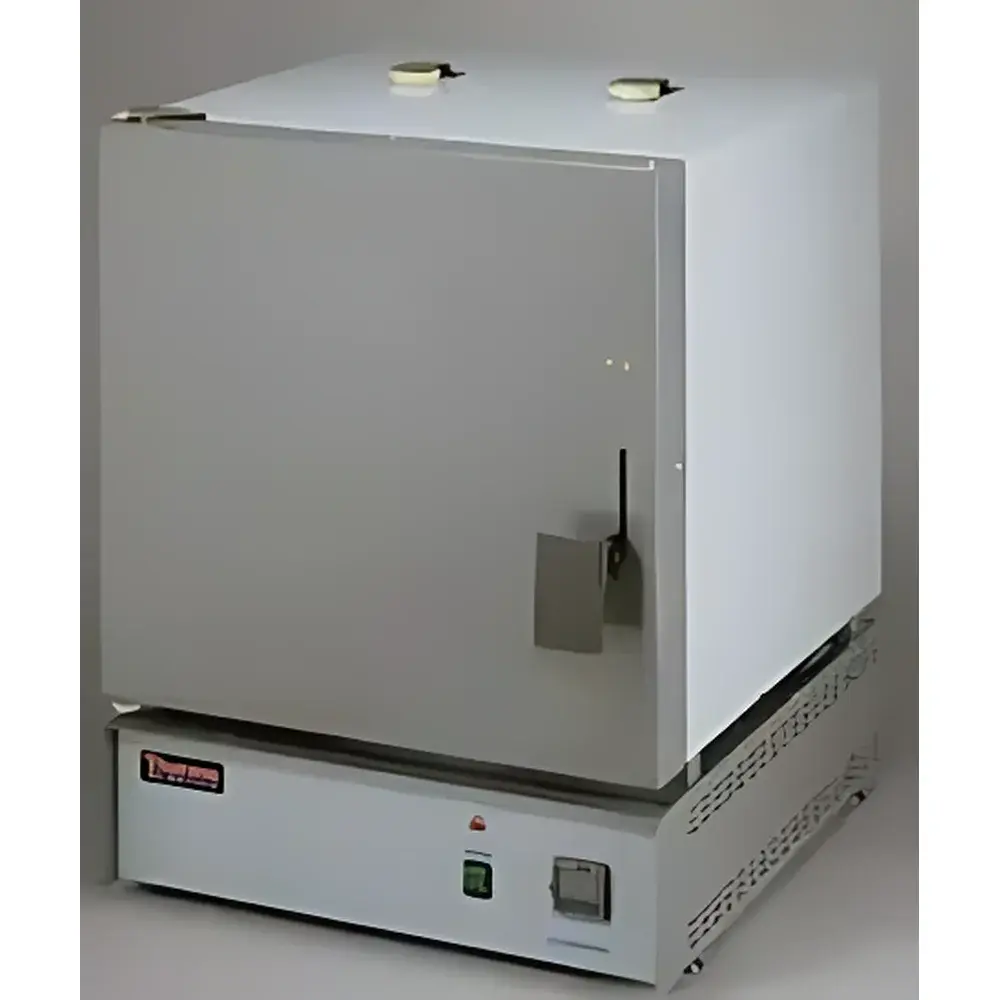
Thermo Fisher Scientific F30400 Large-Capacity Box-Type Muffle Furnace
| Brand | Thermo Fisher |
|---|---|
| Origin | USA |
| Manufacturer | Thermo Fisher Scientific |
| Product Type | Box-Type Muffle Furnace |
| Model | F30400 |
| Maximum Temperature | 1200°C |
| Temperature Uniformity (at 1000°C) | ±3.45°C |
| Temperature Stability (at 1000°C) | ±1.2°C |
| Control Accuracy | ±2–4°C |
| Chamber Dimensions (W×H×D) | 360 × 360 × 360 mm |
| Chamber Volume | 45 L |
| Max Power | 5500 W |
| Heating Rate (to max temp) | 6–12°C/min |
| Heating Method | Resistance Wire Heating |
| Electrical Supply | 240 V, 50/60 Hz, 22.9 A |
| Weight (Shipping) | 117.9 kg |
| Safety | 35 A Circuit Breaker, Door-Interlocked Power Cut-off, Mechanical Over-Temperature Relay |
| Optional Accessories | Dual Removable Shelves (enabling up to 3× sample capacity) |
| Exhaust Port | 9.5 mm diameter rear port for external monitoring or venting |
| Compliance | Designed for GLP/GMP environments |
Overview
The Thermo Fisher Scientific F30400 is a large-capacity, high-temperature box-type muffle furnace engineered for precision thermal processing in research laboratories, quality control facilities, and industrial R&D settings. Operating on the principle of resistive heating via high-grade Kanthal A1 alloy resistance wire elements—strategically mounted on the top, bottom, and both side walls—the furnace delivers exceptional thermal uniformity across its 45 L chamber. This symmetrical heating architecture minimizes radial and axial temperature gradients, ensuring reproducible calcination, ashing, sintering, and heat-treatment protocols. With a maximum operating temperature of 1200°C and stable operation from 100°C to 1093°C, the F30400 meets stringent requirements for ceramic pre-firing, metallurgical sample preparation, pharmaceutical residual solvent removal, and environmental solid-waste analysis per EPA Method 9010B and ASTM D3175.
Key Features
- 45-liter internal volume (360 × 360 × 360 mm) enables batch processing of multiple crucibles, boats, or standardized test specimens without compromising thermal integrity
- Triple-zone resistive heating system ensures ±3.45°C uniformity at 1000°C and ±1.2°C stability—validated per ASTM E220 calibration practices
- Integrated 9.5 mm rear port allows real-time insertion of external thermocouples (Type K or S) for independent chamber or sample temperature verification
- Dual removable stainless-steel shelves (optional) expand effective loading capacity by up to 200%, supporting concurrent multi-level thermal treatments
- Standard exhaust aperture facilitates controlled venting of volatile decomposition products, moisture, and acidic gases—protecting heating elements and extending service life
- Three-tier digital control options (B1, C1, D1) provide scalable programmability: from single-setpoint operation to multi-step thermal profiles with up to 4 stored programs (16 segments each), all featuring mechanical over-temperature cut-off relays
- Comprehensive safety architecture includes a dedicated 35 A circuit breaker, automatic power disconnection upon door opening, and redundant thermal protection circuits
Sample Compatibility & Compliance
The F30400 accommodates standard laboratory crucibles (alumina, platinum, quartz, and silicon carbide), ceramic boats, metal trays, and refractory sample holders up to 350 mm in width or height. Its inert muffle chamber—constructed from high-purity alumina-silica fiber insulation and sealed with double-layered ceramic fiber gaskets—prevents cross-contamination during ashing of organic matrices or trace-metal analysis. The furnace complies with electrical safety standards IEC 61010-1 and UL 61010-1, and supports regulatory workflows aligned with FDA 21 CFR Part 11 when paired with validated D1 controller logging via RS232. It is routinely deployed in ISO/IEC 17025-accredited labs for method validation under ASTM E1530 (thermal stability testing) and ISO 5660-1 (fire reaction calorimetry sample conditioning).
Software & Data Management
While the F30400 operates as a standalone instrument, the D1 controller provides native RS232 serial output for integration into lab-wide data acquisition systems. Users may log time-stamped temperature readings (setpoint, actual, and optional external probe input), ramp/soak events, and alarm triggers—including door-open status and over-temperature alerts. When connected to compliant third-party software (e.g., LabVIEW or custom Python-based SCADA interfaces), the furnace supports audit-trail generation, electronic signature capture, and automated report export in CSV or PDF format—meeting GLP documentation requirements. Firmware updates are performed locally via USB-to-serial adapter; no cloud dependency or proprietary subscription is required.
Applications
- Quantitative ash content determination in food, feed, and biomass per AOAC 942.05 and ISO 2171
- Preparation of oxide catalysts and battery cathode precursors via controlled calcination (e.g., LiCoO₂, Ni-rich NMC)
- Thermal gravimetric analysis (TGA) sample conditioning prior to DSC or XRD characterization
- Residue-on-ignition (ROI) testing in water and wastewater sludge per Standard Methods 2540E
- Heat treatment of dental alloys, investment casting molds, and precision ceramics
- Calibration reference furnace applications requiring stable, repeatable 1000°C+ environments
FAQ
Does the F30400 include a power cord?
No. The unit ships without a power cord to comply with regional electrical codes; users must supply a certified 240 V, 30 A, NEMA 6-30R-rated cord.
Can the furnace be used under inert or reducing atmospheres?
The standard configuration is air-atmosphere only. For inert gas purging, a custom flanged inlet/outlet kit and pressure-regulated gas manifold must be installed externally; consult Thermo Fisher Technical Support for compatibility assessment.
Is validation documentation available?
Yes. IQ/OQ protocols, factory-as-tested calibration certificates (NIST-traceable), and temperature mapping reports (per ASTM E220) are available upon request and included with DQ packages for regulated environments.
What maintenance intervals are recommended?
Visual inspection of insulation integrity and door gasket compression every 200 operational hours; full thermocouple recalibration annually or after 1000 h of cumulative use at >1000°C.
How is temperature uniformity verified?
Using a 9-point grid mapping procedure per ASTM E220 Annex A3, with five calibrated Type S thermocouples placed at defined spatial coordinates within an empty chamber at 1000°C for ≥30 minutes.



