
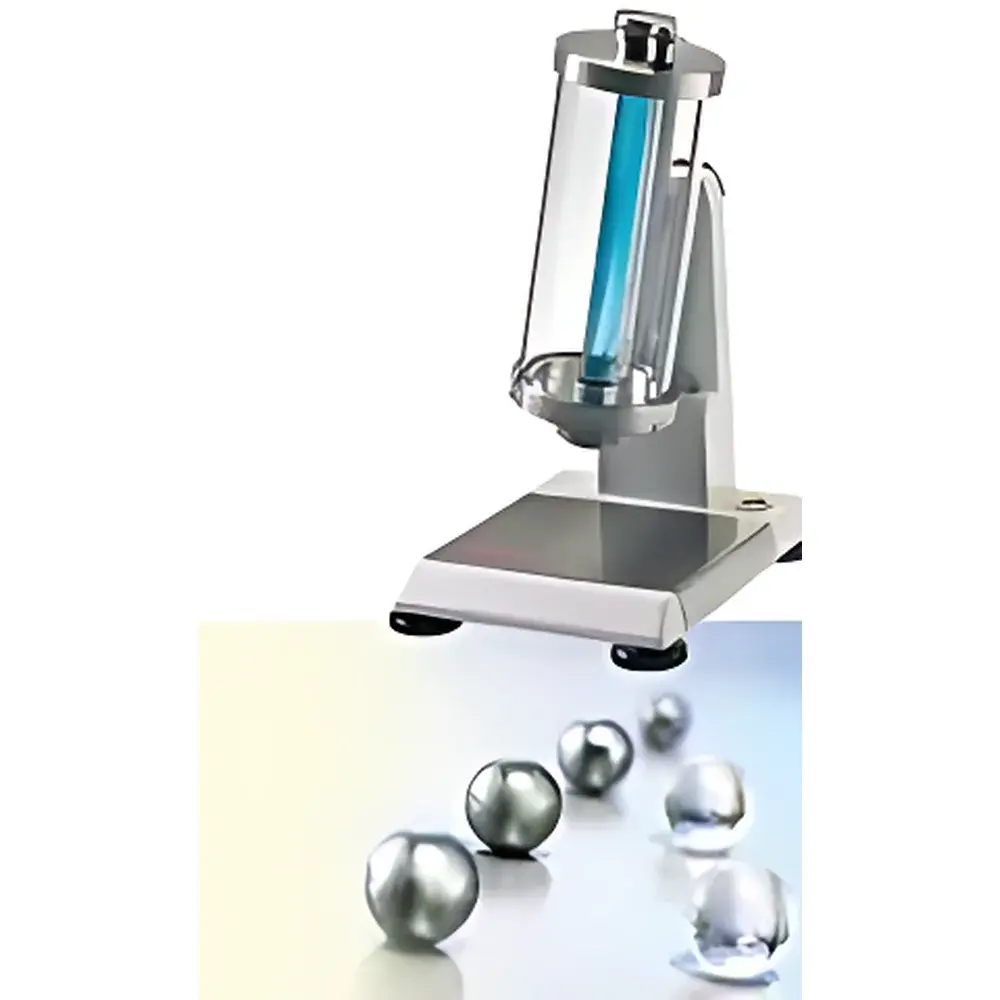
Thermo Fisher Scientific HAAKE Viscotester Falling Ball C Viscometer
| Brand | Thermo Fisher Scientific |
|---|---|
| Origin | USA |
| Manufacturer Status | Authorized Distributor |
| Origin Category | Imported |
| Model | HAAKE Viscotester Falling Ball C |
| Instrument Type | Falling Ball Viscometer |
| Viscosity Range | 0.5 – 100,000 mPa·s (cP) |
| Temperature Range | −20 °C to +150 °C |
| Repeatability | < 0.5 % |
| Reproducibility | < 1 % |
| Tube & Balls 1–2 & G | Borosilicate Glass |
| Balls 3–6 | Ni-Fe Alloy |
Overview
The Thermo Fisher Scientific HAAKE Viscotester Falling Ball C is a precision primary-standard viscometer engineered for the absolute measurement of dynamic viscosity in transparent Newtonian fluids and gases. It operates on the classical falling-ball principle rooted in Stokes’ law and Poiseuille flow theory, where the terminal velocity of a calibrated sphere descending under gravity through a vertically oriented, temperature-controlled capillary tube is directly related to the fluid’s dynamic viscosity. Unlike rotational or capillary viscometers that require calibration against reference standards, the Falling Ball C functions as a primary instrument—its output is traceable to SI units via dimensional metrology (sphere diameter, tube geometry, density differential, and transit time), eliminating reliance on empirical calibration curves. This makes it suitable for use as a reference standard in metrology laboratories, regulatory validation environments, and high-accuracy QC workflows across pharmaceutical, chemical, and petrochemical sectors.
Key Features
- Primary-standard capability with SI-traceable viscosity determination based on fundamental physical constants and geometric parameters
- High-precision temperature control integration compatible with external circulators (−20 °C to +150 °C), ensuring thermal stability within ±0.01 °C during measurement
- Six interchangeable test spheres (Borosilicate glass for low-density applications; Ni-Fe alloy for higher-density media), enabling optimal range coverage across 0.5–100,000 mPa·s
- Dual-directional measurement mode: automatic reversal of the vertical tube allows paired upward/downward transit timing to cancel gravitational asymmetry and buoyancy drift
- Mechanically robust borosilicate glass measurement tube with laser-etched timing marks and optical-grade clarity for unambiguous ball detection
- Compliance with DIN 53015 and ISO 120587 for method validation, supporting audit-ready documentation in GLP/GMP-regulated facilities
Sample Compatibility & Compliance
The Falling Ball C is validated for transparent, homogeneous, Newtonian liquids—including polymer solutions, glycerol, pharmaceutical excipients, edible syrups, mineral oils, and low-viscosity solvents. Non-Newtonian, opaque, or particulate-laden samples are excluded due to optical detection requirements and laminar flow assumptions. Its design conforms to ISO/IEC 17025:2017 for testing laboratory competence and supports full traceability per NIST SP 800-53 and ASTM D445 Annex A1 for kinematic viscosity correlation. When operated within certified environmental conditions and with documented sphere calibration certificates, results satisfy FDA 21 CFR Part 11 data integrity requirements when paired with compliant acquisition software.
Software & Data Management
While the base instrument operates manually via stopwatch or optical timer, optional digital interfaces (e.g., HAAKE Viscotester Control Module) enable automated timing capture, temperature logging, and real-time viscosity calculation. All raw data—including transit time, ambient pressure, fluid density, sphere mass/diameter, and thermal gradient profiles—are exportable in CSV or XML format for LIMS integration. Audit trails record operator ID, timestamp, calibration status, and environmental metadata, fulfilling ALCOA+ principles (Attributable, Legible, Contemporaneous, Original, Accurate) required in regulated QA/QC environments.
Applications
- Reference calibration of rotational viscometers and capillary viscometers in metrology labs
- Viscosity certification of USP/Ph. Eur. reference standards (e.g., glycerol-water mixtures)
- Batch release testing of active pharmaceutical ingredients (APIs) and liquid dosage forms under ICH Q5C stability protocols
- Quality verification of synthetic lubricants and transformer oils per ASTM D445 and ISO 3104
- R&D characterization of solvent blends and monomer solutions in polymer synthesis process development
- Validation of rheological models for CFD simulation inputs in process engineering
FAQ
Is the Falling Ball C suitable for non-Newtonian fluids?
No. The instrument assumes laminar, steady-state Stokes flow and requires constant shear rate—conditions only met by Newtonian fluids. Yield stress or shear-thinning behavior invalidates the underlying physics model.
Can it measure kinematic viscosity directly?
No. It measures dynamic viscosity (mPa·s) directly. Kinematic viscosity (mm²/s) must be derived by dividing dynamic viscosity by fluid density, which must be measured separately using a calibrated densitometer.
What temperature accuracy is required for compliance with ISO 120587?
The standard mandates temperature control within ±0.05 °C over the measurement duration. Use of a certified external bath with PID feedback and NIST-traceable probe is mandatory for official reference use.
How often must the spheres be recalibrated?
Annually—or after any mechanical impact—per ISO 120587 Annex B. Calibration includes dimensional metrology (diameter, sphericity), density determination, and magnetic susceptibility screening for Ni-Fe alloys.
Does it support 21 CFR Part 11 compliance out of the box?
The standalone unit does not include electronic records. Full Part 11 compliance requires integration with validated software, electronic signatures, and audit-trail-enabled hardware modules—available through Thermo Fisher’s HAAKE Digital Suite.



