
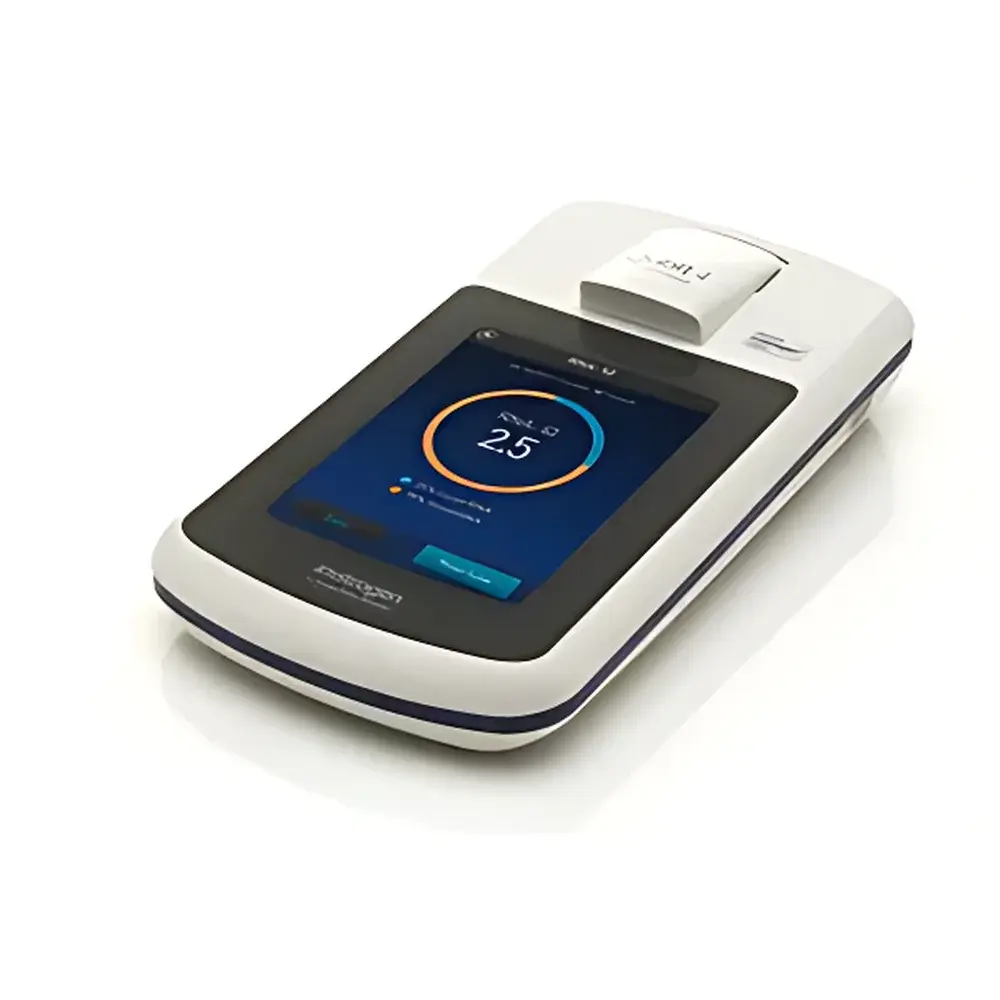
Thermo Fisher Scientific Invitrogen Qubit 4 Fluorometer for Nucleic Acid and Protein Quantitation
| Brand | Thermo Fisher Scientific Invitrogen |
|---|---|
| Origin | Singapore |
| Manufacturer Type | Original Equipment Manufacturer (OEM) |
| Import Status | Imported |
| Model | Qubit 4 |
| Pricing | Available upon request |
Overview
The Thermo Fisher Scientific Invitrogen Qubit 4 Fluorometer is a benchtop, single-tube fluorescence-based quantitation system engineered for high-specificity measurement of DNA, RNA, and protein in complex biological samples. Unlike absorbance-based methods (e.g., UV-Vis spectrophotometry), the Qubit 4 employs target-selective fluorescent dyes—developed under the Invitrogen Molecular Probes portfolio—that emit signal only upon binding to intact double-stranded DNA, single-stranded RNA, or specific protein conformations. This molecular recognition principle eliminates interference from free nucleotides, salts, solvents, degraded nucleic acids, or common contaminants such as guanidine, EDTA, or phenol—enabling accurate quantitation across diverse sample matrices encountered in next-generation sequencing (NGS), qPCR, CRISPR editing, and recombinant protein workflows. The instrument operates on the principle of fluorescence intensity calibration against dye-specific standard curves, delivering concentration values with sub-picomolar sensitivity and inter-assay reproducibility ≤5% CV.
Key Features
- High-selectivity detection: Patented Qubit assay dyes bind exclusively to target analytes—dsDNA, ssRNA, or total protein—minimizing cross-reactivity and enabling reliable quantitation in crude lysates or purified fractions.
- Ultra-low sample consumption: Requires only 1 µL per assay, supporting precious or low-yield samples without dilution or volume compromise.
- Enhanced throughput and responsiveness: Dual-core processor enables concentration calculation in ≤5 seconds post-read; onboard storage accommodates up to 1,000 assay results with timestamp, user ID, and assay metadata.
- Intuitive human interface: 5.7-inch capacitive color touchscreen with multi-language support (English, French, German, Spanish, Chinese, Japanese) and context-sensitive navigation.
- Integrated reagent calculator: Built-in tool for rapid preparation of working solutions—automatically computes required volumes of dye and buffer based on stock concentrations and desired final assay volume.
- Wireless data management: Wi-Fi connectivity enables secure transfer of assay files (CSV, PDF) to local networks or cloud platforms without physical USB media.
Sample Compatibility & Compliance
The Qubit 4 is validated for use with all current Invitrogen Qubit assay kits—including Qubit dsDNA HS/BR, RNA HS, Protein Assay, and the specialized Qubit RNA IQ Assay. The RNA IQ assay utilizes two orthogonal dyes: one selective for high-molecular-weight RNA (e.g., 18S/28S rRNA, full-length mRNA), and another preferentially binding fragmented or degraded RNA species. The resulting RNA Integrity & Quality (IQ#) score—ranging from 1 to 10—is calculated algorithmically from the dual-channel fluorescence ratio and correlates strongly with electrophoretic integrity metrics (RIN, RQI). While not a replacement for fragment-size analysis, the RNA IQ assay meets ISO/IEC 17025–aligned verification criteria for qualitative RNA degradation screening in routine QC workflows. Instrument firmware complies with FDA 21 CFR Part 11 requirements for electronic records and signatures when used with MyQubit Software v3.0+ and networked audit-trail configurations.
Software & Data Management
Data acquisition, analysis, and reporting are supported via the MyQubit Software platform (Windows/macOS), which enables assay customization, calibration curve generation, batch processing, and GLP-compliant report export (PDF/CSV with digital signature fields). All instrument-generated data include embedded metadata: date/time stamp, operator ID, assay type, lot numbers of reagents used, and environmental sensor logs (if enabled). Wi-Fi-enabled instruments support TLS 1.2–secured transmission to enterprise LIMS or ELN systems. Raw fluorescence values and normalized concentration outputs are stored in non-proprietary formats to ensure long-term archival accessibility and third-party interoperability.
Applications
The Qubit 4 serves as a critical QC checkpoint across academic, clinical, and industrial life science laboratories. Typical applications include: pre-NGS library quantitation and normalization; verification of RNA integrity prior to reverse transcription or Nanopore sequencing; assessment of protein yield in purification pipelines; validation of CRISPR guide RNA synthesis efficiency; and routine quality control of biobanked nucleic acid extracts. Its specificity makes it particularly valuable for samples derived from FFPE tissue, plasma cfDNA, exosomal RNA, or bacterial lysates—where contaminant-induced overestimation by spectrophotometry is common.
FAQ
How does the Qubit 4 differ from UV-Vis spectrophotometers like NanoDrop?
The Qubit 4 uses fluorescence-based detection with analyte-specific dyes, whereas UV-Vis measures total absorbance at 260 nm—a value confounded by free nucleotides, RNA, protein, and chemical contaminants. Qubit provides >100-fold greater specificity for intact dsDNA and is recommended for applications requiring precise stoichiometric input (e.g., library prep).
Can the Qubit 4 quantify degraded RNA?
Yes—the Qubit RNA IQ assay differentiates intact versus fragmented RNA populations and reports an RNA Integrity & Quality (IQ#) score. It does not resolve individual fragment sizes but delivers a rapid, quantitative metric strongly correlated with electrophoretic RIN values.
Is the Qubit 4 compliant with regulatory documentation standards?
When operated with MyQubit Software v3.0+ and configured for networked audit trails, the system supports 21 CFR Part 11 compliance, including electronic signatures, change control logs, and secure user authentication—suitable for GMP/GLP environments.
What is the minimum detectable concentration for dsDNA?
Using the Qubit dsDNA HS Assay, the lower limit of quantitation (LLOQ) is 10 pg/µL in a 1 µL sample volume—equivalent to 10 fg total dsDNA per reaction.
Are assay kits compatible across Qubit instrument generations?
All current Qubit assay kits (including RNA IQ) are fully compatible with Qubit 4, Qubit 3, and Qubit 2.0 instruments; however, only Qubit 4 supports Wi-Fi connectivity, the RNA IQ assay, and the integrated reagent calculator.





