
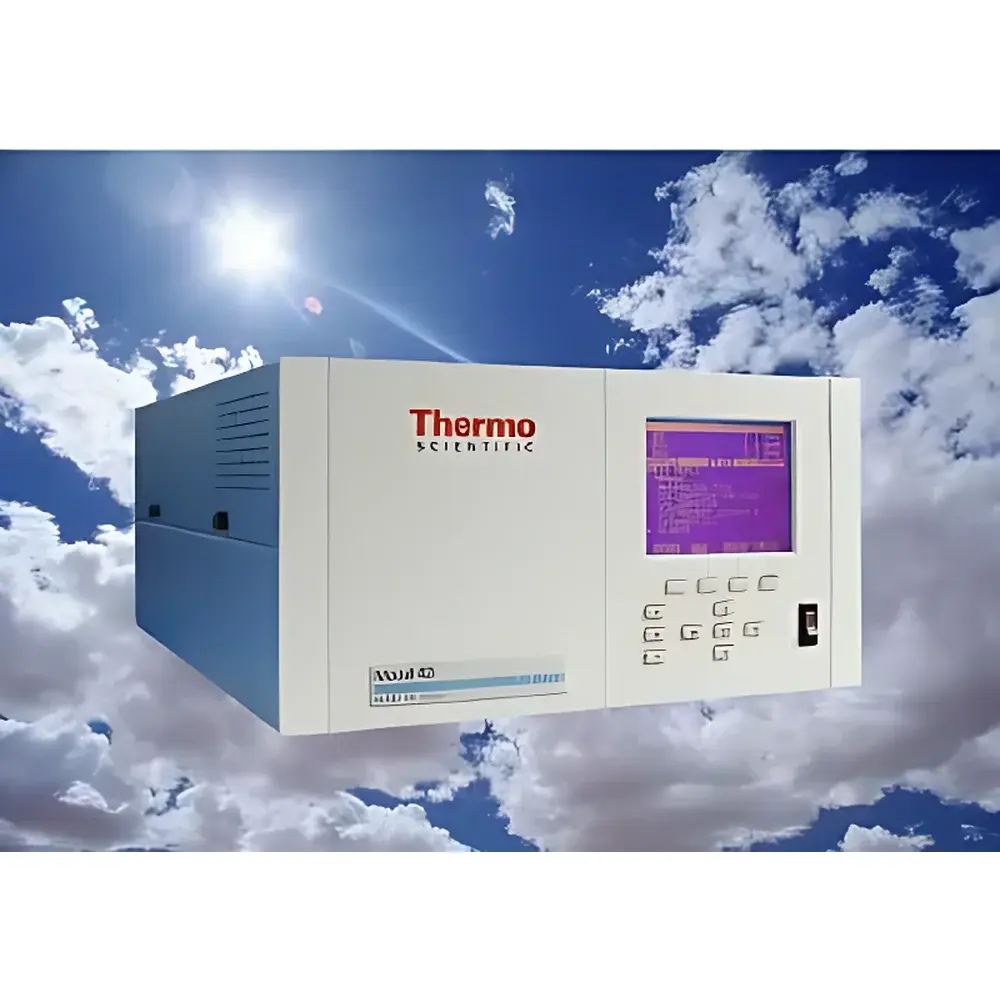
Thermo Fisher Scientific Model 42i Nitrogen Oxides (NO-NO₂-NOₓ) Analyzer
| Brand | Thermo Fisher Scientific |
|---|---|
| Origin | USA |
| Manufacturer | Thermo Fisher Scientific |
| Product Line | 42i Series |
| Detection Principle | Chemiluminescence |
| Measurement Range | 0–100 ppm (NO/NO₂/NOₓ) |
| LOD | 0.40 ppb (60-s average) |
| Zero Noise | 0.20 ppb RMS |
| 24-hr Zero Drift | < 0.40 ppb |
| 24-hr Span Drift | ±1% of full scale |
| Response Time | < 5 s |
| Operating Modes | Dual-range, Auto-ranging, NO-only, NOₓ-only, or simultaneous NO/NO₂/NOₓ output |
| Calibration | Independent calibration for NO, NO₂, and NOₓ |
| Environmental Correction | Integrated temperature & pressure compensation |
| Connectivity | Ethernet interface with remote access capability |
| Display | High-resolution LCD with customizable soft keys |
| Data Storage | Flash-based memory with extended capacity |
| Compliance | Designed to meet EPA Performance Specification 1 (PS-1), EN 14211, ISO 7935, and supports GLP/GMP audit trails per FDA 21 CFR Part 11 requirements |
Overview
The Thermo Fisher Scientific Model 42i Nitrogen Oxides (NO-NO₂-NOₓ) Analyzer is a laboratory-grade, chemiluminescence-based gas analyzer engineered for continuous, high-fidelity measurement of nitrogen monoxide (NO), nitrogen dioxide (NO₂), and total reactive nitrogen oxides (NOₓ) in ambient air, stack emissions, and indoor environmental monitoring applications. It operates on the well-established principle of gas-phase chemiluminescent reaction between nitric oxide (NO) and ozone (O₃), generating photons proportional to NO concentration. For NO₂ quantification, the instrument incorporates a catalytic molybdenum (Mo) converter that quantitatively reduces NO₂ to NO prior to detection—enabling accurate, real-time differentiation between NO and NO₂ species. The 42i employs a single reaction chamber and a single photomultiplier tube (PMT), with electromagnetic valve switching between NO and NOₓ measurement modes—ensuring minimal cross-interference, thermal stability, and long-term baseline integrity. Its optical architecture, refined from the legacy 42-series platform, delivers sub-part-per-trillion sensitivity and robust signal-to-noise performance across dynamic concentration ranges—from trace-level ambient monitoring (sub-ppb) to industrial emission compliance (up to 100 ppm).
Key Features
- Chemiluminescence detection with Mo-converter-based NO₂ conversion, validated for accuracy under variable humidity and temperature conditions
- Simultaneous, independent analog and digital outputs for NO, NO₂, and NOₓ concentrations with user-selectable units (ppb, ppm, µg/m³, mg/m³)
- Dual-range and auto-ranging operation modes for seamless adaptation to fluctuating concentration profiles without manual intervention
- Integrated temperature and barometric pressure compensation algorithms compliant with ISO 7935 and EPA Method 7E requirements
- Ethernet-enabled network interface supporting remote configuration, real-time data streaming, firmware updates, and diagnostic telemetry via standard TCP/IP protocols
- High-resolution backlit LCD display with context-sensitive soft keys—programmable to launch frequently used functions including calibration, zero/span verification, and alarm threshold adjustment
- Flash-based internal memory capable of storing >1 million timestamped data points with configurable logging intervals (1-second to 1-hour resolution)
- Modular internal layout optimized for field serviceability—optical path alignment, PMT gain calibration, and converter efficiency verification accessible without specialized tools
Sample Compatibility & Compliance
The 42i analyzer is compatible with sample gas streams meeting EPA Method 7E conditioning specifications: dew point ≤ −10 °C, particulate loading < 1 mg/m³, and hydrocarbon interference minimized via optional hydrocarbon scrubber integration. It meets U.S. EPA Performance Specification 1 (PS-1) for NOₓ analyzers used in Continuous Emission Monitoring Systems (CEMS), as well as European Standard EN 14211 for ambient air quality measurement. Instrument firmware supports audit-trail generation—including operator ID, parameter changes, calibration events, and alarm triggers—in accordance with FDA 21 CFR Part 11 and EU Annex 11 requirements for regulated environments. All calibration and diagnostic logs are exportable in CSV or XML format for integration into LIMS or environmental data management platforms.
Software & Data Management
The 42i operates with Thermo Fisher’s iSeries Instrument Manager software suite, providing web-browser-based configuration (no client installation required), real-time trend visualization, and automated report generation. Data export supports both polled (HTTP GET) and push (FTP/SFTP, MQTT) protocols. Internal memory retains full-resolution time-series data even during network outages, with seamless resynchronization upon recovery. User-defined alarm thresholds—concentration limits, zero/span drift alerts, pressure/temperature deviation warnings, and internal fault codes—are configurable with relay outputs for external SCADA interfacing. Firmware updates are delivered via signed packages to ensure cryptographic integrity and version control traceability.
Applications
- Ambient air quality monitoring networks (AQN) operated by national and municipal environmental agencies
- Regulatory CEMS installations for power plants, cement kilns, and waste incinerators subject to NOₓ emission limits
- Indoor air quality (IAQ) assessment in transportation hubs, tunnels, and underground parking facilities
- Research laboratories conducting atmospheric chemistry studies, catalyst efficiency testing, and photochemical smog chamber experiments
- Calibration laboratories performing transfer standards verification and inter-laboratory comparison exercises
- Mobile monitoring platforms where low power consumption (< 150 W), compact footprint (19″ rack-mountable), and vibration resistance are critical
FAQ
What is the minimum detectable concentration for NO using the 42i analyzer?
The instrument achieves a limit of detection (LOD) of 0.40 ppb (60-second averaging time) for NO, as verified per EPA PS-1 protocol.
Can the 42i distinguish between NO and NO₂ without manual mode switching?
Yes—automated valve sequencing enables fully autonomous, sequential NO and NO₂ measurement cycles, with NOₓ calculated in real time as the sum of both species.
Does the 42i support compliance with FDA 21 CFR Part 11 for electronic records?
Yes—audit trail functionality, electronic signatures, and secure user authentication are enabled via firmware configuration and validated during IQ/OQ protocols.
Is converter efficiency monitoring available onboard?
Yes—the analyzer performs periodic NO₂ challenge tests using internal calibration gas pulses and reports converter efficiency as a diagnostic parameter with configurable alert thresholds.
How is data integrity maintained during network interruptions?
All measurements are buffered in non-volatile flash memory; no data is lost during connectivity loss, and buffered records are transmitted automatically upon reconnection.
Related Products







