
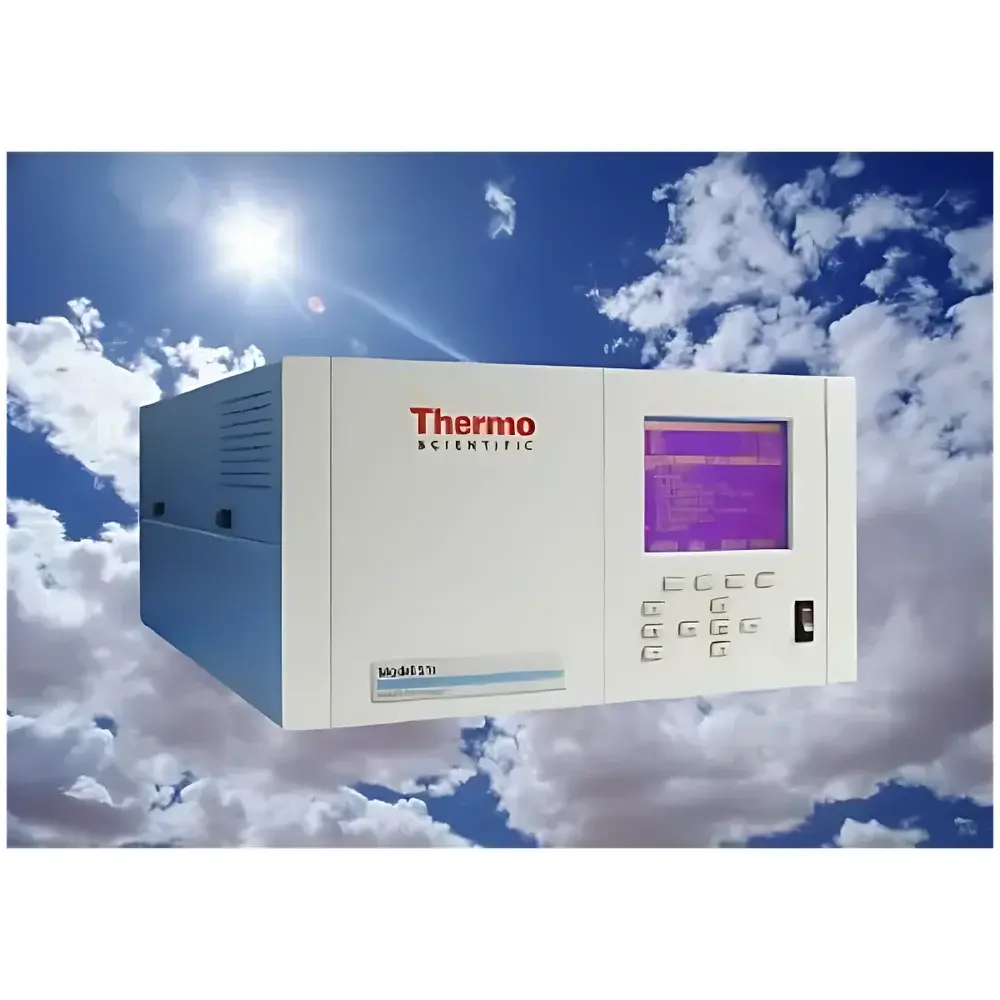
Thermo Fisher Scientific Model 51i Total Hydrocarbons Analyzer
| Brand | Thermo Fisher Scientific |
|---|---|
| Origin | USA |
| Model | 51i |
| Detection Principle | Flame Ionization Detection (FID) |
| Measurement Range | 0–1 to 0–10,000 ppmC |
| LOD | 0.050 ppmC (10-sec avg) |
| Zero Drift (24h) | <0.50 ppmC |
| Span Drift (24h) | <2% of full scale or 0.20 ppmC (whichever is greater) |
| Response Time (90%) | 15 sec (1-sec avg) |
| Accuracy | ±2.0% of reading or ±0.1 ppmC (whichever is greater) |
| Linearity | ±2% of span (10–150% of full scale) |
| Sample Flow Rate | 0.75–1.50 L/min |
| Combustion Air Flow | 150–300 mL/min |
| Zero Air (HC-free) Flow | 10–35 mL/min (H₂) or 50–120 mL/min (H₂/He mixture) |
| Operating Temperature | 15–35 °C |
| Power | 100/115/220–240 VAC ±10%, 50/60 Hz, 420 W |
| Dimensions (W×H×D) | 425 × 219 × 584 mm |
| Weight | 22.7 kg |
| Outputs | Isolated 0–20 mA / 4–20 mA (optional), RS232/RS485, TCP/IP Ethernet, 10 status relays, power-fail alarm |
| Inputs | 16 digital inputs (standard), 8 analog inputs (0–10 VDC, optional) |
Overview
The Thermo Fisher Scientific Model 51i Total Hydrocarbons Analyzer is a high-performance, laboratory-grade ambient air quality monitor engineered for continuous, real-time quantification of total hydrocarbons (THC) expressed as ppm carbon (ppmC). It employs flame ionization detection (FID), a mature, reference-grade analytical technique standardized under ASTM D6348, ISO 8573-5, and EPA Method 25A for gaseous organic compound measurement. Unlike photometric or catalytic bead sensors, FID provides exceptional selectivity for hydrocarbon species—responding linearly to C₁–C₁₂ aliphatic, aromatic, and olefinic compounds while exhibiting negligible response to CO₂, H₂O, NOₓ, SO₂, and common inorganic gases. The instrument’s dual configuration options—low-temperature (LT) and high-temperature (HT)—enable optimized performance across diverse sampling environments: LT mode minimizes condensation in humid ambient air streams, while HT mode ensures complete volatilization and detection of semi-volatile organics (e.g., C₈–C₁₂) in industrial stack or process gas applications. Its robust thermal management system maintains detector and oven stability within ±0.5 °C, directly supporting long-term baseline reproducibility required for regulatory compliance monitoring.
Key Features
- FID-based detection with proven sensitivity (LOD: 0.050 ppmC, 10-sec averaging) and wide dynamic range (0–1 to 0–10,000 ppmC), configurable via factory presets or user-defined spans
- Real-time signal correction algorithms compensate for background drift, humidity-induced quenching, and combustion efficiency variations—ensuring metrological traceability per ISO/IEC 17025 calibration practices
- Integrated 7-inch high-resolution LCD display with customizable soft-key interface: users assign function keys to frequently accessed menus (e.g., calibration log review, span gas verification, diagnostic self-test)
- Onboard flash memory (≥2 GB) stores ≥12 months of second-by-second data (including raw FID current, temperature logs, relay states, and calibration events) with automatic timestamping and UTC synchronization
- Standard Ethernet (TCP/IP) port compliant with Modbus TCP and HTTP RESTful API protocols—enabling seamless integration into SCADA systems, centralized EMS platforms, and cloud-based environmental data warehouses
- Configurable analog outputs (isolated 4–20 mA, 0–20 mA) with NIST-traceable scaling; optional 16-channel digital I/O supports external valve sequencing, alarm latching, and interlock signaling per IEC 61511 SIL-2 requirements
Sample Compatibility & Compliance
The Model 51i accepts sample gas streams from ambient air, indoor workspaces, fenceline monitoring points, or conditioned process ducts—provided particulate loading remains below 1 mg/m³ and dew point is maintained at least 10 °C below operating temperature. It complies with key international standards governing air quality instrumentation: EN 14625 (ambient THC monitoring), ISO 10156 (gas cylinder labeling for calibration standards), and US EPA Performance Specification 8 (PS-8) for FID-based THC analyzers. Its firmware architecture supports 21 CFR Part 11-compliant audit trails—including operator ID logging, electronic signature capture for calibration events, and immutable record retention—making it suitable for GLP and GMP-regulated facilities. All internal gas pathways are electropolished stainless steel with SilcoNert® deactivation to prevent adsorption of polar VOCs such as aldehydes or ketones.
Software & Data Management
Instrument control and data handling are managed through Thermo Fisher’s proprietary Insight™ Software Suite (v4.2+), deployable on Windows 10/11 platforms. The software enables remote configuration, scheduled zero/span validation, and automated report generation in PDF/CSV formats compliant with EU Directive 2008/50/EC Annex IX reporting templates. Raw FID current signals (0–1 V DC) are digitized at 10 Hz and stored with metadata tags (e.g., flow rate, pressure, detector temperature) to support uncertainty budgeting per GUM (JCGM 100:2018). Data export includes ISO/IEC 17025-required elements: measurement uncertainty estimates (k=2), calibration certificate references, and environmental condition logs. Firmware updates are delivered via signed .pkg files with SHA-256 hash verification to ensure integrity and prevent unauthorized modification.
Applications
- Ambient air quality networks (AAQNs) performing continuous THC monitoring per national air quality objectives (e.g., China’s HJ 654-2013, India’s CPCB guidelines)
- Industrial fenceline monitoring for LDAR (Leak Detection and Repair) programs under US EPA 40 CFR Part 60 Subpart OOOOa and EU IED Annex I
- Indoor air quality (IAQ) assessment in semiconductor cleanrooms, pharmaceutical manufacturing suites, and battery production facilities
- Calibration laboratory reference standard transfer using certified hydrocarbon gas mixtures (NIST SRM 1860a, BIPM P-101)
- Mobile monitoring platforms integrating GPS-synchronized THC mapping for urban pollution hotspot identification
FAQ
What calibration gases are recommended for routine verification?
Certified methane-in-air standards (e.g., 10 ppmC, 100 ppmC, 1000 ppmC) traceable to NIST Standard Reference Materials (SRMs) are preferred. Propane or hexane blends may be used if method validation confirms equivalent FID response factors.
Can the 51i operate unattended for extended periods?
Yes—its solid-state electronics, passive cooling design, and auto-diagnostic routines (e.g., flame-out detection, flow sensor validation, voltage rail monitoring) support >30-day unattended operation when paired with redundant zero air supply and scheduled remote health checks.
Is the instrument compatible with third-party data acquisition systems?
Fully compatible via Modbus TCP (register map provided in Appendix B of User Manual) and ASCII-based RS232/RS485 serial protocol (EIA/TIA-232-F and -485-A compliant); no proprietary drivers required.
How does the analyzer handle high-humidity samples?
The LT configuration incorporates a thermoelectrically cooled Nafion™ dryer (optional) upstream of the FID, maintaining sample dew point ≤5 °C. Alternatively, chilled mirror hygrometers can be integrated into the sample train for real-time moisture compensation.
What maintenance intervals are specified for regulatory compliance?
Daily: zero check; Weekly: span verification; Quarterly: FID jet cleaning and detector alignment; Annually: full metrological recalibration with uncertainty evaluation per ISO/IEC 17025 Clause 6.5.
Related Products







