
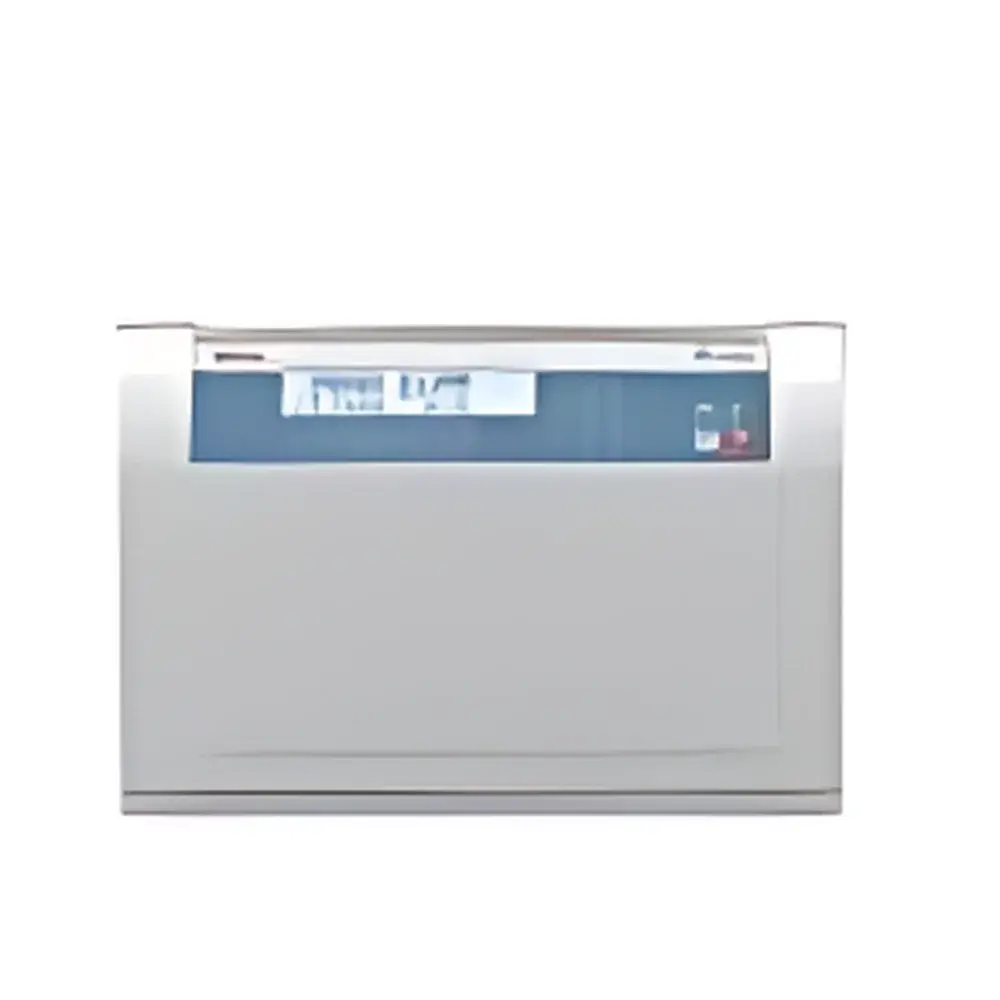
Thermo Fisher Scientific Multifuge X1 High-Speed Refrigerated Centrifuge
| Brand | Thermo Fisher Scientific |
|---|---|
| Origin | USA |
| Model | Multifuge X1 |
| Max Capacity | 6 × 400 mL |
| Max Speed | 15,200 rpm |
| Max RCF | 25,830 × g (with fixed-angle rotor) |
| Temperature Range | –10 °C to +40 °C |
| Dimensions (W × D × H closed) | 44 cm × 60.5 cm × 36 cm |
| Weight | 57.5 kg (base configuration) / 91.5 kg (fully equipped) |
| Compliance | IEC 61010-1, IEC 61010-2-020, EN 292, EN 61326, EN 55011 Class B |
| Certifications | UL, CSA, CE, IVD |
Overview
The Thermo Fisher Scientific Multifuge X1 is a high-speed refrigerated centrifuge engineered for precision, safety, and operational flexibility in regulated laboratory environments. Utilizing advanced rotor dynamics and a dual-sensor temperature control architecture, the X1 maintains precise thermal management of both chamber air and sample temperature—critical for preserving labile biomolecules during isolation protocols. Its modular design supports a wide range of rotor configurations—including fixed-angle, horizontal, and high-capacity swing-out types—enabling applications from routine clinical specimen processing to demanding molecular biology workflows such as plasmid DNA purification, viral pellet recovery, and subcellular fractionation. Designed and manufactured in the United States, the Multifuge X1 complies with international safety and electromagnetic compatibility standards (IEC 61010-1, EN 61326), and carries IVD certification for in vitro diagnostic use in clinical laboratories operating under ISO 13485 or CLIA frameworks.
Key Features
- Auto-Lock® III Rotor System: Tool-free rotor installation and removal completed in under 3 seconds; eliminates mechanical wear and simplifies cleaning of the centrifuge chamber.
- SMARTSpin® Technology: Real-time imbalance detection, adaptive acceleration/deceleration profiles (9 acceleration and 10 deceleration settings), and automatic run termination upon anomaly detection ensure reproducible results and operator safety.
- Dual-Temperature Control: Independent monitoring of ambient chamber air and sample temperature enables accurate thermal regulation—even during extended runs—supporting protocols requiring strict thermal stability (e.g., RNA integrity preservation).
- ClickSeal® Biocontainment System: One-handed, latch-free sealing of swing-bucket rotors; validated for biosafety level 2 (BSL-2) containment per WHO and CDC guidelines when used with certified rotors (e.g., BIOShield 720).
- Programmable Interface: Full alphanumeric keypad with 99 programmable methods; real-time parameter adjustment during operation (speed, time, temperature); pre-cool activation via dedicated button.
- Energy-Efficient Refrigeration: CFC-free cooling system with optimized heat dissipation; rated at 1010–1400 W (230 V) and 850–1200 W (120 V), compliant with ENERGY STAR®-aligned thermal management practices.
Sample Compatibility & Compliance
The Multifuge X1 accommodates diverse sample formats through interchangeable rotor systems, including 6 × 400 mL fixed-angle (Fiberlite F14-6x400y), 4 × 400 mL horizontal (TX-400), and specialized biocontainment rotors (BIOShield 720, 8×50 sealed). It supports standard conical tubes (15 mL, 50 mL), microcentrifuge tubes (0.2–2.0 mL), PCR plates, and blood collection tubes (up to 76 per run in TX-400 configuration). All rotors are certified to IEC 61010-2-020 mechanical safety requirements and undergo full traceable validation per ISO 17025 calibration principles. The instrument meets FDA 21 CFR Part 11 readiness criteria when paired with Thermo Fisher’s optional CentriVero™ software for audit-trail-enabled method storage and user access control.
Software & Data Management
While the Multifuge X1 operates via an embedded microprocessor-based controller, it integrates seamlessly with Thermo Fisher’s CentriVero™ software suite for centralized fleet management, method synchronization across instruments, and electronic record retention. Data export is supported via USB port (CSV format), enabling direct import into LIMS or ELN platforms compliant with GLP/GMP documentation standards. Audit trails include timestamped records of rotor ID, speed, RCF, temperature setpoint, run duration, and user login—fully traceable for regulatory inspections under ISO/IEC 17025, CAP, or CLIA accreditation.
Applications
- Clinical diagnostics: Separation of serum/plasma from whole blood (TX-400 rotor, 3,000 × g, 10 min)
- Molecular biology: Pellet recovery of plasmid DNA (Fiberlite F14-6×50, 24,000 × g), viral particles (Fiberlite F8-50y, 24,000 × g), and exosomes (F14-6×50, 20,000 × g, 90 min)
- Cell culture: Harvesting adherent and suspension cells (F14-6×50, 1,500 × g, 10 min)
- Blood banking: Platelet-rich plasma (PRP) preparation using swing-bucket gradients (TX-200, 2,500 × g)
- Tuberculosis diagnostics: Processing of sputum samples in sealed 8×50 rotor under BSL-3-compatible conditions
FAQ
Does the Multifuge X1 support GMP-compliant operation?
Yes—when configured with CentriVero™ software, user authentication, and electronic audit trails, the system satisfies core requirements of FDA 21 CFR Part 11 and EU Annex 11 for computerized system validation.
Can the X1 be used for continuous operation over multiple shifts?
It is rated for intermittent duty cycle (IEC 61010-1 Class II); continuous unattended operation beyond 9 hours 59 minutes requires protocol-specific risk assessment and thermal load monitoring.
Is rotor calibration traceable to NIST standards?
All Fiberlite rotors include factory-calibrated RCF tables with documented uncertainty budgets traceable to NIST SRM 2812 (rotational speed reference standard).
What maintenance intervals are recommended?
Thermo Fisher recommends biannual preventive maintenance by authorized service engineers, including vacuum seal inspection, refrigerant pressure verification, and rotor cavity debris removal per SOP-CL-027.
How does the SMARTSpin® system improve experimental reproducibility?
By dynamically adjusting ramp profiles based on detected load distribution and minimizing vibration-induced sample resuspension, SMARTSpin® reduces inter-run coefficient of variation (CV) in pellet density by up to 37% compared to conventional acceleration algorithms.



