
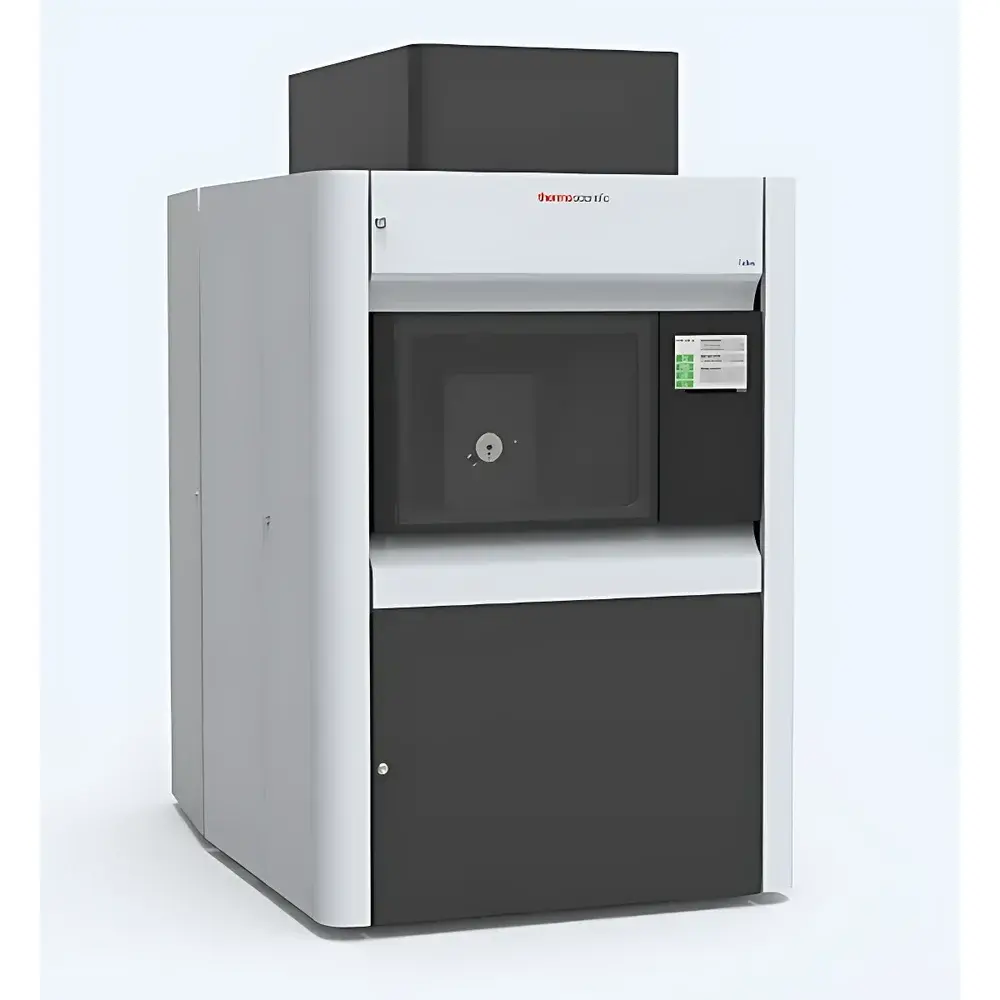
Thermo Fisher Talos F200X S/TEM Scanning/Transmission Electron Microscope
| Brand | Thermo Fisher |
|---|---|
| Origin | Czech Republic |
| Model | Talos F200X S/TEM |
| Accelerating Voltage | 200 kV (standard configuration) |
| Resolution | <0.12 nm TEM point resolution, <0.16 nm STEM HAADF resolution |
| EDS System | Super-X with four integrated silicon drift detectors (SDDs) |
| Camera | Ceta 16M CMOS, 25 fps at 512 × 512 |
| Stage | Piezo-driven high-precision stage with sub-nanometer stability |
| Software | Thermo Scientific Velox S/TEM Platform (FDA 21 CFR Part 11 compliant audit trail option available) |
Overview
The Thermo Fisher Talos F200X S/TEM is a high-performance scanning/transmission electron microscope engineered for quantitative, multi-dimensional nanomaterial characterization in academic, governmental, and industrial research laboratories. Operating at a standard accelerating voltage of 200 kV, it combines high-brightness X-FEG electron optics with a constant-power X-TWIN objective lens to deliver sub-angstrom TEM point resolution (<0.12 nm) and high-angle annular dark-field (HAADF) STEM resolution better than 0.16 nm. Its dual-mode architecture enables seamless switching between conventional TEM imaging, analytical STEM, and simultaneous multi-signal acquisition—including bright-field (BF), annular dark-field (ADF), high-angle ADF (HAADF), and differential phase contrast (DPC)—all within a single instrument platform. The system is designed for rigorous scientific workflows requiring reproducible data acquisition, traceable calibration, and compliance-ready documentation.
Key Features
- X-FEG high-brightness Schottky field-emission gun delivering up to five times higher beam current than standard FEG sources while maintaining small convergence angles—enabling superior signal-to-noise ratio in both low-dose TEM and high-current EDS mapping
- Super-X EDS system with four monolithic silicon drift detectors (SDDs), achieving collection solid angles exceeding 1.0 sr and spectral acquisition rates up to 105 counts per second—optimized for rapid, high-fidelity elemental quantification at nanoscale spatial resolution
- Ceta 16M CMOS camera offering large field-of-view imaging at 25 frames per second (512 × 512 binning), enabling real-time dynamic observation and high-throughput tilt-series acquisition
- Piezo-driven precision stage with active drift compensation and sub-nanometer positional repeatability—critical for atomic-resolution tomography, in situ heating/cooling experiments, and correlated multimodal analysis
- Velox S/TEM software platform featuring intelligent scan engine, multi-detector synchronization, automated aperture alignment, and built-in GLP/GMP-supporting metadata tagging (including timestamped parameter logging and user-accessible audit trails)
- Remote operation architecture with SmartCam digital search/view camera, eliminating darkroom dependency and supporting fully unattended acquisition protocols
Sample Compatibility & Compliance
The Talos F200X accommodates standard 3 mm TEM grids and supports a wide range of specialized in situ holders—including heating, cooling, electrical biasing, and liquid/gas environmental cells—enabling time-resolved structural and chemical evolution studies under controlled conditions. All hardware and software modules comply with ISO/IEC 17025 requirements for testing laboratories and support implementation of Good Laboratory Practice (GLP) and Good Manufacturing Practice (GMP) frameworks. Optional FDA 21 CFR Part 11-compliant electronic signature and audit trail functionality are available for regulated environments. Instrument performance is validated against ASTM E1189 (TEM resolution measurement) and ISO 16700 (EDS quantification standards).
Software & Data Management
Velox S/TEM serves as the unified control and analysis environment, integrating acquisition, processing, and reporting into a single workflow. It supports real-time spectral imaging, 3D EDS tomography reconstruction, DPC vector field mapping, and machine-learning-assisted particle segmentation. Raw data are stored in open-format HDF5 containers with embedded metadata conforming to the EMDB/EMPIAR metadata schema. Data export options include TIFF, MRC, and NRRD formats compatible with third-party platforms such as DigitalMicrograph, HyperSpy, and TomoJ. Remote diagnostics, predictive maintenance alerts, and firmware update management are handled via Thermo Fisher’s Instrument Health Monitoring (IHM) module.
Applications
- Atomic-scale defect analysis in semiconductor heterostructures and battery cathode materials
- In situ thermal and mechanical deformation studies of metallic alloys and 2D materials
- Quantitative 3D compositional mapping of catalyst nanoparticles using EDS tomography
- Magnetic domain imaging via differential phase contrast (DPC) in multiferroic oxides
- Correlative light-electron microscopy (CLEM) sample navigation and targeting
- High-throughput screening of nanoparticle size distribution, crystallinity, and interfacial chemistry
FAQ
What is the standard accelerating voltage for the Talos F200X S/TEM?
The instrument operates at a nominal accelerating voltage of 200 kV, optimized for high-resolution imaging and analytical performance across diverse material classes.
Does the system support automated EDS quantification according to ISO 16700?
Yes—Velox software includes certified quantification routines aligned with ISO 16700, including ZAF and φ(ρz) correction models, standardless analysis, and reference-based calibration workflows.
Can the Talos F200X be integrated into a centralized lab network with remote access controls?
Absolutely—the system supports secure LDAP/Active Directory authentication, role-based user permissions, and encrypted VNC-based remote operation with full audit logging.
Is the piezo stage compatible with cryo-TEM workflows?
While the standard Talos F200X is not a dedicated cryo-system, its piezo stage can be integrated with third-party cryo-transfer systems; however, full cryo-TEM capability requires the Talos Arctica or Glacios platforms.
How is instrument stability maintained during long-duration tilt-series acquisitions?
Stability is ensured through active thermal regulation of the column, vacuum-integrated vibration damping, real-time beam shift correction, and continuous stage position feedback from integrated capacitive sensors.




