
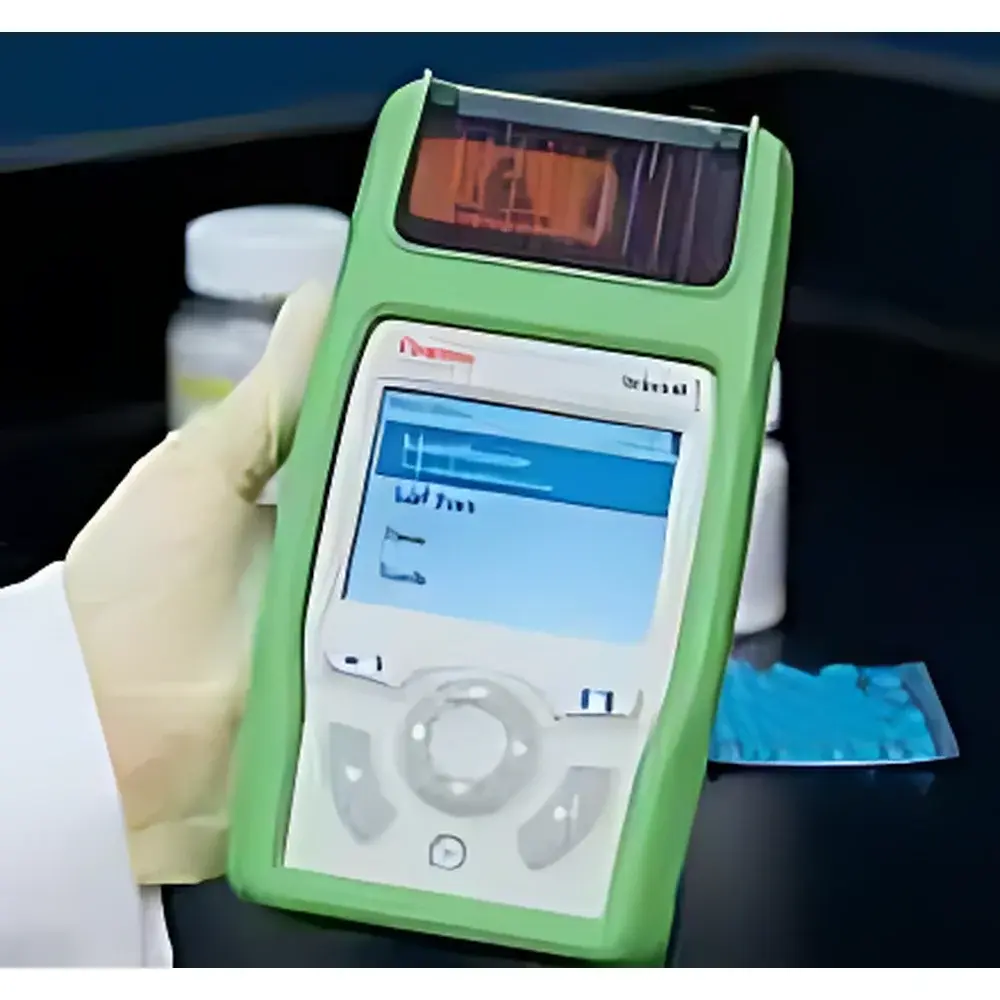
Thermo Fisher TruScan GP Handheld Raman Spectrometer
| Brand | Thermo Fisher |
|---|---|
| Origin | USA |
| Manufacturer | Thermo Fisher Scientific |
| Product Type | Imported |
| Model | TruScan GP |
| Instrument Category | Portable/Handheld Raman Spectrometer |
| Spectral Range | 250–2875 cm⁻¹ |
| Spectral Resolution | 8–10.5 cm⁻¹ (FWHM, across full range) |
| Spatial Resolution | 1 µm (lateral), 1 µm (axial) |
| Minimum Wavenumber | 8 cm⁻¹ |
| Spectral Repeatability | ≤0.1 cm⁻¹ |
| Excitation Wavelength | 785 nm ±0.5 nm |
| Laser Linewidth | ≤2 cm⁻¹ |
| Laser Power Output | 250 mW ±25 mW |
| Collection Optics NA | 0.33 |
| Working Distance | 18 mm |
| Spot Size | 0.2–2.5 mm |
| Exposure Time (Auto Mode) | as low as 12 ms |
| Power Supply | AC 100–240 V, 50/60 Hz via DC wall adapter |
| Weight | 0.9 kg (2 lb) |
| Dimensions | 20.8 × 10.7 × 4.3 cm (8.2 × 4.2 × 1.7 in) |
| Operating Temperature | –20 °C to +40 °C (continuous) |
| Barcode Support | Standard 1D & 2D symbologies |
| Regulatory Compliance | FDA 21 CFR Part 11, CE Marked |
| Accessories | Vial holder, universal tablet holder (optional) |
Overview
The Thermo Fisher TruScan GP Handheld Raman Spectrometer is an engineered solution for rapid, non-destructive material identification at the point of need—designed specifically for pharmaceutical raw material verification, finished product inspection, and chemical manufacturing quality control. Based on confocal dispersive Raman spectroscopy, the instrument employs a stabilized 785 nm diode laser with spectral purity ≤2 cm⁻¹ and power output tightly regulated at 250 mW ±25 mW to ensure consistent excitation across diverse sample matrices. Its optical architecture delivers high signal-to-noise ratio spectra across a broad wavenumber range (250–2875 cm⁻¹), enabling robust discrimination of polymorphs, hydrates, APIs, excipients, and counterfeit substances—even through transparent or semi-transparent packaging such as glass vials, plastic bottles, and blister foils. Unlike benchtop systems requiring sample preparation or lab relocation, the TruScan GP operates in ambient conditions (–20 °C to +40 °C), making it suitable for warehouse receiving docks, cleanroom anterooms, and production line checkpoints without compromising analytical rigor.
Key Features
- Lightweight ergonomic design (0.9 kg) optimized for extended handheld use and operator fatigue reduction during high-throughput screening
- High-fidelity spectral acquisition with ≤0.1 cm⁻¹ wavenumber repeatability—critical for regulatory method transfer and long-term instrument qualification
- Automated exposure control with minimum integration time of 12 ms, enabling rapid analysis of light-sensitive or thermally labile compounds
- Embedded chemometric engine supporting real-time library matching against pre-validated reference spectra (e.g., USP, Ph. Eur., manufacturer-specific libraries)
- Intelligent acquisition guidance including auto-focus feedback, signal saturation alerts, and built-in performance qualification (PQ) checks prior to each measurement
- Comprehensive data integrity safeguards: electronic signatures, audit trail logging, and full compliance with FDA 21 CFR Part 11 requirements for electronic records and signatures
Sample Compatibility & Compliance
The TruScan GP accommodates a wide range of solid and semi-solid samples—including powders, tablets, capsules, crystals, and lyophilized products—without physical contact or sample preparation. Its 18 mm working distance and adjustable spot size (0.2–2.5 mm) allow reliable interrogation of heterogeneous surfaces and small-diameter containers. The system supports direct analysis through common pharmaceutical packaging materials (e.g., polypropylene, PET, borosilicate glass) while maintaining spectral fidelity sufficient for identity confirmation per ICH Q5C and USP . All firmware and software components are validated under GxP-aligned protocols, with documentation packages available for IQ/OQ/PQ execution. CE marking confirms conformity with EU Directive 2014/30/EU (EMC) and 2014/35/EU (LVD). Device-level traceability is maintained via unique serial number registration and integrated calibration certificate management.
Software & Data Management
Operating on a purpose-built embedded Linux platform, the TruScan GP runs Thermo Fisher’s proprietary TruTools™ software suite—designed for seamless integration into enterprise quality management systems (QMS). Data files adhere to ASTM E131-22 and ISO/IEC 17025-compliant metadata structures, embedding instrument parameters, environmental conditions, user credentials, and spectral acquisition settings. Export formats include .spc, .csv, and .pdf reports with embedded digital signatures. Remote synchronization with networked LIMS or ELN platforms is supported via secure HTTPS API endpoints. Software updates are delivered through signed firmware packages with cryptographic hash verification to preserve chain-of-custody integrity. Audit trails record all user actions—including spectrum acquisition, library edits, and report generation—with immutable timestamps and role-based access controls.
Applications
- Pharmaceutical raw material identity testing per USP and EP 2.2.48, including verification of incoming active pharmaceutical ingredients (APIs), excipients, and reagents
- Counterfeit drug detection through spectral fingerprinting of packaging, tablet coatings, and bulk formulations
- In-process monitoring of crystallization endpoints, blend uniformity, and drying kinetics in continuous manufacturing environments
- Chemical inventory verification in research labs and pilot plants—supporting hazard classification (GHS), SDS validation, and storage segregation compliance
- Forensic material analysis in regulatory investigations, customs inspections, and supply chain security audits
FAQ
Does the TruScan GP require external calibration standards for routine operation?
No. The instrument performs automated wavelength and intensity calibration using internal reference sources prior to every measurement session, eliminating manual standardization steps and reducing operator dependency.
Can the TruScan GP distinguish between polymorphic forms of the same API?
Yes. With its spectral resolution of 8–10.5 cm⁻¹ (FWHM) across the full 250–2875 cm⁻¹ range and high photometric stability (<0.1 cm⁻¹ repeatability), it resolves characteristic lattice vibration modes critical for polymorph differentiation—validated per ICH Q5A(R2) comparability guidelines.
Is method transfer from benchtop Raman systems supported?
Yes. Thermo Fisher provides spectral equivalence protocols and cross-platform library migration tools compliant with ASTM E1655-21, enabling straightforward validation of existing methods on the handheld platform.
What cybersecurity measures are implemented in the embedded software?
The device enforces TLS 1.2+ encrypted communications, disables unused network services by default, and supports enterprise-grade authentication via LDAP/Active Directory integration—all aligned with NIST SP 800-53 Rev. 5 controls for scientific instrumentation.
How is data backup and archival handled?
All spectra and associated metadata are stored locally on encrypted internal flash memory and can be automatically synced to designated network shares or cloud repositories using configurable retention policies governed by 21 CFR Part 11 §11.10(d).






