
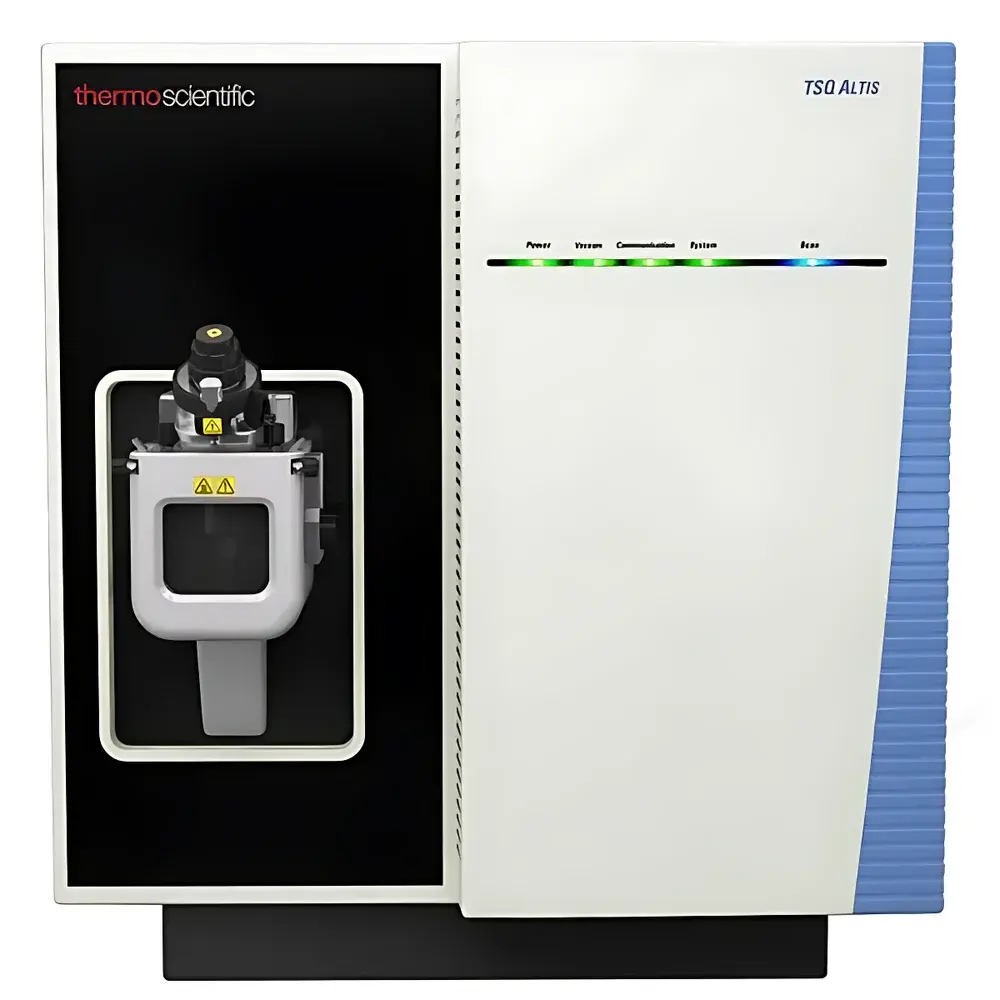
Thermo Fisher TSQ Altis Triple Quadrupole Mass Spectrometer (LC-MS)
| Brand | Thermo Fisher |
|---|---|
| Origin | Shanghai, China |
| Manufacturer Type | Authorized Distributor |
| Regional Classification | Domestically Manufactured |
| Model | TSQ Altis |
| Instrument Type | Tandem Quadrupole (Triple Quad) |
| Software Platform | Thermo Scientific Chromeleon CDS & TraceFinder |
| Linear Dynamic Range | >6 orders of magnitude |
| Minimum Dwell Time | 0.3 ms |
| Polarity Switching Time | 5 ms |
| SRM Acquisition Speed | up to 600 transitions/sec |
| Ion Source | Heated Electrospray Ionization (H-ESI) and Atmospheric Pressure Chemical Ionization (APCI) compatible |
| Collision Cell | Active Q2 with RF-only mode and optimized collision gas dynamics |
| Regulatory Compliance | Designed for 21 CFR Part 11–compliant workflows, GLP/GMP traceability, and ISO/IEC 17025-aligned validation support |
Overview
The Thermo Fisher TSQ Altis Triple Quadrupole Mass Spectrometer is a high-performance liquid chromatography–mass spectrometry (LC-MS/MS) platform engineered for robust, high-sensitivity targeted quantitation and screening in regulated and research laboratories. Operating on the principle of selected reaction monitoring (SRM) within a tandem quadrupole architecture, the instrument isolates precursor ions in Q1, fragments them in the pressurized active Q2 collision cell, and detects specific product ions in Q3—enabling exceptional selectivity against complex biological, environmental, and food matrices. Its design integrates hardware innovations—including thermally stabilized ion optics, low-noise detection electronics, and rapid polarity-switching capability—with software-driven method automation to deliver reproducible quantitative results across diverse sample types and concentration ranges.
Key Features
- Ultra-high sensitivity with sub-femtogram-level detection limits for small molecules under standard UHPLC conditions
- Linear dynamic range exceeding six orders of magnitude, supporting simultaneous quantitation of low- and high-abundance analytes without dilution or re-injection
- SRM acquisition speed up to 600 transitions per second, enabling comprehensive multi-analyte panels (e.g., >1,000 compounds per run) while maintaining ≥12 data points across narrow UHPLC peaks
- Active Q2 collision cell with adaptive RF voltage control and optimized nitrogen gas flow for consistent fragmentation efficiency and reduced spectral skew
- Sub-5 ms polarity switching time, facilitating dual-polarity acquisition within a single chromatographic run without compromising dwell time allocation
- Minimum dwell time of 0.3 ms ensures precise temporal resolution for fast-eluting peaks typical of ultra-high-pressure separations
- Preconfigured SRM libraries and intelligent dwell time calculation algorithms automatically assign optimal dwell based on user-defined peak width or fixed cycle time constraints
Sample Compatibility & Compliance
The TSQ Altis supports a broad spectrum of sample types—including plasma, urine, tissue homogenates, soil extracts, water samples, and food digests—when coupled with Thermo Scientific Vanquish UHPLC or Dionex IC systems. Its ion source architecture accommodates both heated electrospray ionization (H-ESI) and atmospheric pressure chemical ionization (APCI), allowing method flexibility across polar, nonpolar, thermally labile, and volatile analytes. From a regulatory standpoint, the system is architected for compliance with FDA 21 CFR Part 11 requirements when used with Chromeleon CDS v7.3 or later, including full audit trail logging, electronic signatures, and role-based access control. It also supports GLP and GMP environments through documented IQ/OQ/PQ protocols and alignment with ISO/IEC 17025 method validation guidelines for bioanalytical and residue analysis applications.
Software & Data Management
Method development and data processing are streamlined via two integrated software platforms: Chromeleon Chromatography Data System (CDS) serves as the instrument control and sequence management interface, providing validated, audit-ready operation for routine QC labs; TraceFinder software enables automated peak integration, calibration curve fitting, and report generation for targeted workflows—including pesticide residue, pharmaceutical impurity, and clinical biomarker assays. The system supports direct import of discovery-generated MS/MS spectra from Proteome Discoverer or Compound Discoverer into TraceFinder’s method editor, accelerating transition from untargeted screening to validated SRM methods. Integration with mzCloud—a curated, cloud-accessible mass spectral library—allows expansion of compound coverage by retrieving reference spectra and optimized CE values for compounds absent from initial discovery datasets.
Applications
The TSQ Altis is routinely deployed in pharmaceutical quality control (e.g., assay of active pharmaceutical ingredients and genotoxic impurities per ICH M7), clinical toxicology (therapeutic drug monitoring, newborn screening), food safety (mycotoxin, veterinary drug, and pesticide residue testing per EU SANTE/2023/12487), environmental analysis (PFAS, endocrine disruptors, and emerging contaminants), and forensic toxicology. Its combination of speed, sensitivity, and selectivity makes it particularly suitable for high-throughput laboratories performing large-scale surveillance programs where analytical confidence at trace levels (e.g., sub-ng/g in food or pg/mL in plasma) is mandated by regulatory authorities such as the European Commission, US EPA, or China’s CNAS.
FAQ
Is the TSQ Altis manufactured in the United States?
No—the TSQ Altis LC-MS/MS system is assembled and qualified at Thermo Fisher’s manufacturing facility in Shanghai, China, under the same global quality standards applied to instruments produced in Bremen, Germany, and San Jose, California.
Can legacy TSQ Vantage or TSQ Quantum Access MAX methods be migrated directly to the TSQ Altis?
Yes—method portability is maintained through backward-compatible instrument control logic and shared SRM parameter syntax in Chromeleon CDS, enabling seamless transfer with equal or improved signal-to-noise performance without manual re-optimization.
Does the system support quantitative analysis under ISO/IEC 17025 accreditation requirements?
Yes—Thermo Fisher provides comprehensive validation documentation packages, including installation qualification (IQ), operational qualification (OQ), and performance qualification (PQ) templates aligned with ISO/IEC 17025:2017 Annex A.2 for targeted mass spectrometry.
What ion sources are included as standard configurations?
The TSQ Altis ships with a dual-mode ion source capable of H-ESI and APCI operation; optional accessories include nanospray, microflow, and atmospheric pressure photoionization (APPI) sources.
How is data integrity ensured during long-term unattended operation?
Chromeleon CDS implements real-time data streaming to secure network storage, automatic backup of raw files and processing parameters, and continuous system health monitoring with event-triggered alerts—ensuring chain-of-custody integrity over extended batch runs.



