
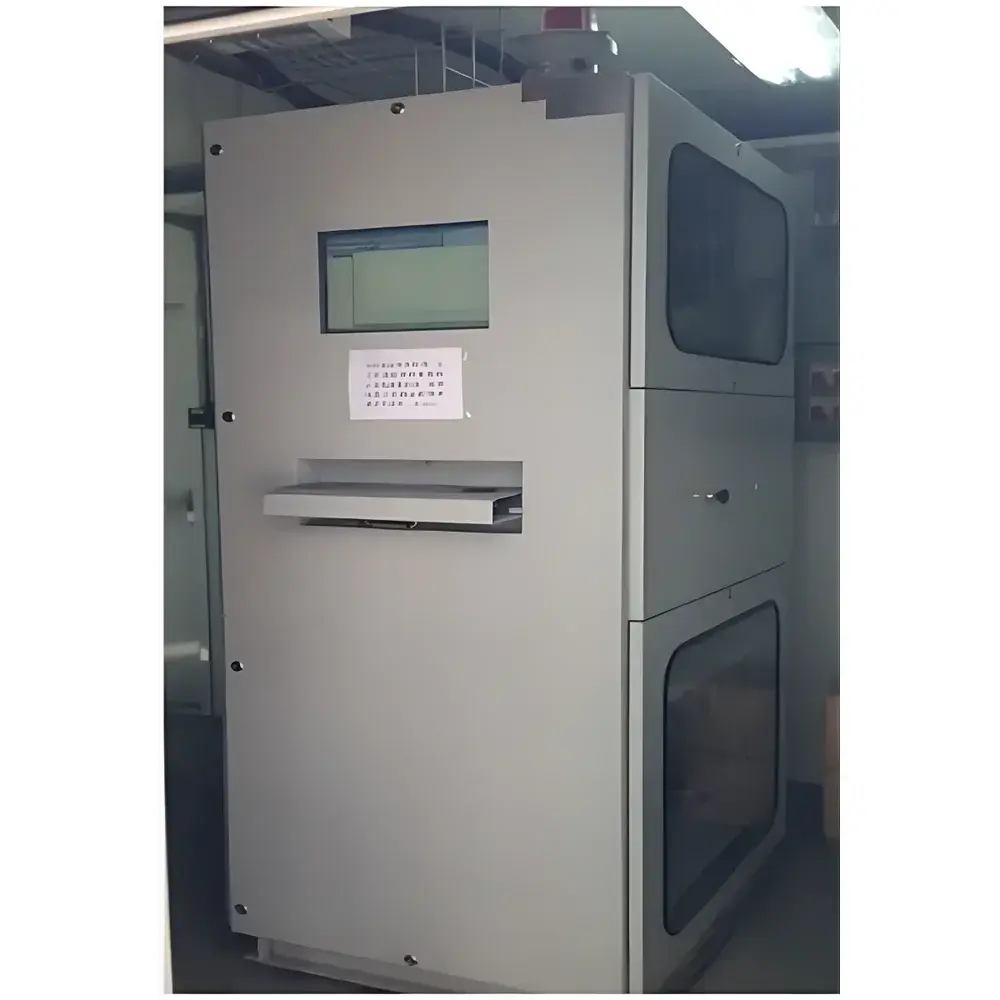
Thermo Fisher TVC-55 Non-Methane Hydrocarbons (NMHC) Continuous Emission Monitoring System
| Brand | Thermo Fisher |
|---|---|
| Origin | USA |
| Manufacturer Type | Authorized Distributor |
| Origin Category | Imported |
| Model | TVC-55 |
| Detection Principle | Gas Chromatography with Flame Ionization Detection (GC-FID) |
| Instrument Type | Online Analytical System |
| Typical Configuration | Integrated CH₄/NMHC Dual-Channel Analyzer |
| Measurement Range | 0–5/50/500 ppm, 0–10/100/1000 ppm, 0–20/200/2000 ppm, or 0–50/500/5000 ppm (user-selectable full-scale ranges) |
| Resolution | 0.025 ppm RMS (300-second averaging time) |
| Accuracy | ±2.0% of reading or ±50 ppb (whichever is greater) |
| Response Time (T₉₀) | ~70 seconds |
Overview
The Thermo Fisher TVC-55 Non-Methane Hydrocarbons (NMHC) Continuous Emission Monitoring System is a certified, regulatory-grade online analyzer engineered for real-time, compliant measurement of methane (CH₄) and total non-methane hydrocarbons in industrial exhaust streams. It employs dual-channel gas chromatography coupled with flame ionization detection (GC-FID), a reference method recognized under EPA Method 25A, EN 12619, and ISO 11890-2 for NMHC quantification. Unlike single-point or sensor-based approaches, the TVC-55 separates CH₄ from C₂–C₁₂+ hydrocarbons via high-resolution capillary column chromatography—ensuring speciation-independent quantification and eliminating interferences from oxygen, moisture, or variable background matrix composition. The system operates on the principle of sequential elution and selective backflush: CH₄ elutes first and is measured by peak height; NMHC components are retained, then backflushed as a collective group and quantified by integrated peak area. This orthogonal signal processing architecture eliminates O₂-induced baseline distortion and ensures robustness across fluctuating combustion conditions.
Key Features
- Direct, simultaneous CH₄ and NMHC measurement using GC-FID—no cold traps, cryogenic cooling, or catalytic oxidation required
- High-temperature, hot-wet sampling architecture: heated probe (up to 200 °C), stainless-steel trace-heated sample line (80–150 °C), and high-temp sample conditioning—preserves volatile integrity of compounds with boiling points up to 260 °C
- Particle and heavy organics removal: dual-stage filtration (0.1 µm pre-filter, >99.995% efficiency; secondary high-temp FID inlet filter)
- Zero air, hydrogen, and calibration gas management with automated valving and pressure regulation
- Intrinsically safe, explosion-proof design: certified per GB3836.1–2000 (equivalent to IEC 60079-0), Class I, Division 1, Group IIC, T4; includes positive-pressure purge cabinet (“X” type), integrated combustible gas detection, and DCS-linked alarm outputs
- Full environmental hardening: IP55-rated enclosure; anti-vibration mounting; corrosion-resistant finish; HVAC with timed ventilation and particulate/activated carbon filtration
Sample Compatibility & Compliance
The TVC-55 is validated for use with flue gases containing particulate loadings ≤10 g/m³, relative humidity up to 100%, and operating temperatures up to 175 °C at the analyzer inlet. Its hot-wet methodology avoids condensation-related losses of water-soluble VOCs (e.g., aldehydes, ketones, alcohols) and prevents adsorption artifacts common with PTFE-lined lines. The system complies with QA/QC requirements of EPA PS-8, EN 14181, and ISO/IEC 17025 for continuous emission monitoring systems (CEMS). Data integrity meets FDA 21 CFR Part 11 and EU Annex 11 expectations through audit-trail-enabled software, electronic signatures, and secure user-role access control. All calibrations are traceable to NIST-certified standards; zero/span verification intervals are configurable per local regulatory mandates (e.g., hourly, daily, or per EN 15267-3).
Software & Data Management
The embedded Thermo Fisher CEMS Suite v4.2 provides fully automated sequence control—including auto-calibration, valve sequencing, temperature ramping, and diagnostic self-checks. Raw chromatograms, retention times, peak heights/areas, and calculated concentrations are stored locally with timestamped metadata. Data export supports Modbus TCP, OPC UA, and 4–20 mA analog outputs for integration into DCS/SCADA environments. Audit logs record all operator actions, parameter changes, and alarm events with immutable timestamps. Optional cloud connectivity enables remote diagnostics, firmware updates, and centralized fleet monitoring across multi-site deployments—all without compromising network segmentation or cybersecurity compliance (IEC 62443-3-3 Level 2 aligned).
Applications
The TVC-55 is deployed across regulated industrial sectors including petrochemical refining, chemical manufacturing, pharmaceutical production, municipal wastewater treatment off-gas streams, and thermal oxidizer stack monitoring. It supports both inlet and outlet monitoring of abatement devices (e.g., RTOs, catalytic oxidizers, carbon adsorbers) to verify destruction efficiency (DRE) and ensure compliance with local VOC emission limits (e.g., China’s GB 31571–2015, US EPA NESHAP Subpart HH, EU IED BREFs). Its ability to operate unattended for >30 days between maintenance cycles makes it suitable for remote or hazardous-area installations where access is restricted.
FAQ
Does the TVC-55 require chilled mirrors or permeation dryers?
No. The hot-wet sampling design eliminates condensation risk and preserves analyte integrity without dehydration—critical for polar VOCs.
Can the system measure NMHC in high-O₂ environments (e.g., boiler flue gas)?
Yes. Oxygen co-elution with methane is mitigated by measuring CH₄ via peak height and NMHC via integrated area—eliminating O₂-induced integration error.
What maintenance intervals are recommended for routine operation?
Filter replacement every 90 days; FID jet cleaning every 180 days; GC column reconditioning annually; full system calibration verification every 7 days (per EN 14181 QAL2).
Is the system compatible with third-party data acquisition platforms?
Yes. Native support for Modbus TCP, OPC UA, and analog I/O ensures seamless integration with Siemens Desigo, Honeywell Experion, Yokogawa CENTUM VP, and custom SCADA solutions.
How is safety ensured in Zone 1 hazardous areas?
Through certified positive-pressure purging (X-type cabinet), redundant gas detection, automatic shutdown interlocks, and structural grounding per IEC 62305—verified during factory acceptance testing (FAT) and site commissioning.







