
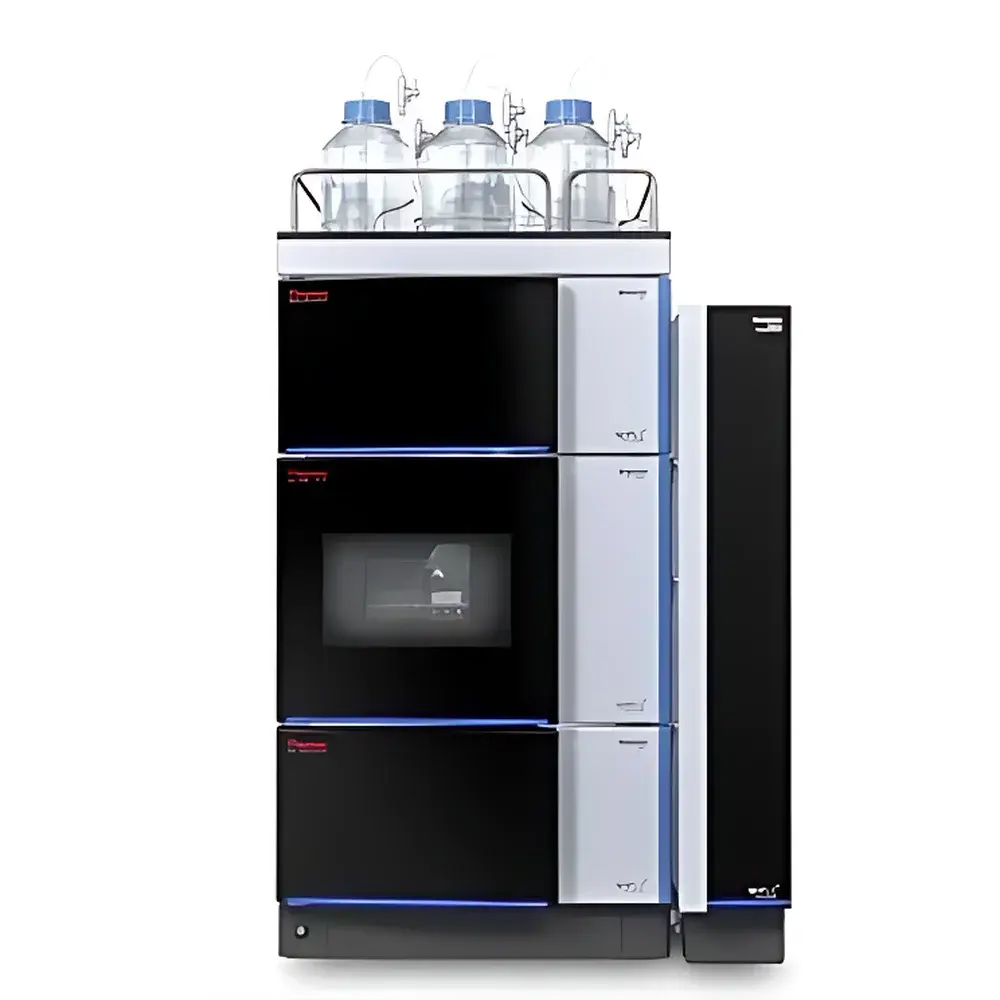
Thermo Fisher Vanquish Flex Quaternary UHPLC System
| Brand | Thermo Fisher |
|---|---|
| Origin | USA |
| Manufacturer Type | Original Equipment Manufacturer (OEM) |
| Product Category | Imported Instrument |
| Model | Vanquish Flex Quaternary UHPLC System |
| Instrument Type | Ultra-High Performance Liquid Chromatograph (UHPLC) |
| Application Scope | Dedicated Analytical Instrument |
| Maximum Pressure | 1000 bar (15,000 psi) |
| Flow Rate Range | Up to 8 mL/min |
| Solvent Channels | 4 (Quaternary Low-Pressure Gradient Mixing) |
| Injector Capacity | 208 injections (single vial) |
| Column Oven Temperature Range | 5–120 °C (dual-zone gas-heated & pressurized air system) |
| Detection Options | Diode Array Detector (DAD) with LightPipe™ technology, Fluorescence Detector (FLD), Electrospray Ionization Mass Spectrometry (ESI-MS) compatible interface |
Overview
The Thermo Fisher Vanquish Flex Quaternary UHPLC System is an engineered platform for high-resolution, high-throughput liquid chromatographic separations under ultra-high pressure conditions. Based on low-pressure quaternary gradient mixing architecture, it delivers precise, reproducible solvent delivery across complex multi-solvent methods—enabling robust method development, transfer, and routine QC/QA applications in regulated and research environments. Its SmartFlow pump technology dynamically compensates for solvent compressibility and backpressure fluctuations, ensuring consistent flow accuracy (<0.07% RSD) and gradient fidelity independent of mobile phase composition or column resistance. Operating at up to 1000 bar (15,000 psi), the system supports sub-2 µm particle-packed columns and advanced stationary phases, delivering enhanced peak capacity, resolution, and analysis speed compared to conventional HPLC systems.
Key Features
- Quaternary low-pressure gradient mixing with four independently controlled solvent channels—ideal for method scouting, gradient optimization, and multi-analyte profiling.
- SmartFlow pump technology with real-time solvent pre-compression compensation—guarantees <0.1% gradient accuracy and <0.07% flow rate RSD across all mobile phase compositions and system backpressures.
- Vanquish Flex Split Injection FT module featuring 208-injection single-vial capacity; expandable to 8,832-sample capacity via optional Vanquish Loader Module supporting 23-well microtiter plate formats.
- Intelligent sample aspiration with active sample pre-compression and air-gap-free metering—ensuring <0.25% injection volume precision and minimal carryover (<0.005%).
- Vanquish Column Compartment H module with dual-zone heated/pressurized gas circulation—maintains stable column temperature from 5 °C to 120 °C with ±0.1 °C stability; includes active solvent pre-heating and post-column cooling to eliminate thermal mismatch effects.
- Viper fingertight fitting system—tool-free, leak-free connections with <0.5 nL dead volume per joint, minimizing band broadening and facilitating rapid system reconfiguration.
Sample Compatibility & Compliance
The Vanquish Flex platform accommodates a broad range of sample matrices—including biological fluids, pharmaceutical formulations, environmental extracts, and polymer solutions—without requiring derivatization or extensive cleanup for most applications. Its modular architecture allows seamless integration with autosamplers, column ovens, detectors, and mass spectrometers compliant with ISO/IEC 17025, ASTM D7976, USP , and ICH Q2(R2) guidelines. All hardware and firmware components meet electromagnetic compatibility (EMC) standards per IEC 61326-1 and safety requirements per IEC 61010-1. When operated with Chromeleon CDS software configured for audit trail, electronic signatures, and user access control, the system satisfies FDA 21 CFR Part 11 and EU Annex 11 requirements for data integrity in GxP-regulated laboratories.
Software & Data Management
The Vanquish Flex system is fully integrated with Thermo Scientific Dionex Chromeleon Chromatography Data System (CDS) software—a validated, scalable platform supporting both single-instrument control and enterprise-wide deployment. Chromeleon implements Operational Simplicity™ design principles, enabling intuitive method building, sequence setup, and report generation without programming expertise. It provides full audit trail functionality—including time-stamped, immutable records of all method changes, instrument events, and user actions—essential for GLP/GMP compliance. Data export complies with AIA, ANDI, and mzML standards; raw data files are stored in open-format .CDF or vendor-neutral .mzML when coupled to MS detectors. Remote monitoring and secure web-based access are supported through Chromeleon Cloud Connect modules.
Applications
- Pharmaceutical impurity profiling and stability-indicating assays per ICH Q5 and Q6 guidelines.
- Biopharmaceutical characterization—including monoclonal antibody subunit analysis, glycan mapping, and peptide mapping workflows.
- Environmental contaminant screening (e.g., PFAS, pesticides, PAHs) using EPA Methods 533, 8321B, and 8082A.
- Food and beverage quality control—vitamin quantitation, mycotoxin detection, and adulterant screening.
- Academic and industrial metabolomics and lipidomics studies requiring high peak capacity and retention time stability across large sample cohorts.
- Method transfer between laboratories and platforms—facilitated by consistent gradient delivery, column temperature control, and standardized data handling protocols.
FAQ
What is the maximum operating pressure of the Vanquish Flex quaternary system?
The system operates at up to 1000 bar (15,000 psi), supporting UHPLC columns with sub-2 µm particles and advanced core-shell technologies.
Can the Vanquish Flex be used for regulatory submissions?
Yes—when paired with validated Chromeleon CDS software configured for 21 CFR Part 11 compliance, including electronic signatures, audit trails, and role-based access control.
Is the quaternary mixer suitable for gradient method development?
Yes—the low-pressure quaternary design enables rapid solvent ratio adjustments, precise dwell volume control (~500 µL), and excellent reproducibility across complex multi-step gradients.
How does the dual-zone column oven improve chromatographic performance?
By independently regulating inlet and outlet gas temperatures, it eliminates thermal lag and ensures solvent entering the column is pre-equilibrated to column temperature—reducing retention time drift and improving peak shape.
What detector options are natively supported?
Native support includes LightPipe-enabled DAD, fluorescence detector (FLD), and electrospray ionization (ESI) interfaces for LC-MS coupling; additional third-party detectors may be integrated via analog/digital I/O or Ethernet protocols.




