
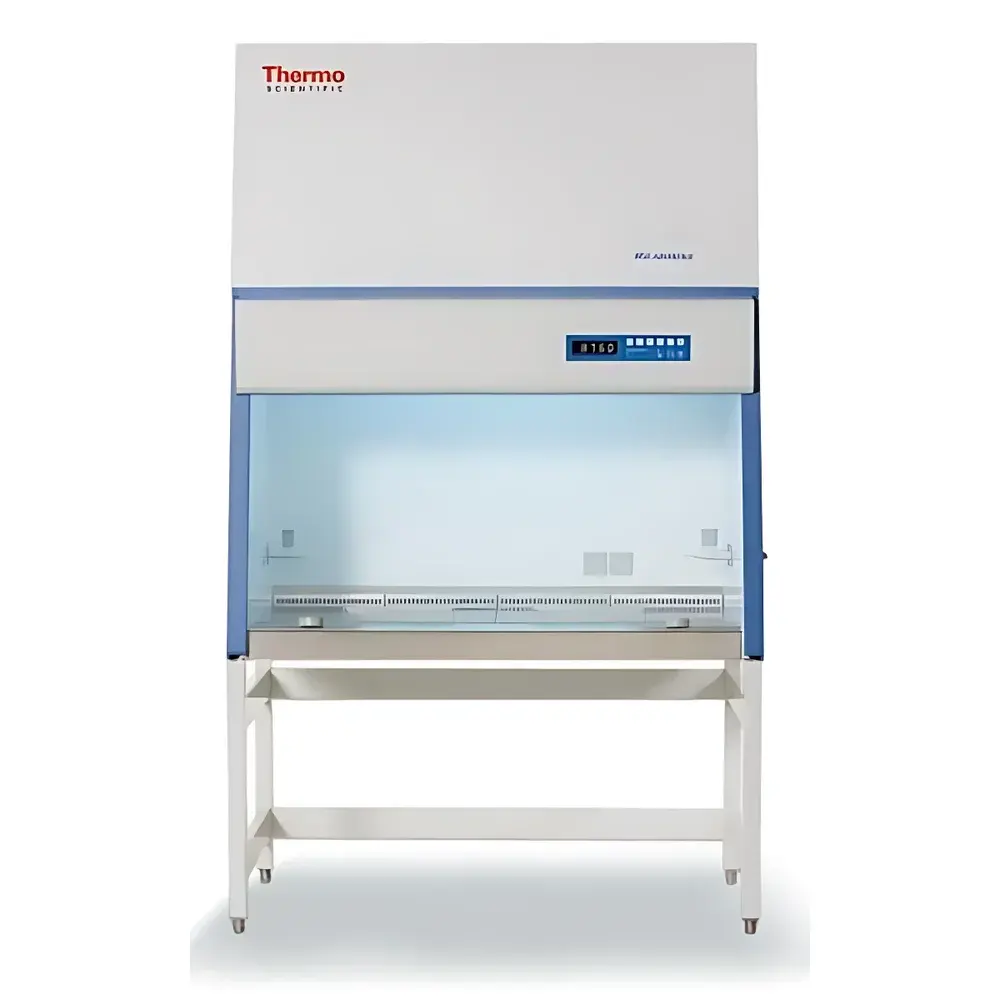
Thermo Scientific 1300 Series A2 Class II Biological Safety Cabinet
| Brand | Thermo Fisher Scientific |
|---|---|
| Origin | Germany |
| Certification | NSF/ANSI 49, UL Listed, EN 1822 H14 HEPA |
| Model | MSC-1356 / MSC-1358 |
| Airflow | 530 m³/h (330 CFM) / 840 m³/h (490 CFM) |
| Work Area Surface | 0.56 m² / 0.84 m² |
| Front Window Opening | 250 mm (max 535 mm) |
| Internal Dimensions (W×H×D) | 780×1200×495 mm / 780×1800×495 mm |
| External Dimensions (W×H×D) | 1520×1300×795 mm / 1520×1900×795 mm |
| Weight (net) | ~530 kg / ~750 kg |
| Filtration Efficiency | ≥99.999% at 0.3 µm |
| Noise Level | 63 dB(A) / 65 dB(A) |
| Illumination | >65 fc |
| Power Input | 230 V, 50/60 Hz |
| Protection Class | IP20 |
| Electrical Rating | 0.2 kW / 0.4 kW |
| UV Lamp Timer | 1–24 h programmable |
Overview
The Thermo Scientific™ 1300 Series A2 Class II Biological Safety Cabinet is an engineered solution for containment of biological agents at Biosafety Levels 1–3, compliant with NSF/ANSI 49 and certified to UL and EN 1822 standards. Designed using Couette-flow-inspired aerodynamic principles, it maintains a unidirectional, laminar downward airflow (70% recirculated, 30% exhausted) across the work surface while simultaneously drawing room air through the front aperture to form an inward-moving protective barrier. This dual-path airflow architecture—combined with H14-grade HEPA filtration on both supply and exhaust streams—ensures ≥99.999% particle removal efficiency at the most penetrating particle size (MPPS) of 0.3 µm. The cabinet operates under negative pressure relative to the laboratory environment, with double-walled construction and vacuum-sealed side panels eliminating leakage pathways. Its structural integrity is reinforced by a seamless, welded U-shaped stainless steel work chamber with radiused corners and polyester-coated non-reflective surfaces resistant to UV, disinfectants, and chemical corrosion.
Key Features
- Dual DC Motor System: Two independently controlled EBM-branded brushless DC motors drive separate downflow and exhaust blowers, enabling real-time, closed-loop compensation for filter loading-induced airflow decay—ensuring stable velocity profiles over time without manual recalibration.
- Patented Airfoil-Optimized Downflow: A proprietary angled diffuser design directs laminar airflow at a precise incidence angle to eliminate turbulence and vortex formation across the entire work surface (0.56–0.84 m²), verified via ISO 14644-3 smoke visualization protocols.
- Differential Pressure Monitoring: Dual-sensor front sash height detection provides redundant verification of sash position; deviation beyond ±5 mm triggers immediate audible/visual alarm and automatic airflow adjustment to maintain personnel protection per NSF/ANSI 49 sash velocity requirements (0.38–0.51 m/s).
- Front-Access Service Architecture: All critical components—including H14 HEPA filters, pre-filters, UV lamps, and electrical modules—are accessible from the front panel without tools or disassembly, supporting rapid certification revalidation and minimizing downtime during GLP/GMP audits.
- Energy-Efficient Operation: Brushless DC motor technology reduces power consumption by up to 60% versus legacy AC systems; integrated EcoMode cuts energy use by 90% when sash is fully closed (downflow reduced to 30% nominal), with programmable UV lamp timers (1–24 h) extending lamp service life.
Sample Compatibility & Compliance
The 1300 Series accommodates standard microbiological workflows involving BSL-1–BSL-3 pathogens, including bacterial cultures, viral vectors, and primary mammalian cells. It permits concurrent use of low-volatility toxic chemicals (e.g., ethidium bromide, formaldehyde ≤0.005 ppm) and trace quantities of volatile radioisotopes (e.g., 3H, 14C) under institutional radiation safety officer (RSO) oversight. All configurations meet NSF/ANSI 49 Section 5.3 (personnel, product, and environmental protection), ISO 14644-1 Class 5 (ISO 5) cleanroom equivalency in the work area, and IEC 61326-1 electromagnetic compatibility requirements. Structural weld integrity, gasket sealing, and negative-pressure containment are validated per ANSI Z9.5 laboratory ventilation standards and support FDA 21 CFR Part 11-compliant audit trails when integrated with Thermo Fisher’s optional LabManager™ software.
Software & Data Management
While the base unit operates via a dedicated microprocessor-based control panel with LED status indicators (“traffic-light” interface), optional integration with Thermo Fisher’s LabManager™ platform enables centralized monitoring of airflow velocity logs, UV runtime history, sash position events, and filter differential pressure trends. Data export complies with ASTM E2500-21 for instrument qualification documentation and supports electronic signatures per 21 CFR Part 11 when deployed in regulated environments. All event timestamps are synchronized to NTP servers, and system diagnostics generate CSV-formatted reports suitable for inclusion in IQ/OQ/PQ validation packages.
Applications
This cabinet serves as a primary containment device in academic research laboratories conducting recombinant DNA work (NIH Guidelines Appendix G), pharmaceutical QC microbiology (USP ), sterile compounding in hospital IV admixture centers (USP ), and biomanufacturing process development. Its robust airflow stability and HEPA redundancy make it suitable for handling aerosol-generating procedures such as centrifugation of clinical specimens, tissue dissociation, and lentiviral transduction—all while maintaining operator exposure below OSHA PEL thresholds. The large internal height (up to 1800 mm) accommodates tall equipment stacks (e.g., biosafety-compatible centrifuges, CO2 incubators), and the front-access design facilitates routine decontamination cycles using vaporized hydrogen peroxide (VHP) or chlorine dioxide.
FAQ
Does the 1300 Series comply with international biosafety standards?
Yes—it is certified to NSF/ANSI 49 (USA), EN 12469 (Europe), and meets ISO 14644-1 Class 5 requirements for particulate cleanliness in the work area.
Can it be used with volatile organic solvents?
It supports limited use of low-volatility chemicals (e.g., ethanol, isopropanol) under manufacturer-defined concentration limits; flammable solvent use requires additional explosion-proof modifications and institutional EH&S approval.
What maintenance intervals are recommended for HEPA filters?
Filter replacement frequency depends on usage intensity and ambient particulate load; annual integrity testing (DOP/PAO scan per ISO 14644-3) is mandatory, with typical service life ranging from 3–7 years under normal laboratory conditions.
Is remote monitoring supported out-of-the-box?
Standard operation uses local controls; remote data logging and alarm notification require optional LabManager™ software licensing and Ethernet connectivity.
How does the dual-motor system improve reliability over single-fan designs?
Independent control eliminates cross-coupling effects between downflow and exhaust circuits, prevents flow starvation during filter aging, and extends mean time between failures (MTBF) to >50,000 hours per motor per IEC 61810-1 reliability modeling.




