
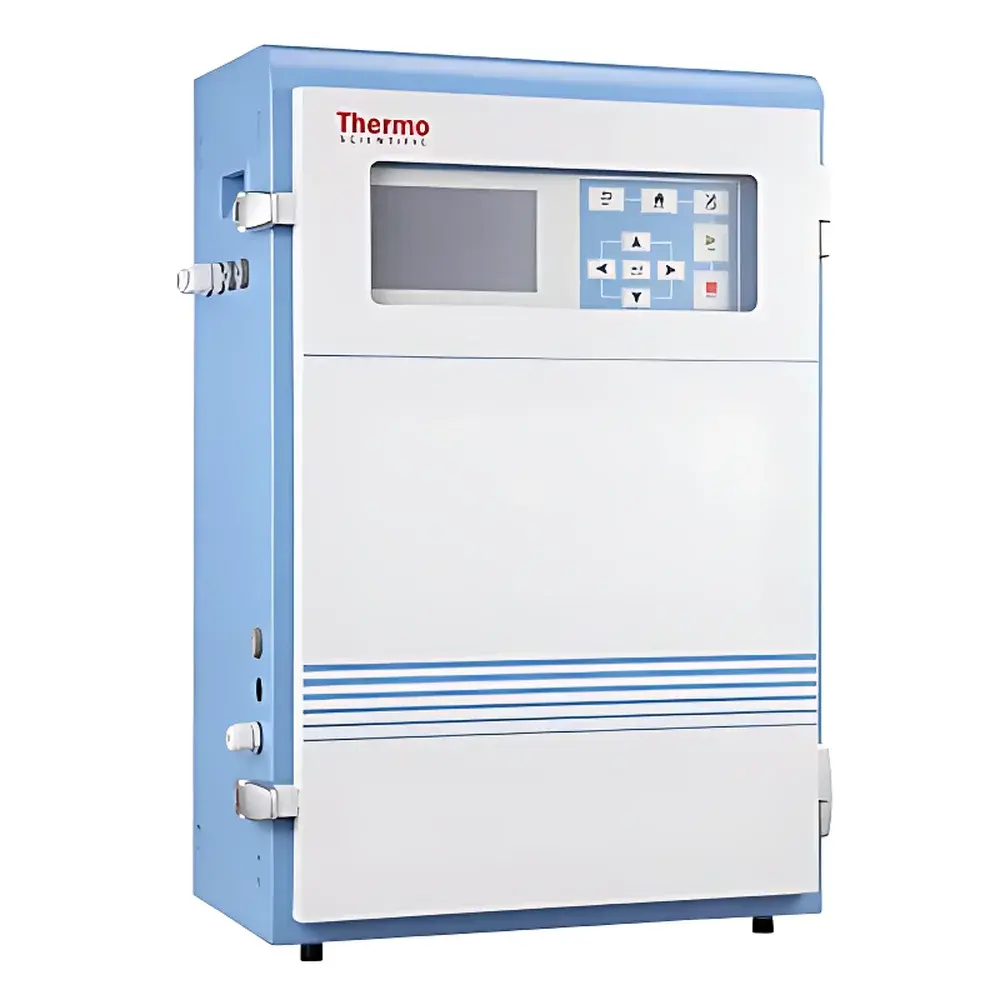
Thermo Scientific 2240 Ammonia Nitrogen Online Analyzer
| Brand | Thermo Fisher |
|---|---|
| Origin | Shanghai, China |
| Manufacturer Type | Authorized Distributor |
| Product Origin | Domestic (China) |
| Model | 2240 |
| Instrument Type | Online Analyzer |
| Measurement Principle | Gas-Sensing Electrode (Ammonia-Selective Electrode) |
| Measurement Range | 0–50.0 mg/L as NH₃–N |
| Accuracy | ±5% of reading or ±0.10 mg/L (whichever is greater) |
| Detection Limit | 0.001 mg/L |
| Analysis Time | <10 minutes per sample |
| Batch Throughput | <10 minutes per measurement |
| Display Interface | Bilingual (English & Chinese) |
| Communication Interfaces | Standard RS-232 and 0–20 mA analog output |
| Self-Diagnostics | Integrated system health monitoring |
| Flow Path | Patented corrosion-resistant fluidic architecture |
| Maintenance Automation | Programmable auto-cleaning and auto-calibration cycles |
Overview
The Thermo Scientific 2240 Ammonia Nitrogen Online Analyzer is a dedicated, continuous-monitoring instrument engineered for reliable, real-time quantification of ammonia nitrogen (NH₃–N) in aqueous environmental matrices. It operates on the well-established gas-sensing electrode principle—specifically, the ammonia-selective ion-sensitive electrode method—wherein ammonium ions (NH₄⁺) are converted to gaseous ammonia (NH₃) under strongly alkaline conditions (pH ≥ 11), and the resultant NH₃ diffuses selectively across a hydrophobic, gas-permeable membrane into an internal electrolyte layer. This diffusion alters the hydrogen ion activity within the internal solution, inducing a measurable potential shift at the integrated pH glass indicator electrode. The resulting electromotive force (EMF) follows the Nernst equation, enabling direct correlation between measured voltage and the logarithm of free ammonia concentration. As such, the 2240 delivers trace-level sensitivity with high specificity, minimal interferences from common water matrix constituents, and stable performance across fluctuating temperature and conductivity conditions typical of wastewater and surface water streams.
Key Features
- Patented corrosion-resistant fluidic path architecture, incorporating chemically inert tubing and valve manifolds compatible with aggressive reagents (e.g., NaOH, buffer solutions) and high-TDS effluents.
- Automated operational sequence: precise syringe-pump-driven reagent and sample metering, pH adjustment, membrane equilibration, electrochemical detection, and post-measurement rinse—fully programmable via embedded controller.
- Self-diagnostic system continuously monitors electrode response slope, zero potential stability, membrane integrity, pump actuation, and flow status—generating actionable alerts prior to analytical drift.
- Bilingual (English/Chinese) graphical user interface with intuitive navigation, real-time trend visualization, and configurable alarm thresholds for exceedance events.
- Integrated maintenance scheduling: users define intervals for automatic electrode cleaning (via ultrasonic or chemical flush), multi-point calibration verification, and reference electrolyte replenishment—reducing manual intervention and sustaining metrological traceability.
Sample Compatibility & Compliance
The 2240 is validated for use with raw influent and treated effluent from municipal and industrial wastewater treatment plants, river and lake surface waters, and process streams in aquaculture and food processing facilities. Its robust design meets requirements for unattended operation in Class I, Division 2 hazardous locations (per UL 1604). While not certified to a single harmonized standard, its measurement methodology aligns with ASTM D1426–15 (Standard Test Methods for Nitrogen in Water) for ammonia determination by electrode methods, and supports compliance with national discharge permit programs (e.g., China’s HJ 101–2019, U.S. EPA Method 350.1 adaptations). Data integrity features—including audit-trail-capable event logging and timestamped calibration records—facilitate GLP/GMP-aligned quality assurance protocols.
Software & Data Management
The analyzer includes embedded firmware supporting Modbus RTU over RS-485 (optional) and ASCII protocol over RS-232 for seamless integration into SCADA, DCS, or LIMS environments. Analog 0–20 mA output provides direct compatibility with legacy PLC-based control systems. All measurement data—including raw mV readings, calculated NH₃–N concentrations, temperature compensation values, diagnostic flags, and maintenance timestamps—are stored locally for ≥30 days. Remote configuration and firmware updates are supported via secure serial or Ethernet gateway (when paired with Thermo’s optional communication module). No cloud dependency or proprietary subscription software is required for core functionality.
Applications
- Continuous compliance monitoring at NPDES or discharge permit outfalls, ensuring adherence to regulatory ammonia limits (e.g., 0.25–2.0 mg/L acute/chronic criteria).
- Influent and effluent monitoring in activated sludge, MBR, and SBR wastewater treatment processes—enabling dynamic aeration control and nitrification/denitrification optimization.
- Early-warning detection of ammonia breakthrough in drinking water distribution systems following chloramination or breakpoint chlorination events.
- Process feedback control in anaerobic digesters and sidestream deammonification units where free ammonia inhibition thresholds must be maintained below 10–150 mg/L depending on microbial consortia.
- Long-term trend analysis for watershed management programs assessing agricultural runoff impact or urban stormwater nutrient loading.
FAQ
What sample types are compatible with the 2240?
It is designed for liquid aqueous samples with turbidity ≤ 200 NTU, suspended solids ≤ 100 mg/L, and chloride concentration < 5,000 mg/L. High-solids or viscous samples require optional pre-filtration or dilution modules.
How often does the ammonia-selective electrode require replacement?
Under typical wastewater monitoring conditions, the electrode service life averages 6–12 months; lifetime is extended by scheduled auto-cleaning and avoidance of sulfide-rich or heavy-metal-contaminated matrices.
Does the 2240 support remote calibration verification?
Yes—users can initiate automated single- or multi-point calibrations remotely via serial command or SCADA trigger; all calibration parameters and residuals are logged with full traceability.
Is temperature compensation automatic?
Yes—the integrated Pt100 sensor continuously measures sample temperature, and firmware applies ISO 7888–1993-compliant non-linear compensation to maintain accuracy across 5–40 °C.
Can the 2240 operate without a central lab network?
Absolutely—it functions autonomously with local display, onboard data storage, and analog output; network connectivity is optional for centralized data aggregation.







