
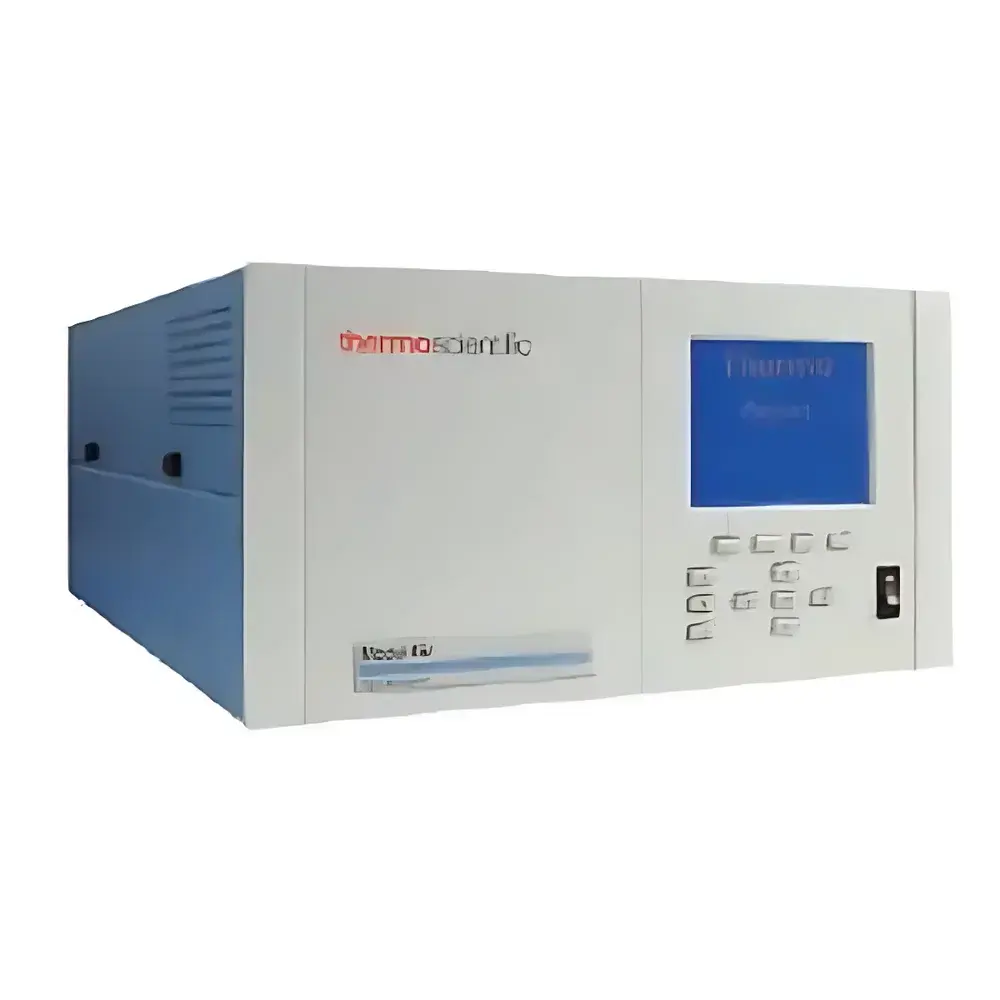
Thermo Scientific 46i-HL High-Level Nitrous Oxide (N₂O) Analyzer
| Brand | Thermo Fisher |
|---|---|
| Origin | USA |
| Manufacturer Type | Authorized Distributor |
| Origin Category | Imported |
| Model | 46i-HL Series |
| Pricing | Available Upon Request |
Overview
The Thermo Scientific 46i-HL High-Level Nitrous Oxide (N₂O) Analyzer is a precision gas measurement instrument engineered for continuous, accurate quantification of nitrous oxide at elevated concentration ranges—specifically up to 2,000 ppm. It employs the Gas Filter Correlation (GFC) spectroscopic technique, a robust and selective method that leverages the unique infrared absorption signature of N₂O. Unlike broadband NDIR or electrochemical sensors, GFC eliminates spectral interference from common background gases (e.g., CO₂, H₂O vapor, CH₄) by using a rotating filter wheel containing matched N₂O-filled and reference cells. This differential optical path enables high specificity and long-term baseline stability, making the 46i-HL suitable for demanding industrial stack monitoring, combustion process control, and environmental compliance applications where high-concentration N₂O must be tracked with metrological rigor.
Key Features
- Gas Filter Correlation (GFC) detection principle—ensures high selectivity for N₂O in complex gas matrices
- Linear response across full 0–2,000 ppm measurement range, validated via NIST-traceable calibration curves
- Dual-range and auto-ranging operation modes for seamless transition between low- and high-concentration regimes
- Integrated pressure and temperature compensation algorithms—corrects for ambient and sample stream fluctuations in real time
- Enhanced mechanical robustness: shock- and vibration-resistant optical architecture optimized for fixed-site industrial installations
- Ethernet interface (10/100BASE-T) supporting Modbus TCP and HTTP-based data retrieval for remote diagnostics and configuration
- Onboard flash memory for buffered data logging (up to 30 days of 1-minute averaged records)
- 5-line backlit LCD display with persistent primary readout and contextual secondary parameters (e.g., T, P, span status)
- Programmable soft keys for rapid navigation to frequently used menus, calibration routines, or diagnostic screens
Sample Compatibility & Compliance
The 46i-HL accepts dry, particle-free sample gas streams with typical operating conditions of 0–50 °C and 70–105 kPa absolute pressure. Optional heated sample line interfaces and particulate filtration modules are available for wet or dirty gas environments. The analyzer meets key regulatory and quality system requirements including EPA Method 25A for gaseous organic compound monitoring (adapted for N₂O), ISO 14064-1 Annex B (greenhouse gas quantification), and supports GLP/GMP-aligned audit trails when paired with Thermo’s optional data acquisition software. Its analog I/O expansion card (Option C) provides 4–20 mA output channels compliant with IEC 61000-4 electromagnetic compatibility standards and enables integration into DCS/SCADA systems under ISA-88 and ISA-95 frameworks.
Software & Data Management
Firmware v3.2+ includes embedded web server functionality—allowing secure remote access via standard browsers for real-time parameter viewing, event log inspection, and firmware updates without physical site visits. All calibration events, zero/span checks, and alarm triggers are timestamped and stored locally with user ID attribution. When connected to Thermo’s centralized Telemetry Hub or third-party platforms via Modbus TCP, the 46i-HL supports automated report generation aligned with ISO/IEC 17025 documentation requirements. Data export formats include CSV and XML, compatible with LIMS and EPA’s CDX submission protocols. Optional audit trail logging satisfies FDA 21 CFR Part 11 requirements when deployed with electronic signature-enabled enterprise software.
Applications
- Continuous emission monitoring (CEMS) of N₂O from nitric acid production facilities and adipic acid plants
- Process optimization and catalyst performance evaluation in ammonia oxidation reactors
- Greenhouse gas inventory reporting per IPCC Tier 2/Tier 3 methodologies
- Verification of abatement system efficiency (e.g., thermal or catalytic N₂O destruction units)
- Research-grade N₂O flux studies in controlled-environment bioreactors and soil incubation systems
- Calibration transfer verification for portable N₂O analyzers used in field surveys
FAQ
What is the maximum measurable N₂O concentration supported by the 46i-HL?
The instrument is calibrated and verified for linear operation from 0 to 2,000 ppm N₂O in air or nitrogen matrix.
Does the 46i-HL require external zero/span gas cylinders?
Not necessarily—models equipped with Option Z (integrated zero/span valve assembly) support automated internal calibration using user-supplied zero air and span gas; otherwise, manual external gas delivery is required.
Can the 46i-HL operate in unheated outdoor enclosures?
Yes, provided ambient temperature remains within 0–50 °C and relative humidity does not exceed 90% non-condensing; optional heated enclosure kits extend operational range to –20 °C.
Is the GFC optical system susceptible to contamination from oil mist or condensate?
The optical bench is sealed and purged; however, inlet gas must be filtered to ≤0.3 µm and dried to dew point < –20 °C to prevent window fouling and maintain signal integrity.
How is traceability maintained for factory calibrations?
Each unit ships with a NIST-traceable calibration certificate documenting linearity, zero drift (< ±0.5 ppm/7 days), and span stability (< ±1% of reading/30 days) under defined test conditions.







