
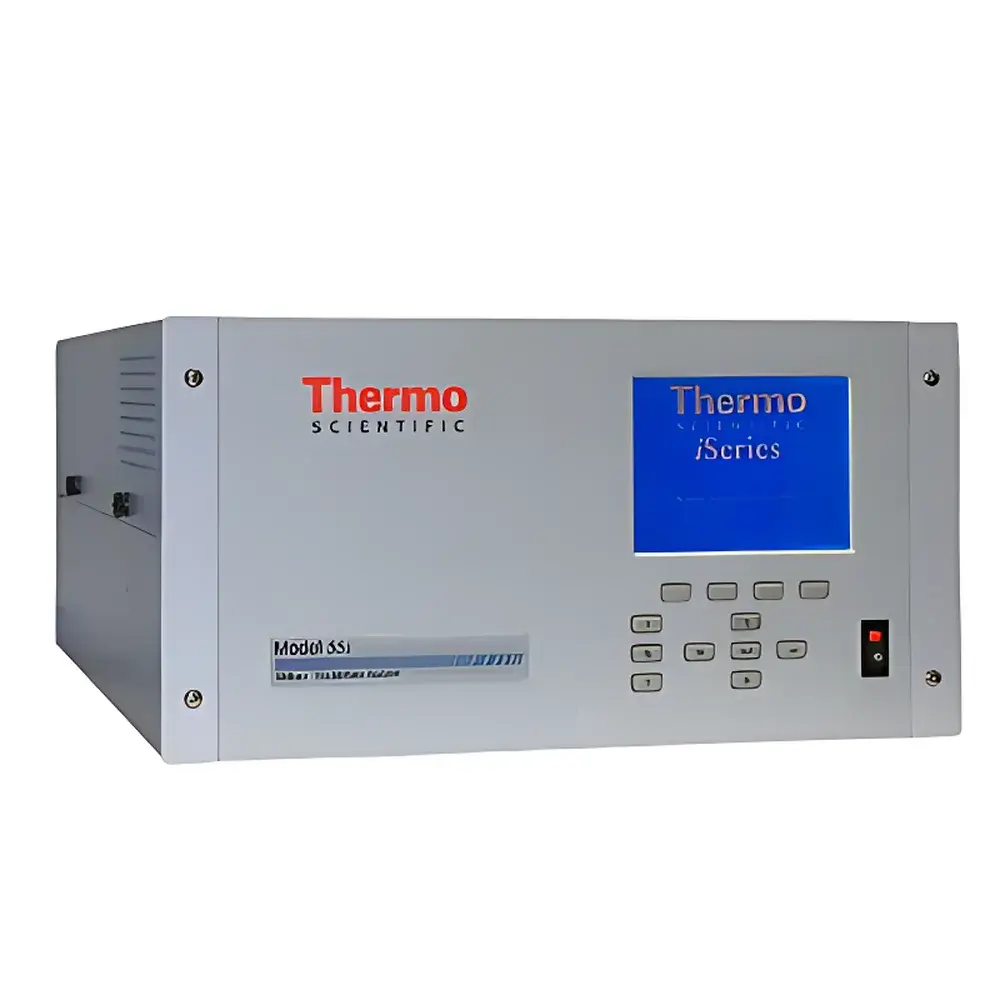
Thermo Scientific 55i Methane and Non-Methane Hydrocarbons Analyzer
| Brand | Thermo Fisher |
|---|---|
| Origin | USA |
| Manufacturer Type | Authorized Distributor |
| Product Origin | Imported |
| Model | Thermo Scientific 55i |
| Detection Principle | Gas Chromatography (GC) with Flame Ionization Detection (FID) |
| Instrument Type | Online Continuous Emission Monitor |
| Configuration | Dual-Channel GC-FID for Simultaneous CH₄ and NMHC Quantification |
| Detection Range | 0–5/50/500 ppm |
| Resolution | 0.050 ppm CH₄ |
| Accuracy | ±2% of reading or ±50 ppb (whichever is greater) |
| Response Time (t₉₀) | 70 s |
| Zero Noise | 0.025 ppm RMS (300-s averaging) |
| Span Drift (24 h) | <2% of full scale |
Overview
The Thermo Scientific 55i Methane and Non-Methane Hydrocarbons Analyzer is a fully automated, online gas chromatographic system engineered for continuous, regulatory-grade measurement of methane (CH₄) and total non-methane hydrocarbons (NMHC) in ambient air, stack emissions, landfill gas, and industrial process streams. It employs dual-column gas chromatography coupled with flame ionization detection (GC-FID), enabling baseline separation of C₁ (methane) from C₂–C₁₂+ hydrocarbons without catalytic oxidation—eliminating catalyst poisoning, thermal degradation, or calibration drift associated with catalytic converters. The instrument operates on the principle of retention-time-based compound differentiation: sample gas is injected into a pre-column for methane elution, then backflushed to direct heavier hydrocarbons onto a second analytical column for NMHC integration. This true chromatographic separation ensures speciation integrity and eliminates interferences from oxygenated VOCs, CO₂, or humidity—critical for compliance with EPA Method 25A, EN 12619, and ISO 11890-2.
Key Features
- Dual-channel, dual-detector GC architecture with independent temperature-controlled ovens for optimized CH₄ and NMHC resolution
- Auto-igniting FID with real-time flame status monitoring and fail-safe shutdown logic
- User-selectable multi-range configuration (e.g., 0–5/50/500 ppm) via software; no hardware reconfiguration required
- Integrated zero/span validation capability with programmable sequence control for unattended operation
- Robust sample handling: heated sample line (up to 180 °C), particulate filter, moisture trap, and pressure-regulated flow control (±0.5% stability)
- Compliance-ready design: meets CE marking requirements, UL 61010-1 safety certification, and EMC Directive 2014/30/EU
Sample Compatibility & Compliance
The 55i accepts gaseous samples across a wide matrix—including humid ambient air (up to 95% RH), biogas (with H₂S scrubbing), and low-particulate industrial exhaust—without requiring external conditioning beyond standard filtration. Its GC-based methodology satisfies data quality objectives (DQOs) outlined in U.S. EPA 40 CFR Part 60 Appendix A–2 (Method 25A), European Standard EN 12619:2013 (stationary source emissions), and ISO 11890-2:2017 (VOC determination in paint and varnish). All measurements are traceable to NIST-certified hydrocarbon standards. The analyzer supports audit-ready data logging aligned with GLP and 21 CFR Part 11 requirements when paired with Thermo’s optional TraceFinder™ software suite.
Software & Data Management
Instrument control, method development, and data review are managed through Thermo’s proprietary iPort™ software—compatible with Windows 10/11 and deployable on local workstations or centralized server environments. The software provides real-time chromatogram visualization, peak integration with retention time locking, automatic calibration curve generation (linear/log-linear), and configurable alarm thresholds (e.g., exceedance, detector fault, flow deviation). Raw chromatographic data (including FID current, oven temperatures, valve timing, and pressure logs) are stored in vendor-neutral .csv and .tdf formats. Audit trails record all user actions, method changes, and calibration events with timestamps and operator IDs—fully compliant with FDA 21 CFR Part 11 electronic record requirements.
Applications
- Ambient air quality monitoring networks (e.g., EPA Photochemical Assessment Monitoring Stations – PAMS)
- Landfill and wastewater treatment plant fugitive emission reporting under GHG Reporting Program (40 CFR Part 98)
- Refinery flare gas composition analysis and combustion efficiency verification
- Indoor air quality studies targeting hydrocarbon sources in manufacturing cleanrooms or laboratories
- Research applications requiring high-fidelity NMHC speciation (e.g., atmospheric chemistry modeling, VOC reactivity studies)
- Regulatory compliance for LDAR (Leak Detection and Repair) programs per EPA Method 21 and OSHA PEL assessments
FAQ
Does the 55i require carrier gas cylinders?
Yes—it operates with ultra-high-purity hydrogen (FID fuel), synthetic air (FID oxidant), and helium or nitrogen (carrier gas). Optional integrated gas generators are available to eliminate cylinder dependency.
Can the 55i measure individual VOC species, or only total NMHC?
It quantifies total NMHC as a summed hydrocarbon response (C₁–C₁₂+ equivalent); for speciated VOC analysis, Thermo’s 5800 or TRACE™ 1300 GC-MS systems are recommended.
What maintenance intervals are recommended for routine operation?
FID nozzle cleaning every 3 months; column bake-out monthly; annual detector alignment and leak check; consumables (filters, traps) replaced per usage log or at 6-month intervals.
Is remote diagnostics supported?
Yes—via secure TLS-enabled Ethernet connection, enabling firmware updates, parameter adjustment, and live chromatogram streaming for technical support teams.
How is calibration verified during unattended operation?
Through scheduled auto-zero/auto-span cycles using certified gas standards; results are logged with pass/fail flags and deviation metrics relative to initial calibration.







