
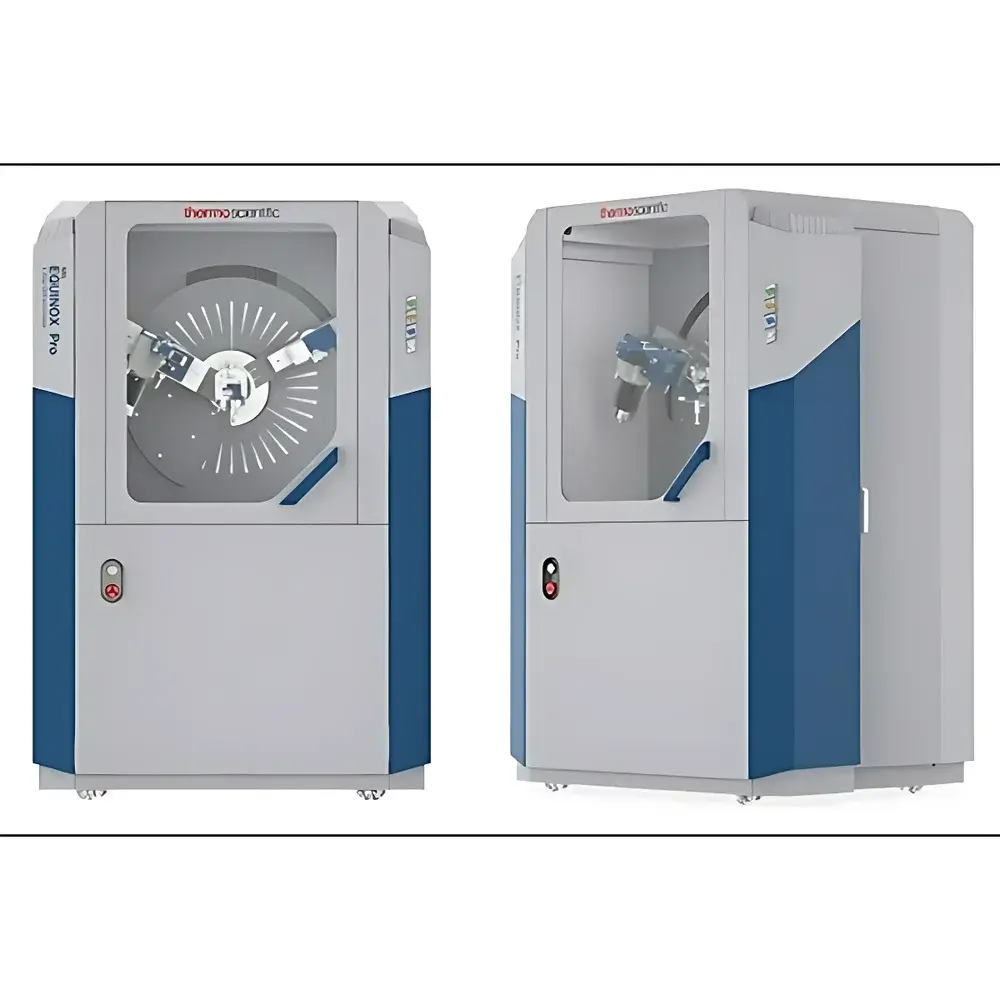
Thermo Scientific ARL EQUINOX Pro Vertical X-ray Diffractometer (XRD)
| Brand | Thermo Fisher |
|---|---|
| Origin | Shanghai, China |
| Manufacturer Type | Authorized Distributor |
| Regional Classification | Domestic (China-manufactured) |
| Model | ARL EQUINOX Pro Vertical X-ray Diffractometer |
| Instrument Type | X-ray Crystal Orientation Analyzer |
| Angular Accuracy | ±0.0001° |
| Resolution | FWHM < 0.026° (2θ, LaB₆ (110)) |
Overview
The Thermo Scientific™ ARL™ EQUINOX Pro Vertical X-ray Diffractometer is a high-precision, Bragg–Brentano θ/θ geometry XRD system engineered for rigorous crystalline phase analysis of polycrystalline powders, thin films, and bulk solids. It operates on the fundamental principle of Bragg’s Law (nλ = 2d sinθ), where monochromatic X-rays interact with periodic atomic planes in crystalline lattices to produce constructive interference patterns—captured as diffraction peaks in angular space (2θ). Designed for laboratory-based R&D, quality control, and regulatory-compliant materials characterization, the EQUINOX Pro integrates a vertically oriented goniometer architecture with real-time position-synchronized detection, enabling robust data acquisition across low-angle (≥0.3° 2θ), mid-range, and high-resolution regimes. Its θ/θ configuration ensures sample stability during scanning, minimizes gravitational sag effects on sample holders, and supports seamless integration with in situ environmental stages—making it suitable for dynamic structural studies under thermal, mechanical, or reactive conditions.
Key Features
- Precision θ/θ Goniometer System: Closed-loop servo motors with optical encoders deliver angular positioning resolution of 0.0001° and repeatability better than ±0.007° across the full 2θ range (−110° to +168°), validated against NIST SRM 1976 corundum reference material.
- Real-Time Position-Synchronized Detection (PTPC Technology): Pulse-triggered photon counting ensures detector gate activation precisely coincides with goniometer arrival at each step—eliminating time-lag-induced peak broadening and preserving intrinsic angular resolution (FWHM < 0.026° at LaB₆ (110)).
- Modular Detector Architecture: Supports zero-dimensional (scintillation counter), one-dimensional (MYTHEN2 series), and two-dimensional (EIGER2 R or ADVAPIX) detectors—enabling flexible trade-offs between speed, dynamic range, and reciprocal-space coverage.
- Plug-and-Play Optical Path Management: “Magic Card” optical alignment system—combined with dynamic mechanical error compensation—allows rapid switching between incident beam optics (e.g., Göbel mirrors, multilayer monochromators) and sample stages without recalibration.
- High-Throughput Data Acquisition: 640-channel detector readout achieves up to 5× intensity gain over legacy 128-channel systems, yielding signal-to-noise ratios (SNR) of 12.9 (640 ch) vs. 5.2 (128 ch) under identical measurement conditions.
- Energy-Dispersive Capability: Integrated energy-resolving detector enables fluorescence background suppression—critical for transition-metal-containing samples such as LiFePO₄—enhancing peak fidelity and quantitative accuracy.
Sample Compatibility & Compliance
The ARL EQUINOX Pro accommodates standard powder cups (Ø10–25 mm), flat-plate, and capillary mounts—and interfaces directly with certified in situ accessories including HTK 1200N (up to 1200 °C), XRK 900 (gas-reactive environments), TTK 600 (−190 °C to +600 °C), CHC Plus+ (humidity-controlled), and BTS 150/500 (benchtop heating). All hardware and software modules comply with ISO 17025:2017 requirements for testing laboratories; data acquisition and processing workflows support audit trails, electronic signatures, and secure user roles per FDA 21 CFR Part 11 and EU Annex 11 guidelines. Instrument calibration protocols align with ASTM E975 (Standard Practice for X-ray Diffraction Crystallographic Analysis) and ISO 13126 (X-ray powder diffraction—terminology and general principles).
Software & Data Management
Control and acquisition are managed via Thermo’s Measurement Scan software (Windows 10/11), offering intuitive scan parameter definition, real-time visualization, and automated background subtraction. Data analysis is performed using Match! (for phase identification) and MDUA DE (for quantitative Rietveld refinement, Le Bail decomposition, crystallinity (DOC), Scherrer crystallite size estimation, and structure solution via Endeavour). The platform natively imports ICDD PDF-4+, COD, and user-defined CIF files—and exports CIF, XYE, RAW, and HDF5 formats. Batch processing, 3D diffraction map overlays, and mouse-driven peak editing (addition, shifting, fitting) streamline routine QC tasks. Cross-platform compatibility extends to macOS and Linux via virtualized deployment options.
Applications
- Quantitative phase analysis of battery cathode/anode materials (e.g., NMC, LFP, SiOx) using RIR and Rietveld methods
- Crystallinity assessment of pharmaceutical APIs per USP <1151> and ICH Q5A
- In situ thermal expansion and phase transition monitoring in ceramics and metal alloys
- Residual stress and texture analysis in additive manufacturing feedstocks
- Low-angle SAXS/WAXS hybrid characterization of mesoporous silica (e.g., MCM-41)
- Polymorph screening and stability testing under controlled humidity and temperature
FAQ
What X-ray tube anodes are supported?
Cu, Co, Cr, Mo, and Ag anodes are available; tube power options include 3 kW and 4 kW high-stability generators.
Is the system compliant with GLP/GMP documentation requirements?
Yes—software includes configurable audit trails, electronic signature support, and role-based access control aligned with FDA 21 CFR Part 11 and EU GMP Annex 11.
Can the instrument perform combined XRD/XRF analysis?
While optimized for XRD, optional energy-dispersive detection enables elemental fingerprinting; full XRF capability requires dedicated instrumentation.
What is the minimum measurable 2θ angle?
The system achieves reliable data collection from 0.3° 2θ onward, enabled by optimized beam divergence and low-background optics.
How is calibration traceability maintained?
Calibration is verified using NIST SRMs (e.g., 1976 corundum, 660 LaB₆); all geometric parameters are stored in instrument metadata and exported with raw data files.






