
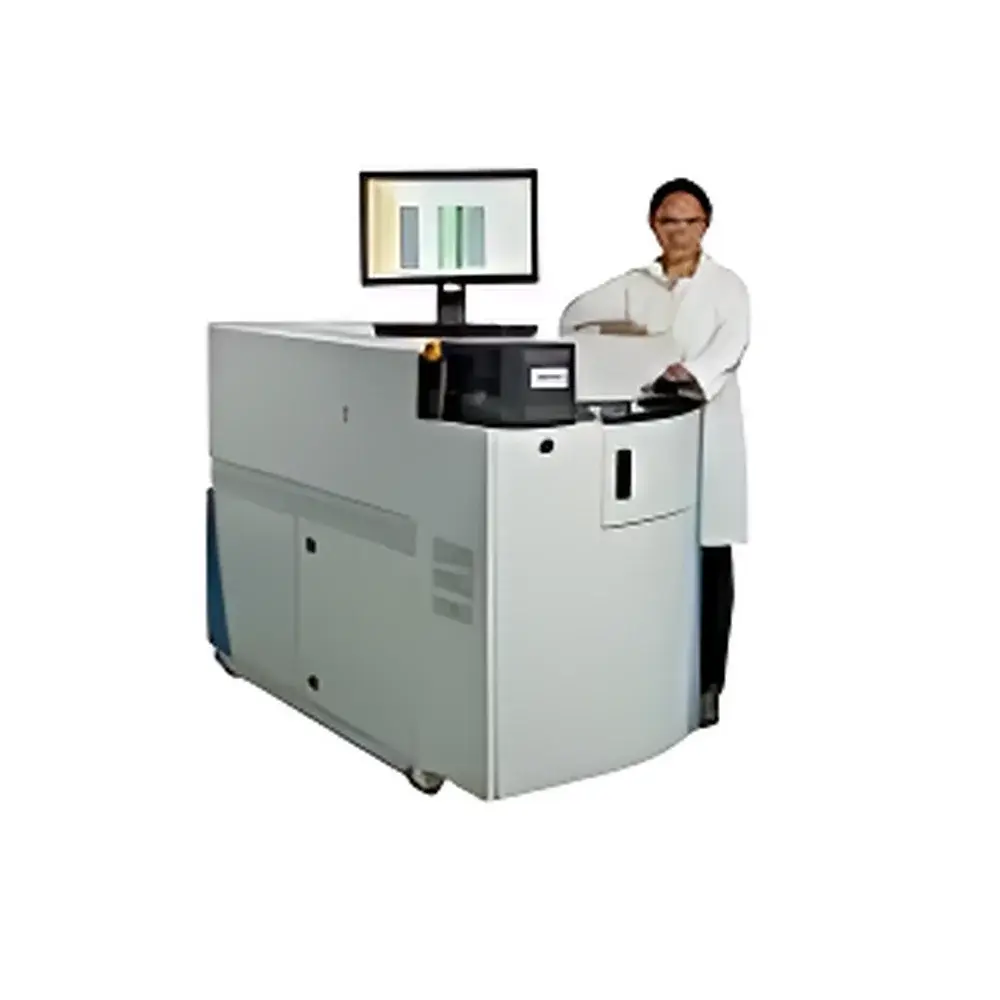
Thermo Scientific ARL iSpark Series Direct-Reading Optical Emission Spectrometer
| Origin | USA |
|---|---|
| Manufacturer Type | Authorized Distributor |
| Origin Category | Imported Instrument |
| Model | Thermo Scientific ARL iSpark Series |
| Price Range | USD 140,000 – 280,000 |
| Instrument Form Factor | Floor-Standing |
| Excitation Source | High-Energy Spark Discharge |
| Detector Configuration | Dual-Detector System (Photomultiplier Tubes + Solid-State CCD Array) |
| Focal Length | Not Applicable (Paschen–Runge Mount with Fixed Optical Path) |
| Groove Density | Not Applicable (Pre-aligned Monochromator Assembly) |
| Wavelength Coverage | 130–800 nm (Simultaneous Full-Spectrum Acquisition) |
| Number of Analytical Channels | Configurable up to 64 Predefined or User-Defined Spectral Lines |
Overview
The Thermo Scientific ARL iSpark Series is a high-performance floor-standing direct-reading optical emission spectrometer (OES) engineered for precise, rapid, and trace-level elemental analysis of metallic alloys in production control, incoming material inspection, and R&D laboratories. Based on the fundamental principle of spark-induced atomic emission spectroscopy, the instrument vaporizes and excites solid metal samples using a controlled high-energy spark discharge in an argon-purged environment. The resulting polychromatic light is dispersed via a fixed Paschen–Runge optical mount and simultaneously detected across the ultraviolet-to-near-infrared range (130–800 nm) using a hybrid dual-detector architecture—combining high-gain photomultiplier tubes (PMTs) for critical low-intensity lines and a thermoelectrically cooled CCD array for broad spectral coverage and flexible line selection. This design ensures high signal-to-noise ratio, excellent long-term stability, and robust quantification for major, minor, and trace elements (down to sub-ppm levels in optimized matrices), meeting the analytical rigor required by ISO/IEC 17025-accredited labs.
Key Features
- Floor-standing mechanical architecture with integrated argon purge manifold and vibration-dampened optical bench for operational stability in industrial environments.
- Dual-detection system: PMTs deliver exceptional sensitivity for regulated analytes (e.g., C, P, S, N in steel), while the CCD enables post-acquisition spectral reprocessing, interference correction, and method expansion without hardware modification.
- Spark source with real-time current and voltage monitoring, adjustable discharge frequency (50–1000 Hz), and programmable pre-spark conditioning for reproducible ablation across heterogeneous or coated samples.
- Automated sample handling interface compatible with standard 32–40 mm diameter discs and custom fixtures; optional robotic loader available for unattended batch analysis.
- Self-calibrating wavelength reference system using internal neon and argon emission lines, eliminating manual lamp alignment and supporting drift-compensated quantification over extended run times.
Sample Compatibility & Compliance
The ARL iSpark supports solid conductive metals—including ferrous alloys (carbon steels, stainless steels, cast irons), non-ferrous metals (Al, Cu, Mg, Zn, Ti, Ni-based superalloys), and sintered or additively manufactured parts—provided surface flatness meets ISO 11573 requirements (≤ 0.05 mm deviation). Sample preparation follows ASTM E407 and ISO 14284 guidelines for grinding and cleaning. The system complies with IEC 61000-6-3 (EMC), UL 61010-1 (safety), and supports audit-ready documentation per FDA 21 CFR Part 11 when configured with Thermo Scientific Qtegra ISM software. All calibration standards are traceable to NIST SRMs or certified reference materials (CRMs) from BAM, IRMM, or LGC.
Software & Data Management
Controlled via Thermo Scientific Qtegra Intelligent Scientific Management Software, the platform provides method development, automated calibration (including multi-point and drift correction), and statistical process control (SPC) charting. Raw spectral data (intensity vs. pixel/wavelength) is stored in vendor-neutral HDF5 format. Audit trails record all user actions, parameter changes, and result modifications with time stamps and operator IDs. Data export supports CSV, XML, and LIMS-compatible ASTM E1382-compliant formats. Optional integration with LabVantage or STARLIMS enables seamless workflow handoff from analysis to QA/QC release.
Applications
- Grade identification and positive material identification (PMI) per ASME B31.3 and API RP 578 protocols.
- Heat-to-heat certification for aerospace-grade titanium and nickel alloys (ASTM E1086, E1479).
- Trace element monitoring in high-purity aluminum for semiconductor packaging substrates (ASTM E1251).
- Carbon equivalency calculation and microalloying element verification (Nb, V, Ti) in pipeline steels (API 5L Annex H).
- Failure analysis support through inclusion mapping and segregation assessment using spatially resolved spark analysis modes.
FAQ
What sample preparation is required prior to analysis?
Flat, clean, and oxide-free surfaces are mandatory. Samples must be ground using silicon carbide paper (P120–P400) under coolant, followed by ethanol or acetone ultrasonic cleaning and immediate analysis to prevent re-oxidation.
Can the system analyze non-conductive or powdered samples?
No—the ARL iSpark requires electrically conductive solid samples. Non-metals or powders require alternative techniques such as XRF or ICP-OES.
How often does the optical system require recalibration?
Under routine operation with daily QC checks, full wavelength calibration is recommended every 3–6 months; the internal reference lamp and auto-alignment algorithms minimize manual intervention.
Is remote diagnostics and software update support available?
Yes—Qtegra includes secure TLS-encrypted remote access for Thermo Fisher service engineers, with scheduled firmware and spectral library updates delivered via Thermo Connect portal.
Does the system meet GLP/GMP documentation requirements?
When deployed with Qtegra ISM in “Regulatory Mode”, it satisfies ALCOA+ principles (Attributable, Legible, Contemporaneous, Original, Accurate, Complete, Consistent, Enduring, Available) and supports 21 CFR Part 11 electronic signatures and audit trail review.
Related Products






