
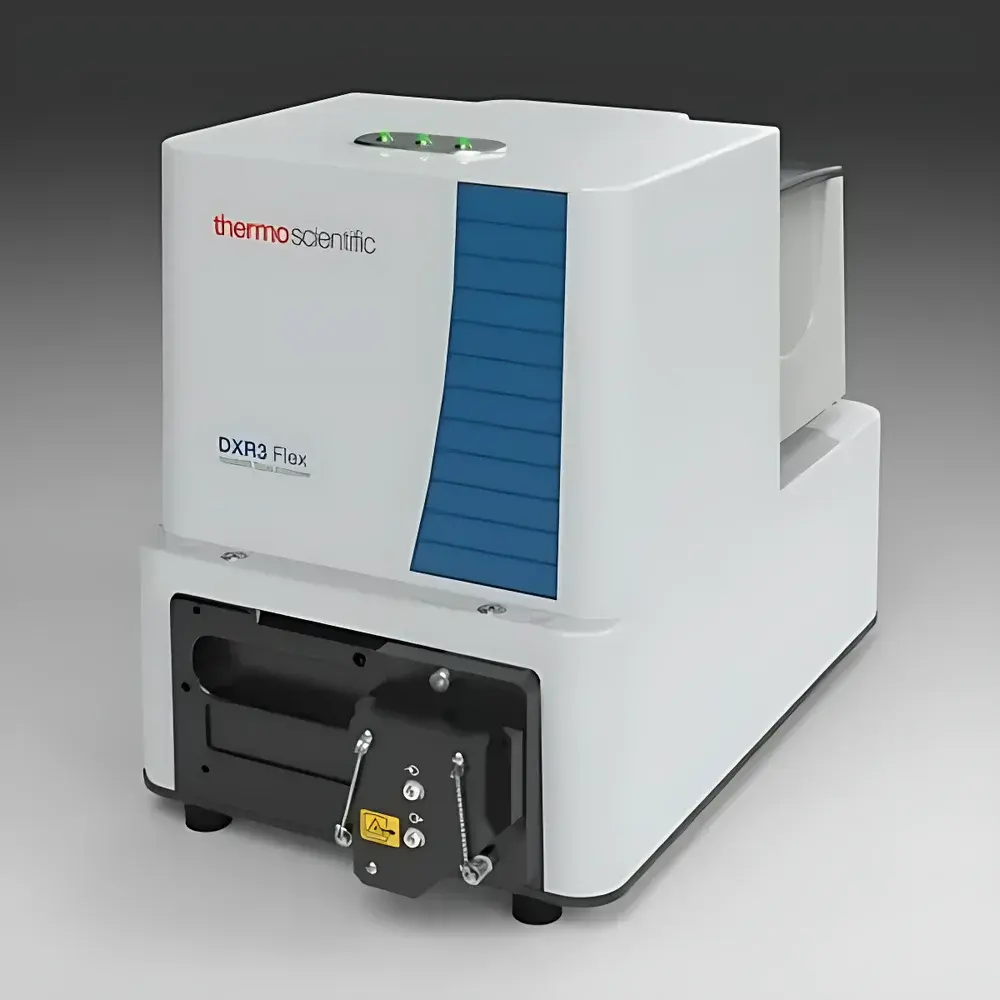
Thermo Scientific DXR3 Flex Raman Spectrometer
| Brand | Thermo Fisher |
|---|---|
| Origin | Shanghai, China |
| Manufacturer Type | Authorized Distributor |
| Regional Classification | Domestic (China-manufactured) |
| Model | Thermo Scientific DXR3 Flex Raman Spectrometer |
| Pricing | Upon Request |
Overview
The Thermo Scientific DXR3 Flex Raman Spectrometer is a modular, research-grade benchtop Raman spectroscopy platform engineered for maximum analytical flexibility and spectral fidelity. Operating on the principle of inelastic light scattering—where monochromatic laser excitation induces vibrational mode shifts in molecular bonds—the DXR3 Flex delivers high-resolution, low-noise Raman spectra across multiple excitation wavelengths. Its open optical architecture enables seamless integration with external instrumentation—including rheometers, thermal analyzers, extruders, custom sample stages, and microscopy systems—allowing real-time, correlative measurements without sample transfer or repositioning. This eliminates inter-measurement variability and preserves sample integrity, making it ideal for dynamic process monitoring, in situ reaction analysis, and multimodal characterization workflows in regulated and non-regulated environments.
Key Features
- Modular free-space optical coupling design eliminates fiber transmission losses, ensuring maximum signal throughput and photometric reproducibility.
- Selectable laser excitation wavelengths (e.g., 532 nm and 785 nm) with configurable spectral resolution to optimize signal-to-noise ratio and fluorescence suppression for diverse sample classes.
- Interchangeable laser modules compatible with Thermo Scientific DXR3 Raman Microscopes, enabling consistent calibration and method transfer across platforms.
- Integrated visible-light camera for precise sample visualization, alignment, and region-of-interest targeting—fully synchronized with spectral acquisition.
- Rugged, portable chassis housed in a certified travel case, supporting field-deployable and mobile lab applications without compromising optical stability.
- Pre-aligned optical interface kits (6″, 3″, 2″, 1″, 0.5″, 0.3″ lens tubes) and coated 90° mirrors facilitate rapid custom beam path configuration for macro-, micro-, and process-scale sampling geometries.
Sample Compatibility & Compliance
The DXR3 Flex accommodates a broad range of physical sample forms—including powders, films, gels, liquids, bulk solids, and reactive intermediates—via interchangeable accessories: macro sample chambers (light-tight, vial- and pouch-compatible), XYZ manual microstages (compatible with standard microscope objectives), immersion and contact probes, and adjustable side- or downward-viewing optical mounts for oversized or irregularly shaped specimens. All hardware and software components are designed to support compliance with international quality frameworks: OMNIC D/S software includes full 21 CFR Part 11 compliance features—electronic signatures, audit trails, user access controls, and data integrity safeguards—enabling deployment in GxP environments including pharmaceutical QC, materials release testing, and academic GLP studies. Instrument performance verification adheres to ISO/IEC 17025 traceability principles where applicable.
Software & Data Management
- Thermo Scientific OMNIC software provides intuitive spectral acquisition, multivariate analysis (PCA, cluster analysis), spectral library searching (including >10,000 reference spectra), and automated peak identification.
- OMNIC D/S edition supports secure, role-based workflow management with electronic signature capability, full audit trail logging, and immutable data archiving—validated for FDA-regulated submissions.
- API-enabled architecture allows bidirectional integration with LIMS, ELN, and MES systems via standardized protocols (e.g., OPC UA, RESTful APIs).
- Data export formats include ASTM E1347-compliant .spc files, CSV, and HDF5 for long-term archival and third-party analysis interoperability.
Applications
The DXR3 Flex serves as a core analytical engine across multidisciplinary research and industrial domains. In nanomaterials science, it characterizes graphene layer count, carbon nanotube chirality, and diamond-like carbon (DLC) film stress states. In pharmaceutical development, it enables polymorph screening, excipient distribution mapping, and foreign particulate identification per USP and ICH Q5A guidelines. Gemological laboratories employ its rapid fingerprinting capability for natural vs. synthetic diamond differentiation and inclusion phase identification. Polymer scientists utilize it for crystallinity quantification, degradation assessment (e.g., UV-induced chain scission), and interfacial adhesion analysis in laminates. Within bioprocess and continuous manufacturing settings, fiber-coupled configurations support real-time monitoring of fermentation metabolites, protein conformational changes, and API crystallization kinetics. Additional validated use cases span aerospace composite failure analysis, cosmetic pigment authentication, biomaterial scaffold characterization, and fundamental academic research in catalysis, electrochemistry, and soft matter physics.
FAQ
Is the DXR3 Flex manufactured in the USA?
No—the DXR3 Flex is manufactured at Thermo Fisher’s integrated production facility in Shanghai, China, under the same global quality system (ISO 9001-certified) applied to all Thermo Scientific analytical instruments.
Can the DXR3 Flex be used in a regulated GMP environment?
Yes—when configured with OMNIC D/S software and operated under documented SOPs, the system meets requirements for electronic records and signatures per 21 CFR Part 11, supporting use in pharmaceutical manufacturing and quality control labs.
Does the instrument support automated calibration verification?
Yes—built-in NIST-traceable polystyrene and silicon reference standards enable routine wavelength and intensity calibration checks, with results logged in the audit trail.
What sample handling options exist for hazardous or air-sensitive materials?
The macro chamber accessory can be adapted with glovebox-compatible feedthroughs; custom inert-atmosphere cells and sealed cuvette holders are available through Thermo Fisher’s OEM solutions group.
Is remote operation supported?
Yes—OMNIC software supports secure remote desktop access and scheduled unattended acquisitions via Windows Remote Desktop Protocol (RDP) or Thermo’s cloud-enabled instrument management portal (optional subscription).



