
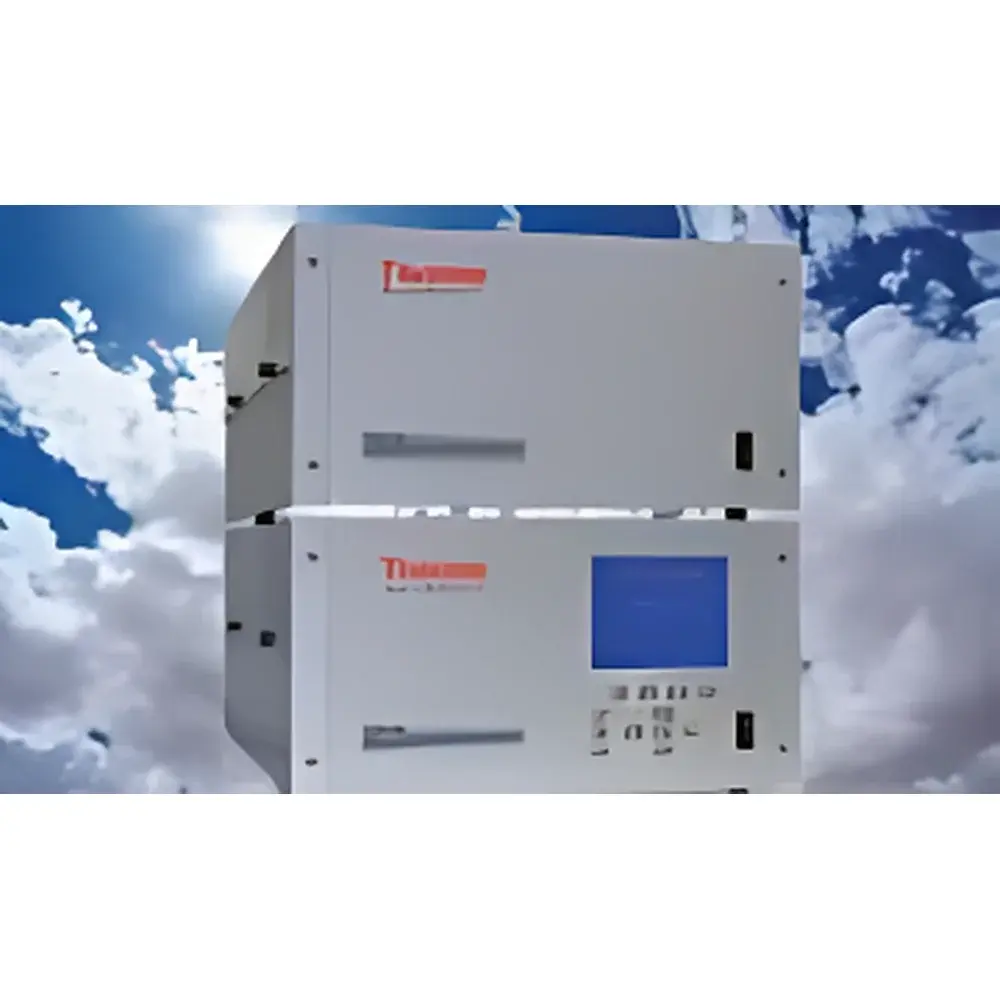

Thermo Scientific Environmental & Process Instruments
| Origin | Imported |
|---|---|
| Manufacturer Type | Distributor |
| Model | Thermo Scientific Environmental & Process Instruments |
| Instrument Type | Continuous Emission Monitoring System (CEMS) |
| Price Range | USD 70,000 – 140,000 |
| Measurement Accuracy | Not Specified |
| Repeatability | Not Specified |
| Response Time | Not Specified |
| Long-Term Stability | Not Specified |
Overview
Thermo Scientific Environmental & Process Instruments represent a comprehensive portfolio of certified, field-proven analytical systems engineered for regulatory-grade continuous emission monitoring (CEMS), ambient air quality assessment, industrial process optimization, and fugitive emission control. These instruments operate on multiple validated physical and electrochemical measurement principles—including non-dispersive infrared (NDIR), paramagnetic oxygen detection, chemiluminescence (CLD), ultraviolet differential optical absorption spectroscopy (UV-DOAS), and beta attenuation (for PM mass concentration)—to deliver trace-level quantification of regulated pollutants such as SO₂, NOₓ, CO, CO₂, O₂, NH₃, HCl, HF, CH₄, VOCs, and particulate matter (PM₁, PM₂.₅, PM₁₀, TSP). Designed for permanent installation in stack ducts, ambient monitoring stations, cleanrooms, construction sites, and refinery perimeters, the platform supports compliance with EPA Methods 1–10, EN 15267, EN 14181, ISO 12039, and EU Directive 2010/75/EU (IED).
Key Features
- Modular CEMS architecture enabling scalable configuration—from single-gas extractive systems to multi-component in-situ analyzers with integrated data acquisition and reporting modules.
- Automated calibration verification (ACV) and zero/span validation protocols compliant with EPA Performance Specification 2 (PS-2) and EN 14181 QAL2/QAL3 requirements.
- Ruggedized sampling trains with heated probe filtration, condensate management, and particle removal optimized for high-moisture, high-dust flue gas environments (e.g., cement kilns, waste incinerators, coal-fired boilers).
- Real-time particulate monitoring using β-ray absorption (for PM mass) and laser scattering (for size-resolved distribution), meeting EPA Method 9030B and EN 13284-1 standards.
- LDAR-ready portable and fixed VOC analyzers with photoionization detection (PID) and flame ionization detection (FID), supporting EPA Method 21 and ASTM D6420 workflows.
- IP65-rated enclosures, redundant power supplies, and NEMA 4X environmental protection for outdoor deployment under extreme temperature and humidity conditions.
Sample Compatibility & Compliance
The Thermo Scientific Environmental & Process Instruments are validated for use across diverse sample matrices: hot/wet flue gases (up to 200 °C, >30 % RH), ambient air (−30 °C to +50 °C), indoor office environments, and fugitive emission plumes from valves, flanges, and connectors. All CEMS configurations undergo third-party type approval per MCERTS (UK), TÜV Rheinland certification (Germany), and EPA-certified test laboratories. Systems support full audit trails, electronic signatures, and 21 CFR Part 11-compliant data integrity features when deployed in GLP/GMP-regulated facilities or under EU Annex 11 requirements.
Software & Data Management
Instrument operation and data handling are centralized through Thermo Scientific™ Emissions Manager™ software—a secure, web-enabled platform supporting real-time visualization, automated report generation (including EPA Form 7500 and EU ETS templates), remote diagnostics, and integration with enterprise SCADA and LIMS systems via OPC UA and Modbus TCP. The software provides configurable alarm thresholds, drift correction algorithms, and mandatory QA/QC logging aligned with EN 14181 QA Level 1–3 documentation frameworks. All raw sensor outputs, calibration records, maintenance logs, and system status events are stored with immutable timestamps and user-access controls.
Applications
- Regulatory CEMS for power plants, petrochemical refineries, steel mills, and municipal waste-to-energy facilities.
- Ambient air quality networks (AQMS) meeting WHO and EU Air Quality Directive (2008/50/EC) limit values.
- Construction site dust monitoring (PM₁₀/PM₂.₅) with automatic alerting to local environmental authorities.
- Indoor air quality (IAQ) surveillance in hospitals, laboratories, and semiconductor fabrication cleanrooms.
- Leak detection and repair (LDAR) programs across upstream oil & gas, chemical manufacturing, and pharmaceutical production sites.
- Process optimization and combustion efficiency analysis via O₂, CO, and CO₂ co-monitoring in boiler and furnace applications.
FAQ
Are these instruments certified for regulatory reporting in the United States and European Union?
Yes—systems are pre-qualified under EPA PS-2, EN 15267-3, and MCERTS schemes; final site-specific certification requires QAL1 testing per EN 14181.
Can the CEMS be integrated with existing plant DCS or cloud-based environmental dashboards?
Yes—native support for OPC UA, Modbus TCP, and MQTT ensures seamless interoperability with industrial automation platforms and SaaS-based EHS analytics tools.
What maintenance intervals are recommended for long-term operational reliability?
Preventive maintenance is scheduled quarterly for extractive systems and biannually for in-situ configurations, including filter replacement, optical path cleaning, and span gas verification—documented in accordance with EN 14181 QA Level 2.
Is remote firmware update capability available?
Yes—secure over-the-air (OTA) updates are supported via TLS 1.2-encrypted connections, with rollback functionality and version-controlled change logs.







