
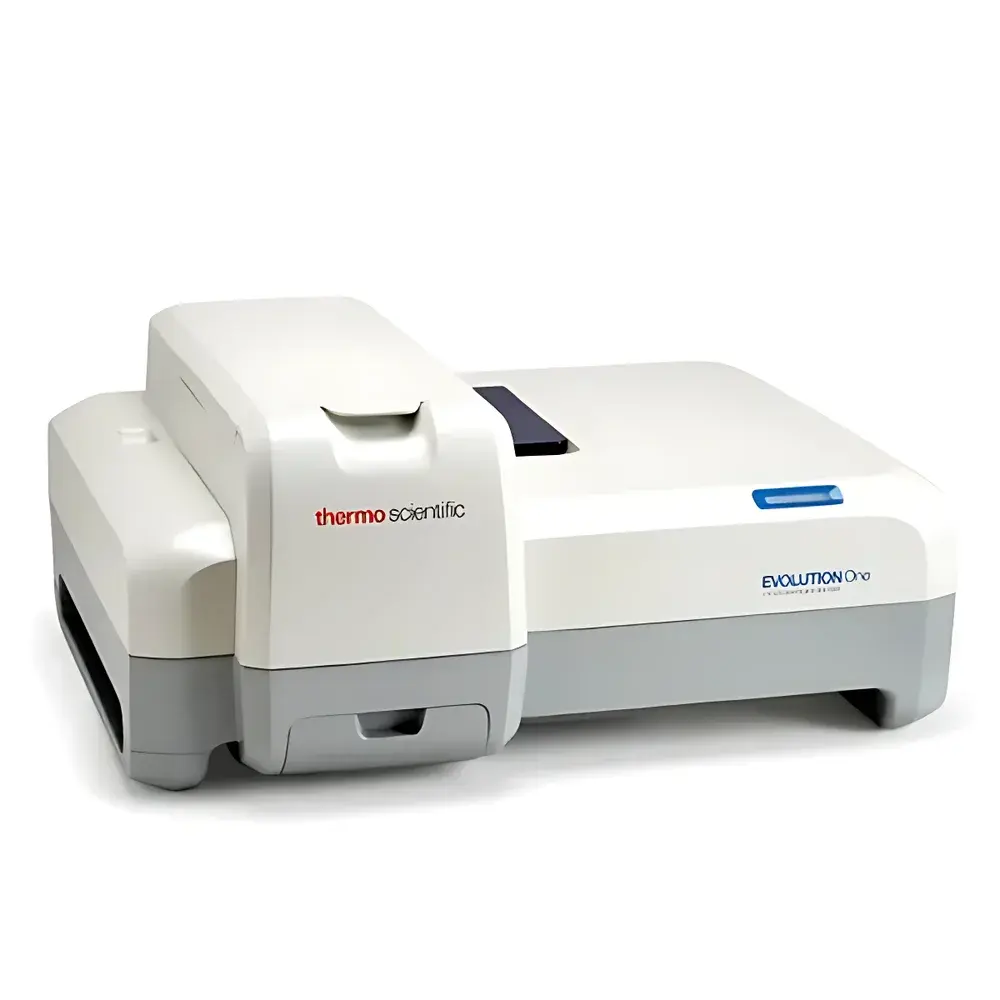
Thermo Scientific Evolution™ One/One Plus UV-Vis Spectrophotometer (Domestically Manufactured in Shanghai)
| Brand | Thermo Fisher |
|---|---|
| Origin | Shanghai, China |
| Manufacturer Type | Authorized Distributor |
| Origin Category | Domestic |
| Model | Evolution™ One/One Plus UV-Vis Spectrophotometer (Domestically Manufactured) |
| Pricing | Available Upon Request |
| Wavelength Range | 190–1100 nm |
| Spectral Bandwidth | Fixed 1.0 nm (standard), variable options available on One Plus |
| Optical Design | Double-beam with Czerny-Turner monochromator |
| Light Source | Xenon flash lamp |
| Detector | Dual silicon photodiode array |
| Baseline Flatness | ±0.001 A (200–800 nm, 1.0 nm SBW, smoothed) |
| Photometric Accuracy | ±0.010 A @ 60 mg/L K₂Cr₂O₇ |
| Stray Light | ≤1% T @ 198 nm (KCl) |
| Wavelength Accuracy | ±0.5 nm (@ Hg lines 541.9/546.1 nm), ±0.8 nm (full range) |
| Wavelength Repeatability | ≤0.05 nm (SD, 10 measurements @ 546.1 nm Hg line) |
| Photometric Precision | ±0.004 A @ 1 A, ±0.008 A @ 2 A (NIST-traceable neutral density filters, 440 nm) |
| Noise Level | ≤0.00015 A RMS @ 0 A |
| Drift | <0.0005 A/h @ 500 nm (1.0 nm SBW, 1 h warm-up) |
| Scan Speed | 1–6000 nm/min (variable) |
| Data Interval | 0.1–10 nm selectable |
| Photometric Display Range | –0.3 to 4.0 A |
| Absorbance Linearity | >3.5 A |
| Dimensions (L×W×H) | 593 × 475 × 266 mm |
| Weight | 14.5 kg (32 lb) |
| Power Requirement | 100–240 V AC, auto-switching, 50/60 Hz, max. 150 W |
| Lamp Lifetime | >5 years (typical usage, no real-time signal monitoring) |
| Compliance | USP <857>, EP 2.2.25, ISO/IEC 17025, ASTM E275, FDA 21 CFR Part 11 (with Insight Pro Security Pack) |
Overview
The Thermo Scientific Evolution™ One and One Plus UV-Vis Spectrophotometers are double-beam instruments engineered for precision, reproducibility, and regulatory readiness across academic research, pharmaceutical quality control, and industrial R&D laboratories. Based on a Czerny-Turner monochromator architecture and powered by a xenon flash lamp, these systems eliminate warm-up delays and deliver stable, high-intensity output across the full 190–1100 nm spectral range. The fixed 1.0 nm spectral bandwidth (SBW) ensures consistent resolution for routine quantitation, while the Evolution One Plus model supports additional bandwidth flexibility and incorporates Advanced Focusing Beam Guidance (AFBG) optics—enhancing signal-to-noise ratios for microvolume cuvettes, solid samples, and fiber-optic probe measurements. All models meet critical pharmacopeial requirements—including USP and EP 2.2.25—for absorbance accuracy, stray light, wavelength calibration, and baseline flatness—making them suitable for method validation, stability-indicating assays, and release testing under GxP frameworks.
Key Features
- Double-beam optical path with simultaneous sample/reference measurement, minimizing drift and environmental interference
- Xenon flash lamp source providing instantaneous measurement capability and >5-year operational lifetime under typical usage conditions
- Fixed 1.0 nm spectral bandwidth (standard); Evolution One Plus offers optional variable SBW for method-specific optimization
- Advanced Focusing Beam Guidance (AFBG) optics (One Plus only) improves throughput and signal fidelity for low-volume and heterogeneous samples
- Baseline flatness of ±0.001 A (200–800 nm, 1.0 nm SBW, smoothed) and photometric noise as low as ≤0.00015 A RMS at 0 A support high-sensitivity kinetic and trace analysis
- Wavelength accuracy of ±0.5 nm at mercury emission lines and ±0.8 nm over full range ensures traceability to NIST standards
- Integrated thermal management with Peltier-controlled single-cell or 8-position sample holders (0–100 °C) enables temperature-dependent studies and QC stability protocols
Sample Compatibility & Compliance
The Evolution One/One Plus accommodates diverse sample formats—including standard 10-mm quartz/cuvettes, microvolume cells (down to 1 µL), solid reflectance accessories, integrating spheres, and fiber-optic probes—via modular, software-recognized attachments. All hardware and firmware comply with ISO/IEC 17025 general requirements for competence of testing and calibration laboratories. For regulated environments, optional compliance packages include Validator for Insight Pro software, USP/EP-certified reference filter sets, and documentation kits aligned with FDA 21 CFR Part 11 electronic records and signatures requirements. Audit trail functionality, user role-based access control, and electronic signature support are enabled through Insight Pro Security Edition—facilitating GLP/GMP-aligned workflows and internal or third-party audits.
Software & Data Management
Insight Pro software serves as the central analytical interface, combining intuitive workflow design with rigorous data governance. Its Custom User Environment (CUE) allows creation of validated, step-by-step procedures—including multi-stage calibrations, kinetic time courses, and multi-wavelength quantitation—reducing operator dependency and transcription errors. All raw spectra, processed results, metadata (user ID, timestamp, instrument configuration), and audit logs are stored in a secure, encrypted database compliant with ALCOA+ principles (Attributable, Legible, Contemporaneous, Original, Accurate, Complete, Consistent, Enduring, Available). Software updates are delivered via secure channels and validated per change control SOPs. Export options include CSV, PDF, XML, and vendor-neutral JCAMP-DX for long-term archival and cross-platform interoperability.
Applications
These spectrophotometers support a broad scope of quantitative and qualitative applications: protein concentration determination (A280, Bradford, BCA), nucleic acid purity assessment (A260/A280), enzyme kinetics (e.g., NADH/NADPH oxidation), dissolution testing, colorimetric assay development (ELISA, immunoassays), polymer characterization, nanoparticle size estimation (via plasmon resonance), and pharmaceutical excipient compatibility screening. In QC labs, they execute compendial tests per USP, EP, and JP monographs—including identity confirmation, assay, and related substances analysis. Their robust optical design and low drift characteristics also make them suitable for long-duration environmental monitoring and materials aging studies.
FAQ
Is the Evolution One/One Plus manufactured in the USA?
No. This configuration is domestically manufactured in Shanghai, China, under Thermo Fisher’s quality system oversight and adheres to the same engineering specifications and performance benchmarks as globally supplied units.
Does the xenon flash lamp require alignment or periodic recalibration?
No. The lamp is factory-aligned and requires no user maintenance. Its solid-state design eliminates filament degradation and provides stable spectral output throughout its service life.
Can Insight Pro software be validated for 21 CFR Part 11 compliance?
Yes—when deployed with the Insight Pro Security Pack and Validator toolkit, the software supports full electronic record and signature validation, including audit trail review, electronic signatures, and role-based permissions.
What is the difference between Evolution One and Evolution One Plus?
The One Plus adds Advanced Focusing Beam Guidance (AFBG) optics, variable spectral bandwidth capability, enhanced detector sensitivity for low-light applications, and expanded accessory compatibility—including automated solid-sample mapping and fiber-optic coupling.
Are NIST-traceable calibration standards included with the system?
A qualification-grade filter set (including UV and visible certified reference filters) is available as part of optional USP/EP Compliance Kits. Primary NIST-traceable calibration is performed during factory acceptance testing and documented in the Certificate of Conformance.




