
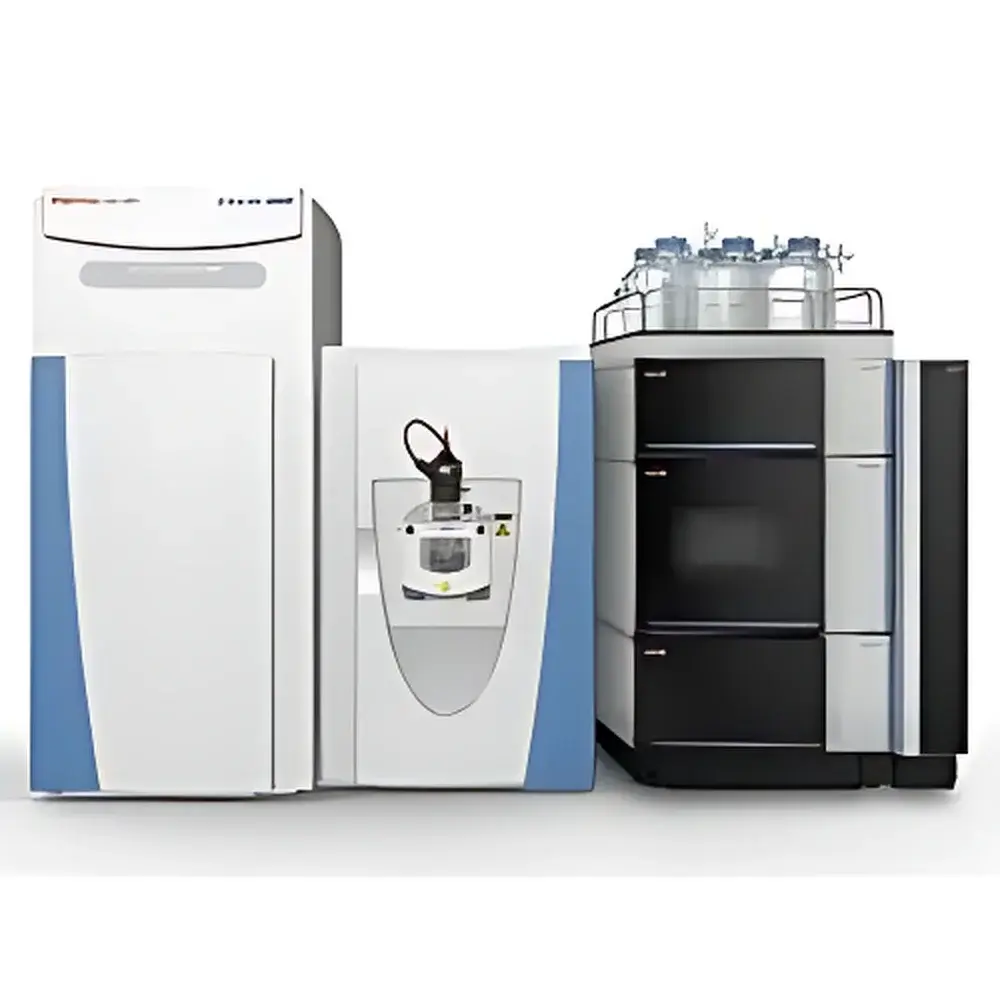
Thermo Scientific Q Exactive UHMR Orbitrap Mass Spectrometer
| Brand | Thermo Fisher |
|---|---|
| Origin | USA |
| Manufacturer Type | Authorized Distributor |
| Origin Category | Imported |
| Model | Q Exactive UHMR |
| Instrument Type | Quadrupole-Orbitrap Hybrid Mass Spectrometer |
| m/z Range | Up to 80,000 |
| Precursor Selection Range | Up to 25,000 m/z |
| Ion Transmission Mode | In-Source Capture (ISC) |
| Fragmentation | Higher-Energy Collisional Dissociation (HCD) with Injection Flatapole |
| Application Focus | Native MS, Top-Down Proteomics, Intact Protein Complex Analysis |
Overview
The Thermo Scientific Q Exactive UHMR Orbitrap Mass Spectrometer is a purpose-built hybrid quadrupole-Orbitrap platform engineered for ultra-high-mass-range (UHMR) native mass spectrometry. It operates on the principle of electrospray ionization (ESI) coupled with high-field asymmetric waveform ion mobility spectrometry (FAIMS)-compatible ion optics, quadrupole-based precursor selection, and high-resolution, high-mass-accuracy detection in the Orbitrap analyzer. Unlike conventional LC-MS systems optimized for peptides or small molecules, the Q Exactive UHMR is structurally reinforced to maintain ion transmission efficiency and mass resolving power across an extended m/z range—up to 80,000—enabling direct analysis of intact macromolecular assemblies under non-denaturing conditions. Its design addresses core challenges in structural biology and biopharmaceutical characterization: low sample abundance, heterogeneity of post-translational modifications (PTMs), stoichiometric variability in ligand binding, and conformational dynamics of membrane-associated complexes.
Key Features
- Ultra-high m/z detection capability (up to 80,000 m/z) with sub-5 ppm mass accuracy and resolving power >10,000 at m/z 20,000 (FWHM), validated per ASTM E2947-20 standards for high-mass calibration.
- Quadrupole mass filter with extended precursor selection range (up to 25,000 m/z), enabling isolation of intact protein complexes without prior size-exclusion chromatography.
- In-Source Capture (ISC) technology enhances ion transmission efficiency for large, labile biomolecules by reducing in-source dissociation and improving desolvation kinetics—critical for preserving non-covalent interactions.
- Injection Flatapole collision cell and optimized HCD activation enable controlled, tunable fragmentation of intact proteins and subcomplexes, supporting both top-down sequencing and ligand-release experiments.
- Integrated FAIMS Pro interface compatibility allows gas-phase separation of co-eluting charge-state distributions, improving signal-to-noise ratio and reducing spectral congestion in heterogeneous samples.
- Robust vacuum architecture with differential pumping stages maintains stable pressure gradients across the ion path, ensuring reproducible performance during extended acquisition cycles required for native MS workflows.
Sample Compatibility & Compliance
The Q Exactive UHMR supports analysis of intact proteins, multi-subunit enzyme complexes, antibody-drug conjugates (ADCs), virus-like particles (VLPs), and detergent-solubilized membrane proteins—including GPCRs and ion channels—under near-physiological buffer conditions (e.g., ammonium acetate, Tris-HCl). Sample introduction is compatible with nano-ESI, standard ESI, and microfluidic chip-based sources. The system complies with ISO/IEC 17025:2017 requirements for analytical instrument validation and supports audit-ready operation under GLP and GMP environments. Data integrity is ensured via built-in support for FDA 21 CFR Part 11-compliant electronic signatures, user access controls, and full audit trail logging in Thermo Scientific Compound Discoverer and BioPharma Finder software.
Software & Data Management
Instrument control and data acquisition are managed through Thermo Scientific Tune software v3.5+, which includes dedicated UHMR method templates, automatic m/z range optimization, and real-time charge deconvolution algorithms. Raw data processing leverages Thermo Scientific BioPharma Finder 4.0+ for automated intact mass determination, PTM localization, stoichiometry quantification, and heterogeneity profiling. All software modules adhere to ICH Q5E guidelines for comparability assessment and integrate with LIMS platforms via standardized APIs. Data files conform to mzML 1.1.0 specification and support long-term archival in vendor-neutral formats compliant with NIH/NIST metadata standards.
Applications
- Native top-down proteomics of intact monoclonal antibodies and bispecific constructs, including disulfide bond mapping and domain-level fragmentation.
- Stoichiometric quantification of ligand binding (e.g., ATP, cofactors, inhibitors) to multi-domain enzymes without crystallization or labeling.
- Structural assessment of cryo-EM sample purity and heterogeneity prior to grid preparation.
- Characterization of biosimilar higher-order structure (HOS) equivalence using intact mass fingerprinting and subunit release profiling.
- Analysis of extracellular vesicle cargo composition and membrane protein topology in native lipid environments.
- High-confidence identification of transient, low-abundance protein–nucleic acid complexes relevant to transcriptional regulation and RNA processing.
FAQ
What is the maximum recommended m/z for routine calibration and mass accuracy verification?
Calibration is performed using cesium iodide cluster ions up to m/z 60,000; external calibration with protein calibrants (e.g., apoferritin, immunoglobulin M) validates performance up to m/z 80,000.
Can the Q Exactive UHMR be interfaced with liquid chromatography systems operating at high flow rates?
Yes—it supports standard LC flow rates (100–500 µL/min) and is routinely coupled with SEC-MALS and native-PAGE fraction collectors for offline analysis.
Is source cleaning required more frequently when analyzing membrane proteins in detergents?
No—optimized ISC voltage ramping and heated capillary design minimize detergent accumulation; routine maintenance intervals remain aligned with Thermo’s PM schedule for native MS applications.
Does the system support automated data-dependent acquisition (DDA) for UHMR mode?
Yes—UHMR-DDA methods include dynamic exclusion, intensity thresholding, and charge-state filtering tailored for low-abundance, high-m/z precursors.
How is mass resolution maintained across such an extended m/z range?
Resolution is preserved via adaptive transient length adjustment, segmented frequency-domain signal processing, and harmonic correction algorithms embedded in the Orbitrap acquisition firmware.





