
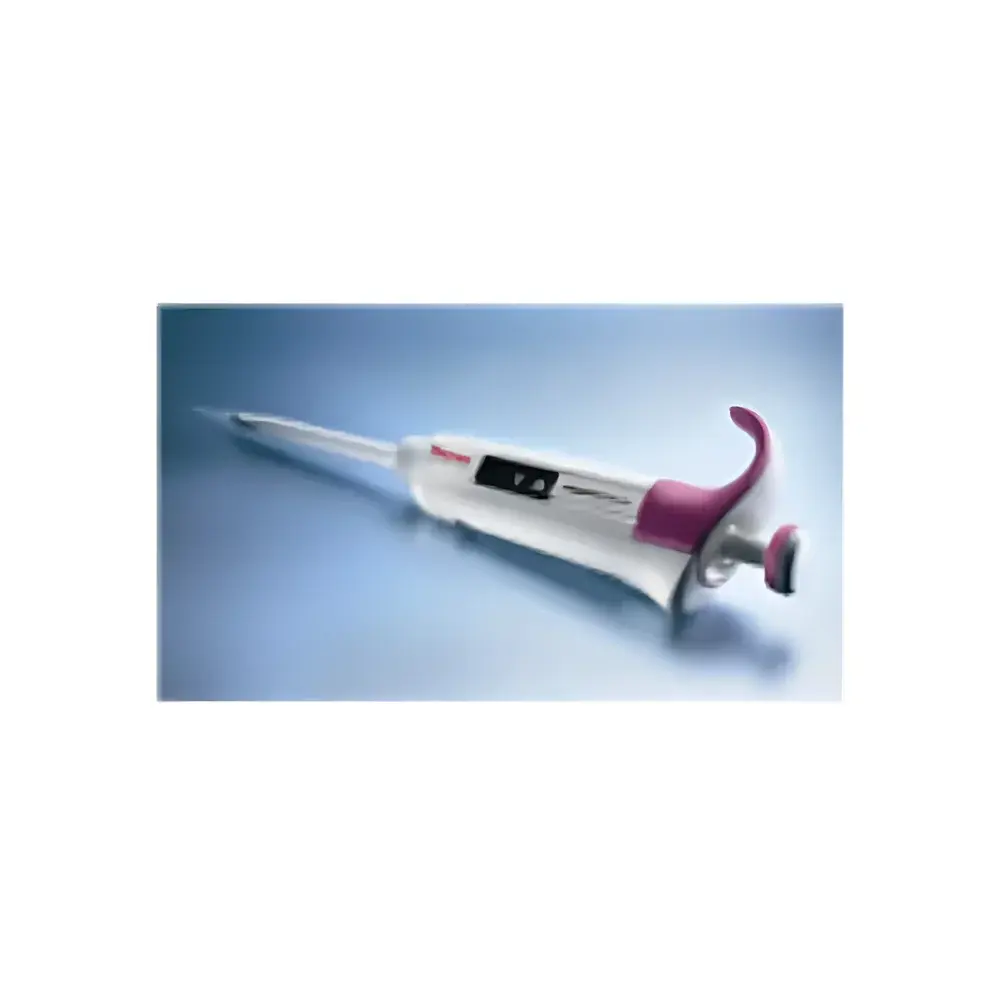
Thermo Scientific Finnpipette F3 Single-Channel Variable-Volume Pipette
| Brand | Thermo Fisher Scientific |
|---|---|
| Origin | Shanghai, China |
| Model | Finnpipette F3 Single-Channel Variable-Volume Pipette |
| Volume Range | Adjustable (model-specific |
| Ergonomic Design | Dual-control volume adjustment, isolated liquid-volume coupling mechanism, integrated Ergovisio display |
| Compliance | Designed for ISO 8655 compliance verification |
| Material | Chemically resistant, autoclavable upper housing and tip ejector |
| Calibration | User-calibratable per ISO 8655-6 |
| Blow-out Function | Enhanced positive displacement blow-out for ≤50 µL ranges |
Overview
The Thermo Scientific Finnpipette F3 Single-Channel Variable-Volume Pipette is an engineered precision liquid handling instrument designed for high-reproducibility volumetric transfer in routine and regulated laboratory environments. Based on air-displacement principle, the F3 integrates a thermally isolated liquid-volume coupling (AVG) mechanism—where the volume-setting dial is mechanically decoupled from the pipette’s thermal mass—to minimize thermal drift caused by hand contact during operation. This architecture ensures long-term accuracy stability across repeated use cycles, particularly critical for low-volume applications (≤50 µL). The device conforms to the metrological framework defined in ISO 8655 (Pipettes for liquids — Part 1: Terms and general requirements; Part 2: Piston-operated volumetric pipettes; Part 6: Calibration), supporting traceable performance verification under GLP and GMP-aligned workflows.
Key Features
- Ergovisio Display: Large-format, high-contrast monochrome LCD with oversized numerals and dedicated micro-adjustment scale—optimized for visual acuity and reduced ocular fatigue during extended benchwork.
- Dual-Control Volume Adjustment System: Top-mounted rotating cap prevents inadvertent volume shift during aspiration/dispense; bottom-mounted color-coded volume dial enables intuitive, single-hand coarse and fine tuning.
- Thermally Isolated AVG Mechanism: The patented Automatic Volume Gearing system physically separates the volume-setting gear train from the piston chamber, maintaining dimensional stability of the air cushion regardless of ambient or operator-induced temperature fluctuations.
- Enhanced Blow-Out for Low Volumes: Models with nominal ranges ≤50 µL incorporate a reinforced positive-pressure blow-out stroke, ensuring quantitative delivery of viscous or volatile samples without residual carryover.
- Human-Centered Handle Architecture: Contoured grip geometry, wide relaxation finger rest with color-coded tactile zones, and balanced mass distribution reduce wrist flexion torque—validated to lower risk of repetitive strain injury (RSI) per ISO 11228-3 ergonomics guidelines.
- Robust Construction: Upper housing and ejection sleeve fabricated from autoclavable, chemically inert polymer; compatible with standard sterilization protocols (121°C, 20 min, saturated steam).
Sample Compatibility & Compliance
The Finnpipette F3 supports aqueous, organic, and mildly corrosive solutions typical in molecular biology, clinical diagnostics, and pharmaceutical QC labs. Tip compatibility spans universal conical polypropylene tips (including low-retention variants) meeting ISO 8655-3 specifications. All models are supplied with factory calibration certificates traceable to NIST standards. The design facilitates user-performed recalibration per ISO 8655-6 procedures, with optional documentation support for audit-ready records in FDA 21 CFR Part 11–compliant environments when paired with Thermo Fisher’s CalCheck software suite.
Software & Data Management
While the F3 operates as a standalone mechanical instrument, its calibration history, maintenance logs, and performance verification data integrate seamlessly into Thermo Fisher’s LabTrack™ digital lab management platform. When used with optional CalCheck-enabled electronic calibrators, the F3 supports structured data export (CSV/Excel) with timestamps, operator IDs, environmental conditions (temperature/humidity), and pass/fail status against predefined tolerance bands (e.g., ±1.0% for Class A volumes per ISO 8655-2). Audit trails comply with ALCOA+ principles—attributable, legible, contemporaneous, original, accurate—and support internal QA reviews or external regulatory inspections.
Applications
The F3 is routinely deployed in nucleic acid quantification (qPCR setup, library preparation), ELISA plate loading, cell culture reagent dispensing, and reference standard dilution series. Its thermal stability and blow-out fidelity make it especially suitable for handling ethanol-based wash buffers, glycerol-containing enzyme stocks, and low-surface-tension solvents common in analytical sample prep. In regulated settings—including ISO/IEC 17025-accredited testing labs—the F3 serves as a primary transfer device where documented metrological integrity is required for method validation (e.g., USP , EP 2.9.34).
FAQ
Is the Finnpipette F3 compliant with ISO 8655?
Yes—designed and verified to meet the performance, construction, and calibration requirements outlined in ISO 8655 Parts 1, 2, and 6.
Can the F3 be autoclaved?
The upper housing, tip ejector, and volume adjustment components are fully autoclavable at 121°C for 20 minutes; refer to the manufacturer’s maintenance manual for disassembly instructions prior to sterilization.
What volume ranges are available for the single-channel F3?
Standard configurations include 0.5–10 µL, 2–20 µL, 10–100 µL, 20–200 µL, 100–1000 µL, and 500–5000 µL—with each range optimized for accuracy and precision per ISO 8655-2 tolerances.
Does the F3 support electronic calibration logging?
When used with Thermo Fisher’s CalCheck calibration station and LabTrack software, full digital calibration records—including environmental metadata and signature capture—are generated and exportable in audit-compliant formats.
How does the AVG mechanism improve accuracy over conventional pipettes?
By isolating the volume-setting gear train from thermal expansion effects in the piston cylinder, the AVG system maintains consistent air-cushion compressibility—reducing temperature-induced volume drift by up to 40% compared to non-isolated designs under identical handling conditions.
Related Products



