
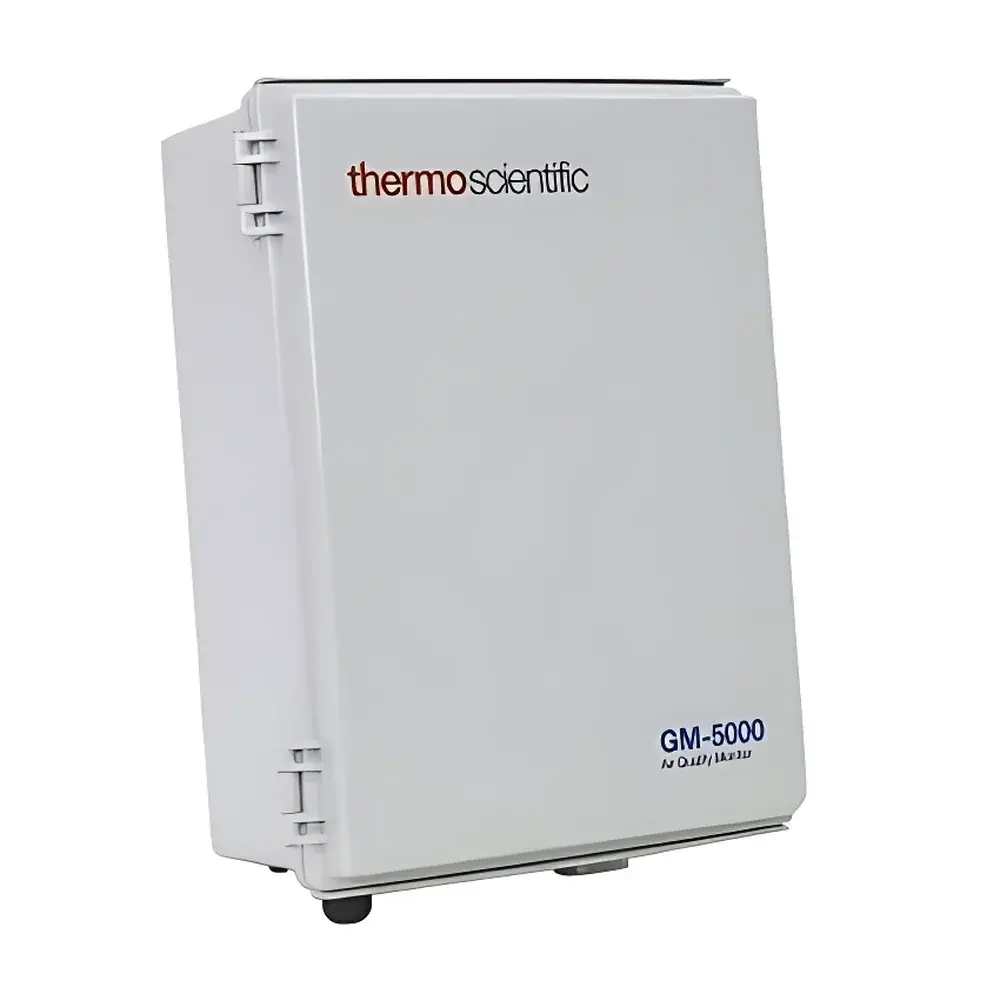
Thermo Scientific GM-5000 Miniature Ambient Air Quality Monitor
| Brand | Thermo Fisher |
|---|---|
| Origin | USA |
| Manufacturer | Thermo Fisher Scientific |
| Product Type | Imported |
| Model | GM-5000 |
| Instrument Type | Online Fixed-Station Monitor |
| Measured Gases | NO₂, SO₂, O₃, CO |
| Response Time (T90) | 120 s (all sensors) |
| Measurement Accuracy | ±10 ppb (gaseous pollutants) |
| Measurement Ranges | NO₂: 0–20 ppm |
| SO₂ | 0–50 ppm |
| O₃ | 0–20 ppm |
| CO | 0–500 ppm |
| PM₂.₅ | 0–1500 µg/m³ |
| PM₁₀ | 0–1500 µg/m³ |
| Detection Limits (2σ) | NO₂: 30 ppb |
| SO₂ | 40 ppb |
| O₃ | 30 ppb |
| CO | 25 ppb |
| PM₂.₅ & PM₁₀ | <1.0 µg/m³ |
| Linearity | ±5% of full scale |
| Zero Drift | ±1% of full scale |
| Repeatability | ±2.5% of full scale |
| Resolution | 10 ppb (gases), 0.1 µg/m³ (PM) |
| Sample Flow Rate | >1.5 L/min |
| Data Logging Interval | 1 min to 1 h |
| Onboard Storage | >500,000 records (~1 year) |
| Operating Temperature | –10 °C to +45 °C |
| Operating Humidity | 15–90% RH (non-condensing) |
| Power Supply | 100–240 VAC, 50–60 Hz |
| Dimensions | 406 mm (H) × 305 mm (W) × 152 mm (D) |
| Weight | 5 kg |
Overview
The Thermo Scientific™ GM-5000 Miniature Ambient Air Quality Monitor is a compact, fixed-site, multi-parameter continuous monitoring system engineered for high-density deployment in urban and peri-urban environments. It integrates electrochemical sensors for gaseous pollutants (NO₂, SO₂, O₃, CO) and optical scattering-based nephelometry for particulate matter (PM₂.₅ and PM₁₀), delivering synchronized, time-stamped measurements with trace-level sensitivity and robust field stability. Designed to operate unattended outdoors for extended periods, the GM-5000 employs active heated sampling and thermally stabilized gas pathways to minimize condensation, reduce sensor drift, and ensure measurement integrity across variable ambient conditions. Its architecture supports both regulatory-grade trend analysis and high-resolution spatial mapping—serving as a scalable complement to reference-grade national monitoring networks while enabling granular exposure assessment at neighborhood, roadway, industrial boundary, and institutional scales.
Key Features
- Simultaneous real-time quantification of NO₂, SO₂, O₃, CO, PM₂.₅, and PM₁₀ with integrated environmental compensation (temperature, relative humidity, barometric pressure, and flow rate)
- Heated inlet and temperature-controlled internal gas path to suppress water vapor interference and maintain sensor operational stability
- Dual communication architecture: embedded 4G LTE modem for primary telemetry and onboard Wi-Fi for local configuration, diagnostics, and firmware updates
- Web-based user interface accessible via standard browsers on desktops, tablets, or smartphones—displaying live concentrations, instrument status, diagnostic logs, and historical trends
- On-device data storage on removable SD card (capacity ≥500,000 records; ~1 year at 1-min logging interval), supporting offline operation and audit-ready archival
- IP65-rated weatherproof enclosure rated for direct outdoor installation, with multiple mounting options (pole, wall, rooftop) and integrated solar-ready power interface
- Field-calibration support via certified span gases or co-location comparison against reference monitoring stations compliant with ISO 12039, EN 14625, and US EPA EQOA protocols
Sample Compatibility & Compliance
The GM-5000 is validated for continuous ambient air sampling per ISO 12039 (SO₂), ISO 14625 (O₃), EN 14626 (CO), EN 14627 (NO₂), and EN 16450 (PM). Its sample conditioning system meets the flow and residence time requirements specified in EU Directive 2008/50/EC Annex III and US EPA Reference and Equivalent Method designations. All gaseous sensors are factory-calibrated against NIST-traceable standards, and the PM module is aligned to gravimetric reference methods using ISO 10473-certified calibration aerosols. The system supports GLP-compliant data handling with timestamped audit trails, configurable data retention policies, and secure authentication for remote access—facilitating integration into regulatory reporting frameworks including national AQMS platforms and municipal environmental dashboards.
Software & Data Management
Data acquisition and device management are handled by an embedded Linux-based runtime environment running Thermo Scientific’s proprietary AirView™ firmware. Each measurement packet includes analyte concentration, environmental metadata (T, RH, P, flow), system diagnostics (voltage rails, heater status, fan RPM), and cryptographic checksums. Data are transmitted via TLS 1.2-encrypted HTTP(S) POST to cloud-hosted or on-premises data ingestion endpoints. Local web UI provides real-time visualization with configurable averaging windows (10 s raw, 120 s reported), alarm thresholds (user-definable high/low limits), and export functionality (CSV, JSON). Firmware updates are delivered over-the-air with rollback capability and SHA-256 signature verification. All stored data conform to ISO/IEC 17025 documentation requirements for traceability and reproducibility.
Applications
- High-resolution urban air quality grids—supporting source attribution, exposure modeling, and policy evaluation at sub-kilometer scale
- Roadside monitoring networks for traffic-related pollutant characterization (e.g., NO₂ peaks during rush hour, PM spikes during braking events)
- Perimeter monitoring at industrial facilities to quantify fugitive emissions and assess compliance with emission limit values (ELVs)
- Community health studies in schools, residential zones, and commercial districts where population-weighted exposure assessment is required
- Validation and downscaling of satellite-derived air quality products (e.g., TROPOMI, MODIS) through ground-truthing campaigns
- Short-term intensive monitoring during construction, demolition, or special events to support dynamic air quality management
FAQ
What regulatory standards does the GM-5000 comply with for gaseous pollutant measurement?
The GM-5000 adheres to EN 14625 (O₃), EN 14626 (NO₂), EN 14627 (SO₂), and EN 14628 (CO) for performance criteria, and its measurement methodology aligns with ISO 12039 and US EPA CTM-022 for sulfur dioxide equivalence.
Can the GM-5000 be used as a reference monitor under national air quality legislation?
No—it is classified as a indicative or supplemental monitor per EU Directive 2008/50/EC Annex III and US EPA 40 CFR Part 53 Subpart C. It is intended for trend analysis, hotspot identification, and network densification—not for official regulatory compliance determination.
How often does the system require calibration maintenance?
Zero/span checks are recommended every 30 days under typical urban conditions; full sensor recalibration is advised every 6 months or after exposure to extreme contamination events.
Is the onboard data storage encrypted?
Yes—SD card data files are stored in AES-128 encrypted format, and access requires authenticated login credentials synchronized with the device’s secure boot chain.
Does the GM-5000 support MQTT or other industrial IoT protocols?
Native MQTT v3.1.1 publishing is supported via optional firmware extension, enabling integration with SCADA systems, AWS IoT Core, or Azure IoT Hub without middleware.







