
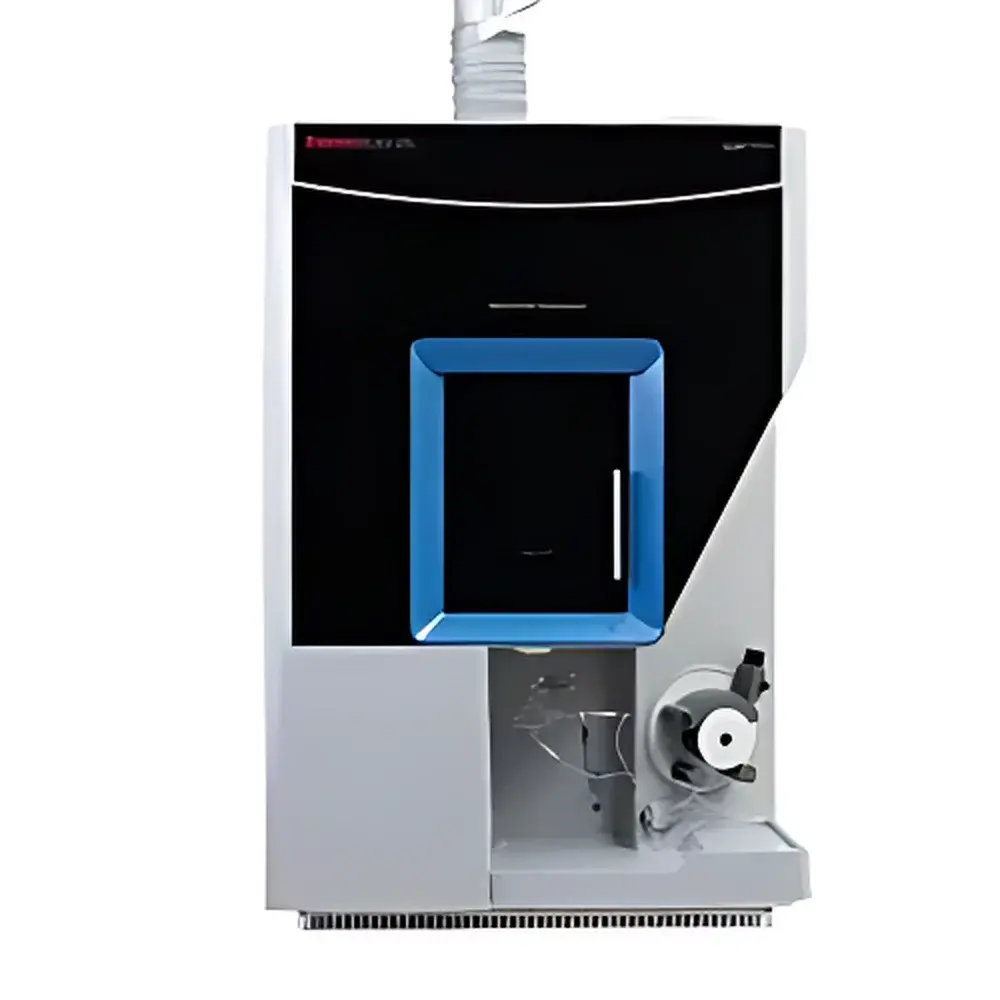
Thermo Scientific iCAP PRO Series Inductively Coupled Plasma Optical Emission Spectrometer
| Brand | Thermo Scientific |
|---|---|
| Origin | Germany |
| Manufacturer Type | Original Equipment Manufacturer (OEM) |
| Origin Category | Imported |
| Model | iCAP PRO ICP-OES |
| Instrument Type | Full-Spectrum Simultaneous ICP-OES |
| Spectral Resolution | 7 pm at 200 nm |
| Wavelength Range | 167.021–852.145 nm |
| RF Generator | 27.12 MHz, 750–1600 W adjustable |
| Plasma Gas Flow | 0.0–20.0 L/min (MFC-controlled) |
| Nebulizer Gas Flow | 0.0–1.5 L/min (MFC-controlled) |
| Auxiliary Gas Flow | 0.0–2.0 L/min (MFC-controlled) |
| Radial Viewing Height | 6–18 mm |
| Torch Orientation | Vertical |
| Detector | Charge Injection Device (CID) Array |
| Purge Gas | Optional integrated MFC (0–0.25 L/min) |
| Sample Introduction | 4-channel peristaltic pump (0–125 rpm) |
| Warm-up Time | ≤5 min from standby |
| UV Enhancement Mode | Dual UV exposure for improved sensitivity below 240 nm |
Overview
The Thermo Scientific iCAP PRO Series Inductively Coupled Plasma Optical Emission Spectrometer (ICP-OES) is a high-performance, benchtop simultaneous spectrometer engineered for robust multi-element trace analysis in complex, high-matrix samples. Operating on the principle of inductively coupled plasma excitation followed by high-resolution optical emission detection, the system employs a vertically oriented torch configuration to optimize plasma stability and minimize matrix-induced signal suppression. Its core optical architecture integrates a thermally stabilized echelle grating monochromator with a cross-dispersing prism—delivering a fixed spectral resolution of 7 pm at 200 nm across the full operational wavelength range (167.021–852.145 nm). This design enables precise separation of analyte emission lines from spectral interferences, particularly critical for elements such as As, Se, V, and rare earths in environmental, geological, and pharmaceutical matrices. The instrument’s solid-state 27.12 MHz self-tuned RF generator ensures consistent plasma ignition and maintenance across diverse sample types—including saline solutions up to 30% total dissolved solids (TDS) and organic solvents—without manual tuning or hardware reconfiguration.
Key Features
- Vertical radial-view torch geometry with semi-demountable EMT design and 2 mm quartz center tube for enhanced thermal stability and reduced carbon deposition.
- Triple mass flow controller (MFC) gas regulation system: independently programmable plasma (0.0–20.0 L/min), nebulizer (0.0–1.5 L/min), and auxiliary (0.0–2.0 L/min) gas flows for reproducible plasma conditions.
- Integrated optional purge gas MFC (0–0.25 L/min) for controlled introduction of oxygen or nitrogen into the plasma, enabling stable analysis of high-salt or organic matrices.
- Thermally regulated echelle spectrometer housing minimizes thermal drift, extending calibration interval stability and reducing routine recalibration frequency.
- Charge Injection Device (CID) detector with random-access readout capability—supporting real-time background correction, dynamic linear range >106, and simultaneous acquisition of all wavelengths without scanning delays.
- Enhanced UV mode utilizing dual UV-focused exposure to improve signal-to-noise ratio for low-wavelength elements (e.g., Al, P, S, Cl) between 167.021 nm and 240.063 nm.
- Interlocked drain sensor system that automatically halts analysis upon detection of liquid leakage in the sample introduction path, preventing sample loss and protecting internal components.
Sample Compatibility & Compliance
The iCAP PRO platform supports a broad spectrum of sample types—including aqueous digests (EPA Method 200.7, 200.8), high-TDS brines, hydrochloric and nitric acid matrices, and diluted organic solvents (e.g., kerosene, diesel)—without requiring hardware modification. Its robust plasma interface accommodates concentric glass nebulizers, cyclonic spray chambers, and chilled spray chambers for volatile or viscous samples. From a regulatory standpoint, the system meets essential requirements for GLP- and GMP-compliant laboratories: Qtegra ISDS software supports audit trail functionality, electronic signatures (in accordance with FDA 21 CFR Part 11), method version control, and raw data integrity verification. Instrument qualification documentation aligns with ASTM D1976, ISO 11885, and USP guidelines for elemental impurities testing. Additionally, the iCAP PRO series carries the ACT (Accountability, Consistency, Transparency) label from My Green Lab—a third-party verified sustainability certification covering manufacturing emissions, energy/water use, packaging recyclability, and end-of-life impact—making it suitable for ESG-aligned procurement frameworks.
Software & Data Management
Qtegra Intelligent Scientific Data Solution (ISDS) serves as the unified software environment for instrument control, method development, real-time spectral visualization, quantitative analysis, and compliance reporting. Its modular architecture allows concurrent tasks: users may define new wavelengths, edit calibration curves, process batch results, and generate audit-ready reports while acquisition is ongoing. The software includes built-in spectral interference correction algorithms (e.g., peak fitting, background subtraction, inter-element correction), automated drift compensation using internal reference lines, and customizable QC flagging based on RSD, recovery, or bracketing standards. All raw spectral data—including full 2D CID frames—are stored in vendor-neutral formats (e.g., .csv, .xml) alongside metadata (instrument parameters, operator ID, timestamp, calibration history) to satisfy ALCOA+ data integrity principles. Secure user role management enforces access control for method editing, result approval, and audit log review.
Applications
The iCAP PRO Series is routinely deployed in environmental monitoring labs for EPA-regulated metals analysis in wastewater, soil extracts, and drinking water; in mining and geochemical services for rapid assay of exploration drill cores and leachates; in pharmaceutical quality control for elemental impurity screening per ICH Q3D; and in food safety testing for toxic metals (Pb, Cd, As, Hg) in infant formula, cereals, and dietary supplements. Its ability to resolve overlapping emission lines—such as Fe 238.204 nm / As 238.204 nm or Cr 267.716 nm / Mg 267.721 nm—enables reliable quantification in single-digestion workflows without dilution or separation chemistry. Routine detection limits (3σ) are sub-ppt for most elements in 2% HNO3, with typical precision (RSD) <1.0% for replicate analyses over an 8-hour run.
FAQ
What sample introduction systems are supported?
Standard configuration includes a concentric glass nebulizer, glass cyclonic spray chamber, and semi-demountable EMT torch. Optional accessories include MicroFlow nebulizers, Scott-type double-pass chambers, and chilled spray chambers for volatile or high-solids samples.
Is the instrument compatible with hydride generation or laser ablation?
Yes—the iCAP PRO platform supports external hydride generation modules (e.g., Thermo Scientific™ HGX-200) and laser ablation systems (e.g., NWR image or UP213) via standardized I/O interfaces and Qtegra LA module integration.
How does the ACT label impact laboratory sustainability reporting?
The ACT label provides verified, third-party quantified metrics on carbon footprint, water consumption, packaging waste, and end-of-life recyclability—enabling direct inclusion in institutional ESG disclosures and green lab certification programs.
Can the CID detector be serviced in-field?
No—CID detectors are sealed, vacuum-integrated units requiring factory-level recalibration and replacement. However, the modular spectrometer design allows detector exchange without optical realignment.
What is the warm-up time required before analysis?
The system achieves operational readiness in ≤5 minutes from standby mode, thanks to optimized plasma ignition sequencing and thermal stabilization protocols embedded in the RF generator firmware.
Related Products






